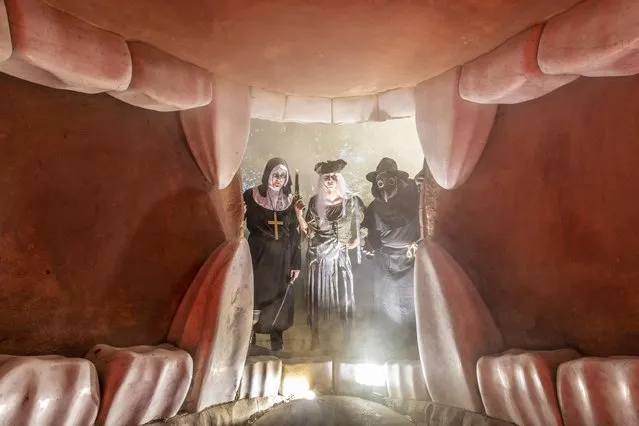
Staff prepare for Halloween at the Forbidden Corner tourist attraction, a labyrinth in the heart of Tupgill Park, in the Yorkshire Dales on October 19, 2022. (Photo by James Glossop/The Times)
Britain's Red Arrows airplane display team perform during D-Day commemorations in Portsmouth in southern England on June 5, 2014. Several hundred surviving veterans of the 1944 D-Day landings are commemorating the 70th anniversary of the mission on both sides of the English channel. (Photo by Carl Court/AFP Photo)
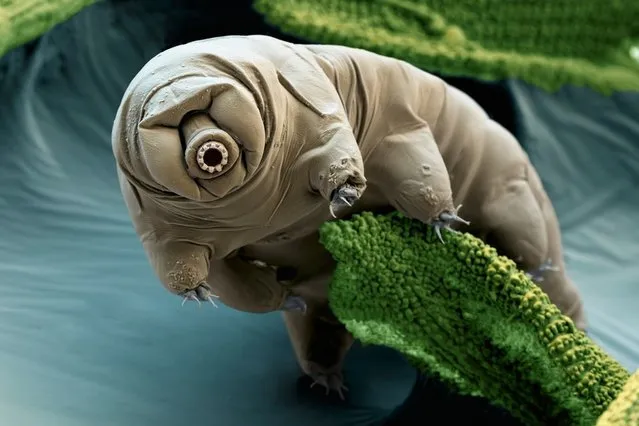
“Tardigrades (commonly known as waterbears or moss piglets) are small, water-dwelling, segmented animals with eight legs. Tardigrades were first discovered in 1773 by Johann August Ephraim Goeze, who called them kleiner Wasserbär, meaning “little water bear” in German. The name Tardigrada means “slow walker” and was given by Lazzaro Spallanzani in 1777. The name water bear comes from the way they walk, reminiscent of a bear's gait. The biggest adults may reach a body length of 1.5 millimetres (0.059 in), the smallest below 0.1 mm. Freshly hatched tardigrades may be smaller than 0.05 mm”. – Wikipedia. Photo: Tardigrades. (Photo by SPL/East News)
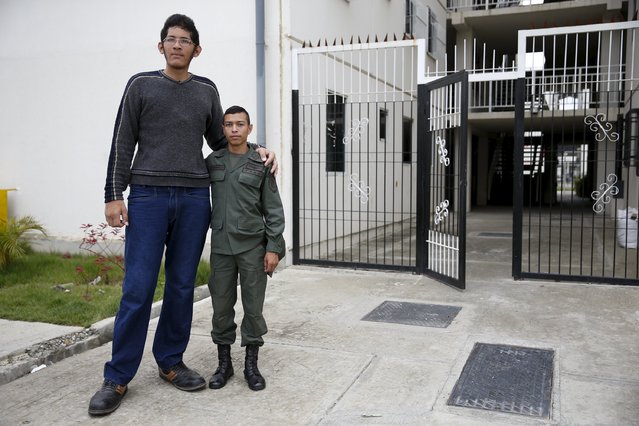
Jeison Rodriguez (L), 19, the living person with the largest feet in the world, poses for a picture with his older brother Wilmer, 24, outside their house in Maracay, Venezuela, October 14, 2015. Rodriguez, holds the Guinness World Record for the largest feet, with 40.1 cm (1 ft 3.79 in) on the right foot and 39.6 cm (1 ft 3.59 in) on the left foot. (Photo by Carlos Garcia Rawlins/Reuters)
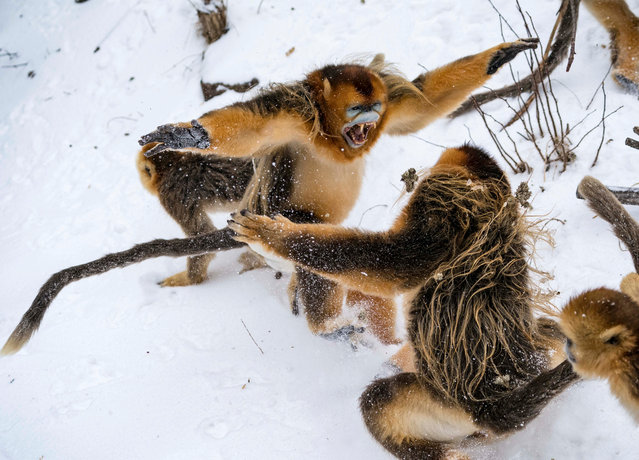
Golden monkeys play at a conservation base in Shennongjia, central China's Hubei Province, January 26, 2018. The golden monkey conservation base witnessed a snowfall recently. (Photo by Du Huaju/Xinhua/Barcroft Images)
The Mil Mi-28 N military helicopter is seen at the MAKS 2019 air show in Zhukovsky, outside Moscow, Russia, August 27, 2019. (Photo by Maxim Shemetov/Reuters)