Loading...
Done
Tridacna Gigas, or Giant Clams

“The giant clam, Tridacna gigas (known as pā’ua in Cook Islands Māori), is the largest living bivalve mollusc. T. gigas is one of the most endangered clam species. It was mentioned as early as 1825 in scientific reports. One of a number of large clam species native to the shallow coral reefs of the South Pacific and Indian oceans, they can weigh more than 200 kilograms (440 lb) measure as much as 120 cm (47 in) across, and have an average lifespan in the wild of 100 years or more”. – Wikipedia

Photo: Tridacna Gigas, or Giant Clams spew water as a traditional fisherman passes by a small sanctuary on January 23, 2004 near Bolinao in the Northern Philippines. The clams, prime builders for coral reefs and providing shelter for spawning fish and other marine life, are exposed by low tides in the sanctuary. Overfishing and pollution throughout the country are not only threatening food security, but are also starting to choke one of the few working clam sanctuaries in the world. (Photo by David Greedy/Getty Images)
Details
01 Oct 2011 13:10:00
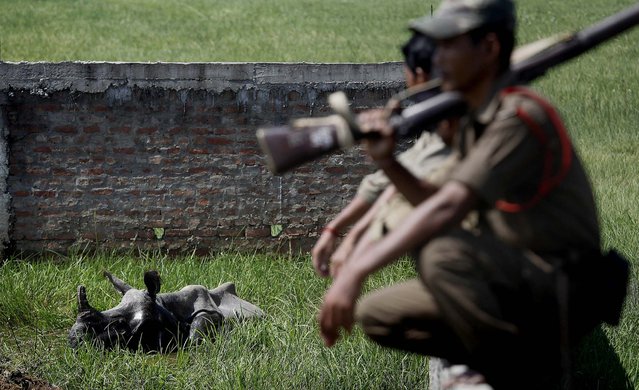
The rhino was finally located on Sunday in a field where it had taken shelter. Forest officials guarded the female one horned rhinoceros until it could be tranquilized and transported back to the Pobitora Wildlife Sanctuary. (Photo by Anupam Nath/Associated Press)

After eight tense days, a female one horned rhinoceros was found and rescued from an area in India that has recently seen four other rhinos killed by poachers.

Photo: The rhino was finally located on Sunday in a field where it had taken shelter. Forest officials guarded the female one horned rhinoceros until it could be tranquilized and transported back to the Pobitora Wildlife Sanctuary. (Photo by Anupam Nath/Associated Press)
Details
11 Oct 2012 09:46:00
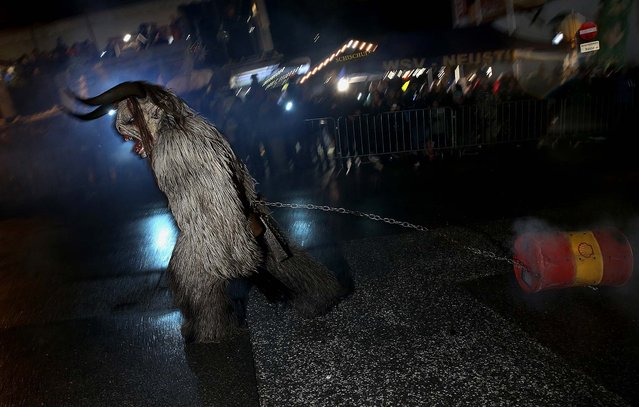
A participant dressed as the Krampus creature pulls a barrel of fire past onlookers during his search for delinquent children in Neustift im Stubaital. (Photo by Sean Gallup)

“Krampus is a beast-like creature from the folklore of Alpine countries thought to punish children during the Yule season who had misbehaved, in contrast with Saint Nicholas, who rewards well-behaved ones with gifts. Krampus is said to capture particularly naughty children in his sack and carry them away to his lair”. – Wikipedia. Photo: A participant dressed as the Krampus creature pulls a barrel of fire past onlookers during his search for delinquent children in Neustift im Stubaital. (Photo by Sean Gallup)
Details
05 Dec 2013 08:29:00
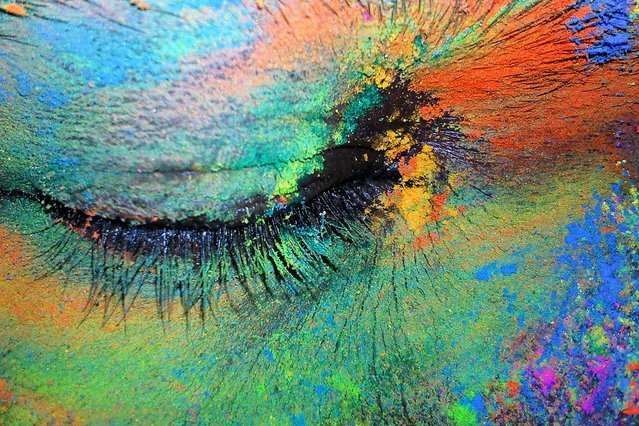
This close-up image – of a Holi Festival celebrant in Vrindivan, India, coated in neon-colored powder – was submitted to National Geographic’s Your Shot in the last week of March. On April 1 we published it on our Daily News site, along with seven other bright scenes captured during the Hindu spring Festival of Colors. (Photo by Tinto Alencherry/National Geographic)

This close-up image – of a Holi Festival celebrant in Vrindivan, India, coated in neon-colored powder – was submitted to National Geographic’s Your Shot in the last week of March. On April 1 we published it on our Daily News site, along with seven other bright scenes captured during the Hindu spring Festival of Colors. (Photo by Tinto Alencherry/National Geographic)
Details
06 Jan 2014 12:30:00
A Hindu worshipper throws vegetables into the crater as offerings during the Kasada Festival at Mount Bromo in Probolinggo, Indonesia's East Java province, August 1, 2015. (Photo by Reuters/Beawiharta)

A Hindu worshipper throws vegetables into the crater as offerings during the Kasada Festival at Mount Bromo in Probolinggo, Indonesia's East Java province, August 1, 2015. Every year people gather for the annual festival where offerings of rice, fruit, vegetables, livestock or money are made to Hindu gods at the active volcano to ask for blessings and assure a bountiful harvest. (Photo by Reuters/Beawiharta)
Details
02 Aug 2015 12:34:00
A man enters an adult amusement establishment in Shinjuku's nightlife district of Kabukicho in Tokyo, August 27, 2015. (Photo by Thomas Peter/Reuters)

A man enters an adult amusement establishment in Shinjuku's nightlife district of Kabukicho in Tokyo, August 27, 2015. (Photo by Thomas Peter/Reuters)
Details
28 Aug 2015 11:19:00
Dog Xiaoniu dressed in clothes walks across a street with its owner (not pictured) in Shanghai, December 19, 2014. According to local media, Xiaoniu accompanies its owner to the food market everyday and is able to walk with its hind legs for up to about an hour. (Photo by Reuters/Stringer)

Dog Xiaoniu dressed in clothes walks across a street with its owner (not pictured) in Shanghai, December 19, 2014. According to local media, Xiaoniu accompanies its owner to the food market everyday and is able to walk with its hind legs for up to about an hour. (Photo by Reuters/Stringer)
Details
27 Dec 2014 12:03:00
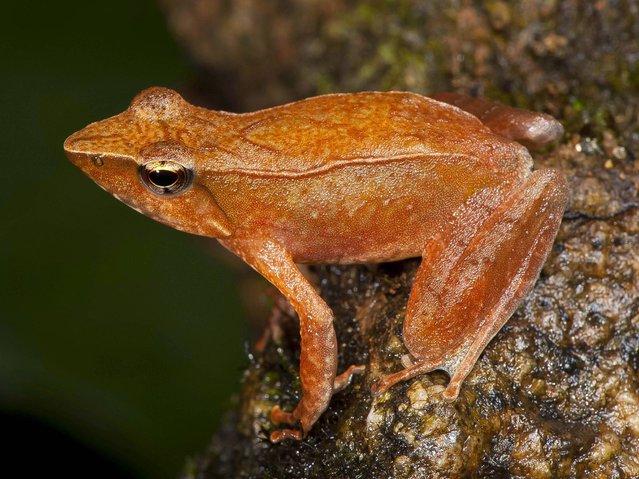
Orange dancing frog discovered by a team headed by University of Delhi professor Sathyabhama Das Biju in the jungle mountains of southern India. (Photo by Satyabhama Das Biju/AP Photo)

This undated photograph shows one of the 14 new species of so-called dancing frogs discovered by a team headed by University of Delhi professor Sathyabhama Das Biju in the jungle mountains of southern India. The study listing the new species brings the number of known Indian dancing frogs to 24 and attempts the first near-complete taxonomic sampling of the single-genus family found exclusively in southern India's lush mountain range called the Western Ghats, which stretches 1,600 kilometers (990 miles) from the west state of Maharashtra down to the country's southern tip. (Photo by Satyabhama Das Biju/AP Photo)
Details
09 May 2014 08:50:00