Loading...
Done
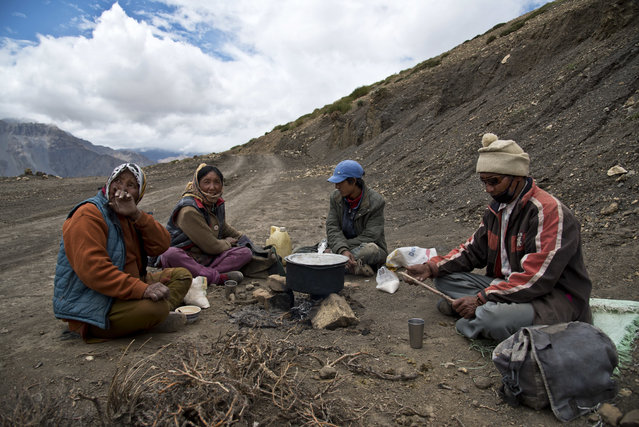
In this August 17, 2016, photo, from left to right, Chhering Chodom, 60, Tashi Yangzom, 50, Lobsang Chhering, 27, and Dorje Tandup, 58, drink milk tea on the side of the road. For centuries, the sleepy valley nestled in the Indian Himalayas remained a hidden Buddhist enclave forbidden to outsiders. Enduring the harsh year-round conditions of the high mountain desert, the people of Spiti Valley lived by a simple communal code – share the Earth's bounty, be hospitable to neighbors, and eschew greed and temptation at all turns. That's all starting to change, for better or worse. Since India began allowing its own citizens as well as outsiders to visit the valley in the early 1990s, tourism and trade have boomed. And the marks of modernization, such as solar panels, asphalt roads and concrete buildings, have begun to appear around some of the villages that dot the remote landscape at altitudes above 4,000 meters (13,000 feet). (Photo by Thomas Cytrynowicz/AP Photo)

In this August 17, 2016, photo, from left to right, Chhering Chodom, 60, Tashi Yangzom, 50, Lobsang Chhering, 27, and Dorje Tandup, 58, drink milk tea on the side of the road. For centuries, the sleepy valley nestled in the Indian Himalayas remained a hidden Buddhist enclave forbidden to outsiders. Enduring the harsh year-round conditions of the high mountain desert, the people of Spiti Valley lived by a simple communal code – share the Earth's bounty, be hospitable to neighbors, and eschew greed and temptation at all turns. That's all starting to change, for better or worse. (Photo by Thomas Cytrynowicz/AP Photo)
Details
15 Sep 2016 09:22:00
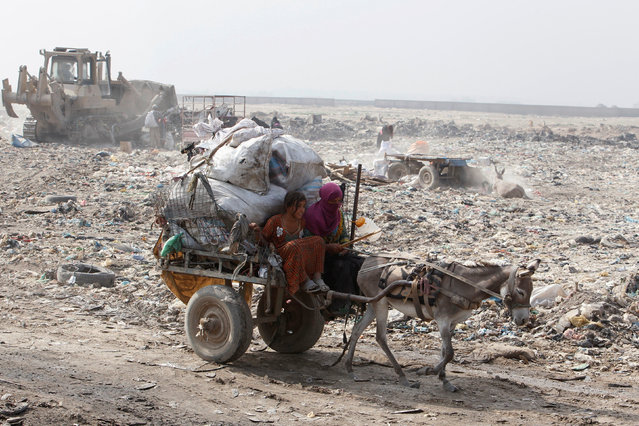
Garbage pickers collect ride on donkey cart while looking for recyclable materials at a rubbish dump in the outskirts of Baghdad, Iraq, August 23, 2016. Despite its huge untapped oil and gas reserves and steadily rising oil output and revenue, 23 percent of the population live below the poverty line, according to the Ministry of Planning. Eg, for 12-year-old Mohammed, life in Sadr City means long days during his school holidays scrabbling through the refuse in the scorching summer heat before selling his daily haul to a middleman. He sells each kilogram (2.2 lb) of plastic bottles or soda cans for 250 Iraqi dinars (around 20 U.S. cents), earning between 2,000 to 4,000 dinars ($1.50–$3) a day. A International Labor Organization report listing dangerous jobs in which children are engaged across the world mentioned collecting garbage as one of the activities in which minors risked suffering violence and injury. (Photo by Khalid al Mousily/Reuters)

Garbage pickers collect ride on donkey cart while looking for recyclable materials at a rubbish dump in the outskirts of Baghdad, Iraq, August 23, 2016. Despite its huge untapped oil and gas reserves and steadily rising oil output and revenue, 23 percent of the population live below the poverty line, according to the Ministry of Planning. (Photo by Khalid al Mousily/Reuters)
Details
24 Aug 2016 11:52:00
A demonstrator wearing a mask is seen during a protest against the government's restrictions amid the coronavirus disease (COVID-19) outbreak, in Berlin, Germany, August 1, 2020. (Photo by Christian Mang/Reuters)

A demonstrator wearing a mask is seen during a protest against the government's restrictions amid the coronavirus disease (COVID-19) outbreak, in Berlin, Germany, August 1, 2020. (Photo by Christian Mang/Reuters)
Details
04 Aug 2020 00:07:00
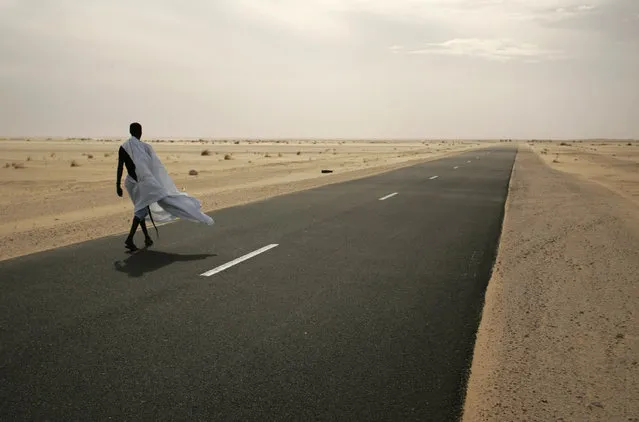
A man walks on the road between Nouahibou and Nouakchott, where three Spanish aid workers were abducted in Mauritania, December 3, 2009. (Photo by Rafael Marchante/Reuters)

A man walks on the road between Nouahibou and Nouakchott, where three Spanish aid workers were abducted in Mauritania, December 3, 2009. (Photo by Rafael Marchante/Reuters)
Details
04 Apr 2016 11:18:00
A protester scuffles with a member of Israeli security forces during a demonstration in the east Jerusalem neighbourhood of Sheikh Jarrah, on December 17, 2021. (Photo by Ahmad Gharabli/AFP Photo)

A protester scuffles with a member of Israeli security forces during a demonstration in the east Jerusalem neighbourhood of Sheikh Jarrah, on December 17, 2021. (Photo by Ahmad Gharabli/AFP Photo)
Details
19 Dec 2021 07:02:00
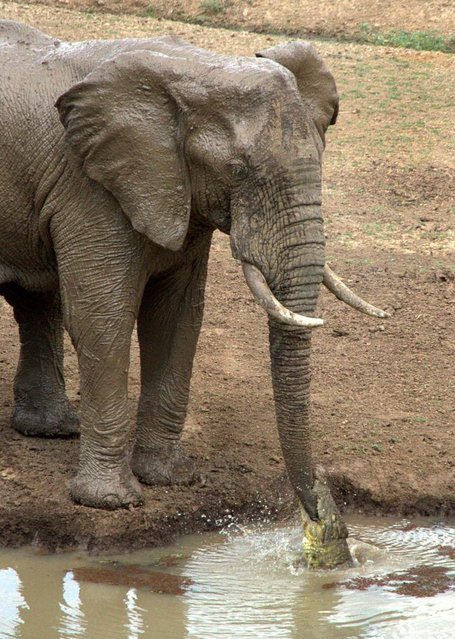
The remarkable scene was captured by amateur wildlife photographer Ian Salisbury, 62, at the South Luangwa National park in Zambia. The crocodile grabs hold of the elephant's trunk, but it soon becomes clear that he has bitten off a lot more than he can chew by grabbing the huge beast. Mr Salisbury said the elephant ‘fled rapidly into the bush’ after the attack. (Photo by Ian Salisbury/Caters News)

The remarkable scene was captured by amateur wildlife photographer Ian Salisbury, 62, at the South Luangwa National park in Zambia. The crocodile grabs hold of the elephant's trunk, but it soon becomes clear that he has bitten off a lot more than he can chew by grabbing the huge beast. Mr Salisbury said the elephant “fled rapidly into the bush” after the attack. (Photo by Ian Salisbury/Caters News)
Details
16 Nov 2013 12:55:00
British fashion designer Mary Quant, right, waves as she poses with models wearing her Mod creations in Little Rock, Ark. on October 25, 1968. The models, from left, are, Amanda Tear, Rory Davis and Penny Yates. (Photo by AP Photo)

British fashion designer Mary Quant, right, waves as she poses with models wearing her Mod creations in Little Rock, Ark. on October 25, 1968. The models, from left, are, Amanda Tear, Rory Davis and Penny Yates. (Photo by AP Photo)

Details
04 May 2019 00:03:00
Ocean voyage

Do you think that history is a science? Well, not exactly. First, and foremost, history is the state's “legend of wars”, it’s official regalia. Of course, public historians are not interested in scientific truth – quite the opposite. In this respect, any attempt to present a state’s history as altruistic and benevolent as possible is welcomed and encouraged – as opposed to any revisionism attempts that may be more accurate. In this matter, Chinese have surpassed us all – they revised in highly creative manner (but rather shamelessly) the technology already invented by Europeans, a process that resulted in oldest state on the planet. Here is an interesting paradox: ask any sinologist about the Middle Kingdom during second century B.C., and he will describe it to you in such a vivid manner as if he has been living there all his life – but as soon as you will ask him to describe Chinese history in the 19-20th centuries… let's say, his eagerness will be greatly diminished. However, we will discuss China in a different article, and in the meantime we will try to understand how exactly historic “legend of wars” is formed and functions – based on a specific and well-known example. A great example is Ferdinand Magellan's first voyage around the world.
Details
14 Nov 2011 09:11:00