Loading...
Done
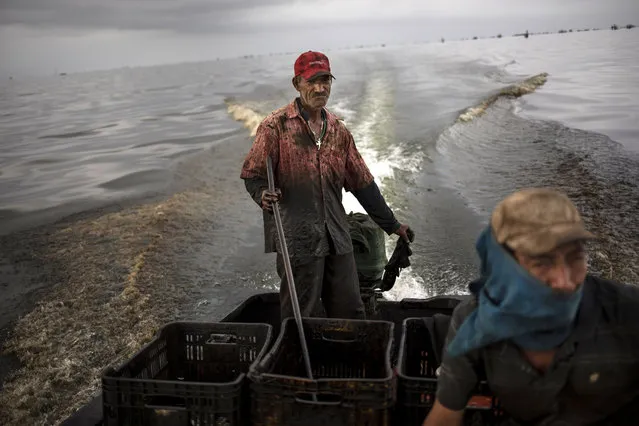
Fisherman Jose Miguel Perez, whose nickname is “Taliban”, navigates the oil infested waters of Lake Maracaibo, near Cabimas, Venezuela, May 21, 2019. Nobody lives as closely with the environmental fallout of Venezuela's collapsing oil industry as the fishermen who scratch out an existence on the blackened, sticky shores of Lake Maracaibo. (Photo by Rodrigo Abd/AP Photo)

Fisherman Jose Miguel Perez, whose nickname is “Taliban”, navigates the oil infested waters of Lake Maracaibo, near Cabimas, Venezuela, May 21, 2019. Nobody lives as closely with the environmental fallout of Venezuela's collapsing oil industry as the fishermen who scratch out an existence on the blackened, sticky shores of Lake Maracaibo. (Photo by Rodrigo Abd/AP Photo)
Details
26 Nov 2019 00:03:00
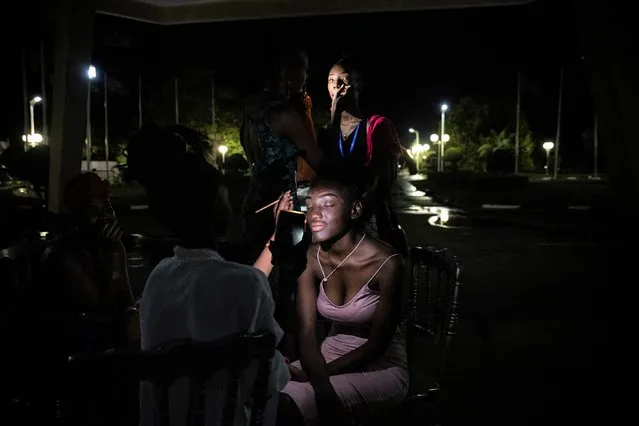
Models use their phone lights during a power outage to put on make-up before the start of the third Ouaga Fashion Week in Ouagadougou, Burkina Faso, Friday May 13, 2022. Ouaga Fashion Week returned to the Burkinabe capital after a two year COVID-19 related break. (Photo by Sophie Garcia/AP Photo)

Models use their phone lights during a power outage to put on make-up before the start of the third Ouaga Fashion Week in Ouagadougou, Burkina Faso, Friday May 13, 2022. Ouaga Fashion Week returned to the Burkinabe capital after a two year COVID-19 related break. (Photo by Sophie Garcia/AP Photo)
Details
27 May 2022 04:43:00
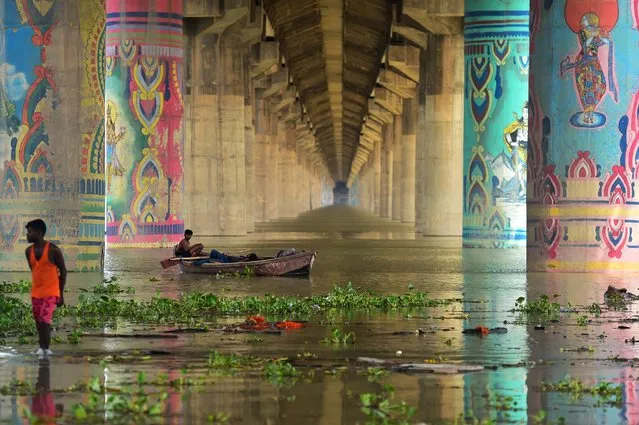
Men rest on a boat in the overflowed Ganges River under the Shastri Bridge in Allahabad on August 17, 2022, as water levels of the Ganges and Yamuna rivers rose following monsoon rainfalls. (Photo by Sanjay Kanojia/AFP Photo)

Men rest on a boat in the overflowed Ganges River under the Shastri Bridge in Allahabad on August 17, 2022, as water levels of the Ganges and Yamuna rivers rose following monsoon rainfalls. (Photo by Sanjay Kanojia/AFP Photo)
Details
24 Aug 2022 04:51:00
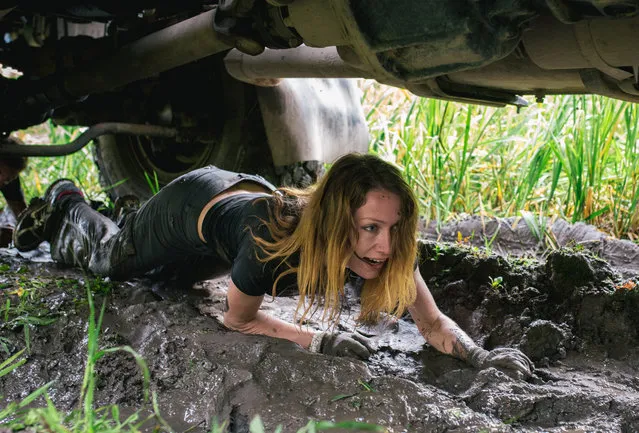
A participant in the Crazy Races extreme sports game competes in the cross-country obstacle race in Ufa, Russia on September 21, 2015. (Photo by TASS/Barcroft Media)

A participant in the Crazy Races extreme sports game competes in the cross-country obstacle race in Ufa, Russia on September 21, 2015. (Photo by TASS/Barcroft Media)
Details
23 Sep 2015 11:47:00
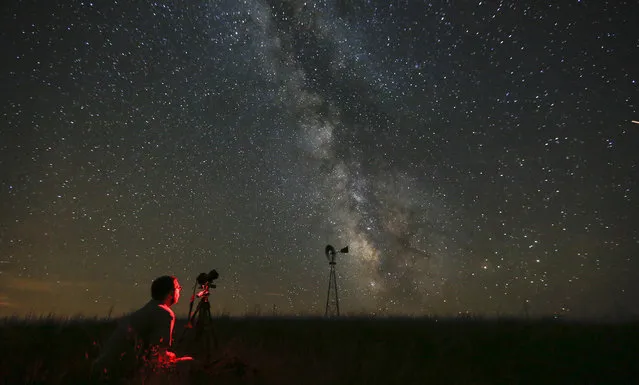
In this Wednesday, July 23, 2014 file photo, Omaha photographer Lane Hickenbottom photographs the night sky in a pasture near Callaway, Neb. With no moon in the sky, the Milky Way was visible to the naked eye. More than one-third of the world’s population can no longer see the Milky Way because of man-made lights, according to a scientific paper by Light Pollution Science and Technology Institute's Fabio Falchi and his team members, published on Friday, June 10, 2016. (Photo by Travis Heying/The Wichita Eagle via AP Photo)

In this Wednesday, July 23, 2014 file photo, Omaha photographer Lane Hickenbottom photographs the night sky in a pasture near Callaway, Neb. With no moon in the sky, the Milky Way was visible to the naked eye. More than one-third of the world’s population can no longer see the Milky Way because of man-made lights, according to a scientific paper by Light Pollution Science and Technology Institute's Fabio Falchi and his team members, published on Friday, June 10, 2016. (Photo by Travis Heying/The Wichita Eagle via AP Photo)
Details
11 Jun 2016 12:37:00
A model wears a floral head dress as she promotes a chain of garden centres at the Royal Horticultural Soceity's Chelsea Flower Show in London, Britain, May 18, 2015. (Photo by Toby Melville/Reuters)

A model wears a floral head dress as she promotes a chain of garden centres at the Royal Horticultural Soceity's Chelsea Flower Show in London, Britain, May 18, 2015. (Photo by Toby Melville/Reuters)
Details
23 May 2015 10:41:00
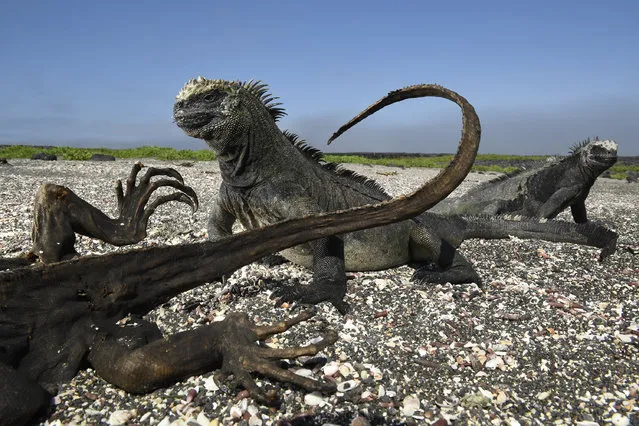
Galapagos – Rocking the Cradle: Four major ocean currents converge along the Galapagos archipelago, creating the conditions for an extraordinary diversity of animal life, April 25, 2016. The islands are home to at least 7,000 flora and fauna species, of which 97 percent of the reptiles, 80 percent of the land birds, 50 percent of the insects and 30 percent of the plants are endemic. The local ecosystem is highly sensitive to the changes in temperature, rainfall and ocean currents that characterize the climatic events known as El Niño and La Niña. These changes cause marked fluctuations in weather and food availability. Many scientists expect the frequency of El Niño and La Niña to increase as a result of climate change, making the Galapagos a possible early-warning location for its effects. (Photo by Thomas P. Peschak for National Geographic/World Press Photo)

Galapagos – Rocking the Cradle: Four major ocean currents converge along the Galapagos archipelago, creating the conditions for an extraordinary diversity of animal life, April 25, 2016. The islands are home to at least 7,000 flora and fauna species, of which 97 percent of the reptiles, 80 percent of the land birds, 50 percent of the insects and 30 percent of the plants are endemic. (Photo by Thomas P. Peschak for National Geographic/World Press Photo)
Details
16 Apr 2018 00:01:00
A model presents a creation by Kashee's during Bridal Festive Fashion show in Karachi on August 18, 2022. (Photo by Asif Hassan/AFP Photo)

A model presents a creation by Kashee's during Bridal Festive Fashion show in Karachi on August 18, 2022. (Photo by Asif Hassan/AFP Photo)
Details
23 Aug 2022 04:33:00