Loading...
Done
A woman wears on her chest the text 'free p*ssy riot' as a demonstration by supporters of the jailed feminist punk band 'p*ssy Riot' takes place outside the Russian Embassy on August 17, 2012 in London, England. The three women who staged an anti-Kremlin protest in a church in February, were found guilty today of hooliganism motivated by religious hatred, and could face a three-year jail sentence. Supporters are gathering in several cities around the world today as a mark of solidarity. (Photo by Dan Kitwood)

“On Friday, after something of a show trial, three young women in a Russian punk band were found guilty and sentenced to two years in prison for an anti-Vladimir Putin protest in a Moscow cathedral earlier this year”. – Daniel Schwartz via CBC News

Photo: A woman wears on her chest the text “free p*ssy riot” as a demonstration by supporters of the jailed feminist punk band p*ssy Riot takes place outside the Russian Embassy on August 17, 2012 in London, England. The three women who staged an anti-Kremlin protest in a church in February, were found guilty today of hooliganism motivated by religious hatred, and could face a three-year jail sentence. Supporters are gathering in several cities around the world today as a mark of solidarity. (Photo by Dan Kitwood)
Details
18 Aug 2012 11:26:00
Palestinian gunmen hold a poster of late Ahmed Jabari, head of the Hamas military wing in Gaza City, while they celebrate the cease-fire agreement between Israel and Hamas in Gaza City, Wednesday, November 21, 2012. Israel and the Hamas militant group agreed to a cease-fire Wednesday to end eight days of the fiercest fighting in nearly four years, promising to halt attacks on each other and ease an Israeli blockade constricting the Gaza Strip. (Photo by Adel Hana/AP)

“News of a ceasefire is greeted by wild celebrations on the streets of Gaza, whilst Israeli residents of Jerusalem and Tel Aviv are more cautious in their support for the peace deal”. – Reuters

Photo: Palestinian gunmen hold a poster of late Ahmed Jabari, head of the Hamas military wing in Gaza City, while they celebrate the cease-fire agreement between Israel and Hamas in Gaza City, Wednesday, November 21, 2012. Israel and the Hamas militant group agreed to a cease-fire Wednesday to end eight days of the fiercest fighting in nearly four years, promising to halt attacks on each other and ease an Israeli blockade constricting the Gaza Strip. (Photo by Adel Hana/AP)
Details
22 Nov 2012 10:59:00
Nino, a ten-year-old toreador apprentice of the French Tauromachy Centre, nicknamed El Nino, touches a practice bull at the bullring of Garons, near Nimes, September 25, 2013. (Photo by Jean-Paul Pelissier/Reuters)

Nino, a ten-year-old toreador apprentice of the French Tauromachy Centre, nicknamed El Nino, touches a practice bull at the bullring of Garons, near Nimes, September 25, 2013. Since 1983, the French Tauromachy Centre in Nimes has trained some 1,000 youths in the art of bullfighting. Twenty of them have gone on to become professional matadors, facing fighting bulls in the arena. Twice a week, students take courses with a matador to learn the movements and gestures of the bullfighter in the ring, but without an animal present. Students train with calves in the surrounding fields during spring, and regularly participate in beginner's bullfights (becerradas) without killing calves. Solal has been taking courses for three years and Nino, for just a year now. Both are normally enrolled in French public schools, but have one thought in mind – bullfighting. They share a passion linked to the city of Nimes, famous for its ferias and bullring. (Photo by Jean-Paul Pelissier/Reuters)
Details
06 Nov 2013 10:12:00
Saciido Sheik Yacquub, 34, poses for a picture with her daughter Faadumo Subeer Mohamed, 13, at their home in Hodan district IDP camp in Mogadishu February 11, 2014. Saciido, who runs a small business, wanted to be a business woman when she was a child. She studied until she was 20. She hopes that Faadumo will become a doctor. Faadumo will finish school in 2017 and hopes to be a doctor when she grows up. (Photo by Feisal Omar/Reuters)

“On March 8th activists celebrate International Women’s Day, which dates back to the early 20th century and has been observed by the United Nations since 1975. In the run-up to the event, Reuters photographers in countries around the globe took a series of portraits of women and their daughters. They asked each mother what her profession was, at what age she had finished education, and what she wanted her daughter to become when she grew up. They also asked each daughter at what age she would finish education and what she wanted to do in the future. The series of images offers an insight into the lives of women and girls around the world”. – Reuters. (Photo by Feisal Omar/Reuters)
Details
09 Mar 2014 04:33:00
Scanning electron micrograph (SEM) of an Arabidopsis thaliana flower, also commonly known as thale cress. Some of the anthers are open, revealing pollen grains ready for dispersal. Arabidopsis was the first plant to have its entire genome sequenced and is widely used as a model organism in molecular and plant biology. Horizontal width of image is 1200 microns. Magnification 100x. (Photo by Stefan Eberhard/Wellcome Images)

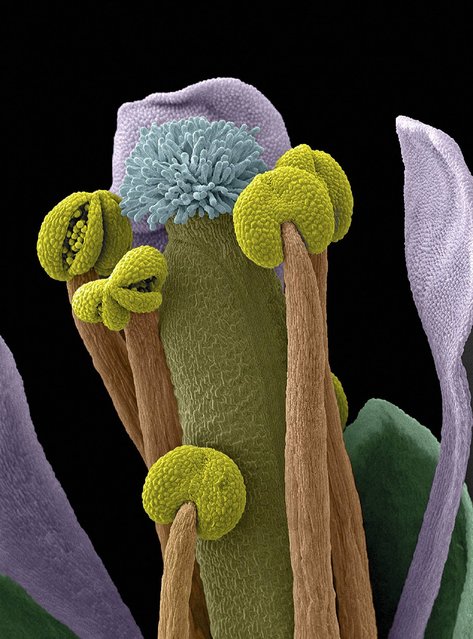
Beautiful, strange and occasionally alarming pictures from the shortlist for this year’s Wellcome image awards – which celebrate the very best in science photography and imaging – from an x-ray of a bat to a micrograph of a kidney stone. The exhibition opens on 12 March at three science centres and the Museum of Science and Industry in Manchester. Photo: Scanning electron micrograph (SEM) of an Arabidopsis thaliana flower, also commonly known as thale cress. Some of the anthers are open, revealing pollen grains ready for dispersal. Arabidopsis was the first plant to have its entire genome sequenced and is widely used as a model organism in molecular and plant biology. Horizontal width of image is 1200 microns. Magnification 100x. (Photo by Stefan Eberhard/Wellcome Images)
Details
11 Mar 2014 05:58:00
This handout photo taken on February 12, 2017 and released on February 16 by the International Federation of Red Cross and Red Crescent Societies (IFRC) shows Mongolian herder Munkhbat Bazarragchaa (C) dragging two sheep – which recently died due to the weather - to a pile of dead animals behind his “ger” in Khuvsgul province, northern Mongolia. Thousands of Mongolian herders face disastrous livestock losses from dreaded severe weather  known as the “dzud”, the Red Cross said on February 16, 2017 in launching an international emergency aid appeal. (Photo by Mirva Helenius/AFP Photo/IFRC)

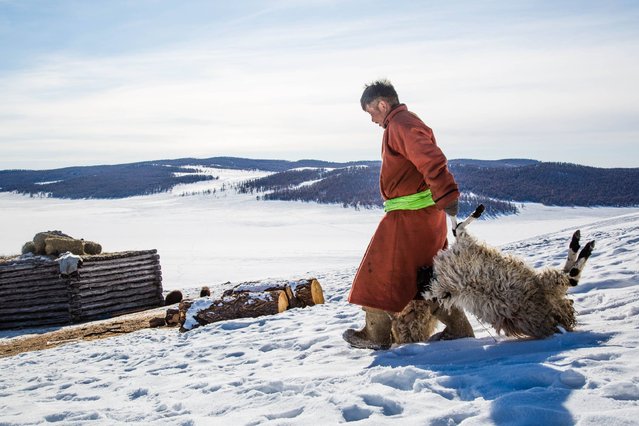
This handout photo taken on February 12, 2017 and released on February 16 by the International Federation of Red Cross and Red Crescent Societies (IFRC) shows Mongolian herder Munkhbat Bazarragchaa (C) dragging two sheep – which recently died due to the weather - to a pile of dead animals behind his “ger” in Khuvsgul province, northern Mongolia. Thousands of Mongolian herders face disastrous livestock losses from dreaded severe weather known as the “dzud”, the Red Cross said on February 16, 2017 in launching an international emergency aid appeal. (Photo by Mirva Helenius/AFP Photo/IFRC)
Details
17 Feb 2017 11:40:00
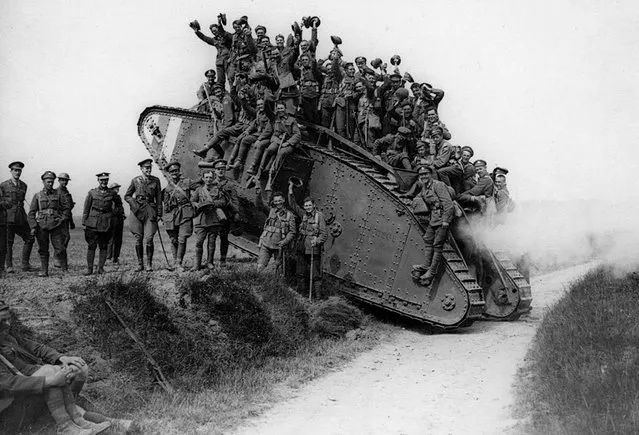
These black-and-white photos are taken from the new book “Armoured Warfare in the First World War 1916 – 1918” by Anthony Tucker-Jones and published by Pen & Sword Military. “Interestingly the British, French and Germans took completely different approaches with varying results”. The British military produced “Little Willie” in Autumn 1915 weighing 18 tonnes, which had a crew of two plus four gunners. “Inspired by a tracked artillery tractor “Little Willie” was referred to as a water tank – hence the name tank – to ensure secrecy”, said Anthony. “This led to the strange looking Mark I with its peculiar rhomboid shape, designed to cross trenches with guns in sponsons on either side. The Germans saw the tank as unchivalrous and were slow to grasp its utility. They favoured the Stormtrooper (specialist soldiers used to infiltrate enemy trenches) and artillery, not the tank”, said Anthony. “However, they didn’t hesitate to make use of captured British tanks. Although the tank helped secure victory and German soldiers dubbed it “Germany’s Downfall” the country was ultimately brought to its knees by the Allies blockade”. Here: British troops hitch a ride on a Mark IV after the massed tank fleet spearheading attack at Cambrai on November 20, 1917. (Photo by Anthony Tucker-Jones/Mediadrumworld.com)

These black-and-white photos are taken from the new book “Armoured Warfare in the First World War 1916 – 1918” by Anthony Tucker-Jones and published by Pen & Sword Military. Here: British troops hitch a ride on a Mark IV after the massed tank fleet spearheading attack at Cambrai on November 20, 1917. (Photo by Anthony Tucker-Jones/Mediadrumworld.com)
Details
23 Feb 2017 00:02:00
Two boys in the Gorbals area of Glasgow, UK on January 31, 1948. The Gorbals tenements were built quickly and cheaply in the 1840s, providing housing for Glasgow's burgeoning population of industrial workers. Conditions were appalling; overcrowding was standard and sewage and water facilities inadequate. The tenements housed about 40,000 people with up to eight family members sharing a single room, 30 residents sharing a toilet and 40 sharing a tap. By the time this photograph was taken 850 tenements had been demolished since 1920. Redevelopment of the area began in the late 1950s and the tenements were replaced with a modern tower block complex in the sixties. (Photo by Bert Hardy/Getty Images)

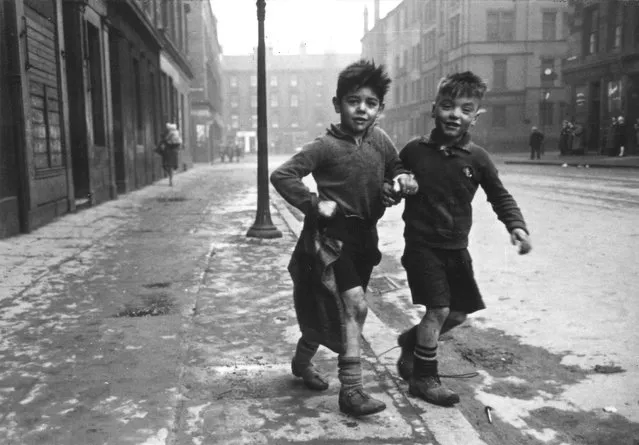
Two boys in the Gorbals area of Glasgow, UK on January 31, 1948. The Gorbals tenements were built quickly and cheaply in the 1840s, providing housing for Glasgow's burgeoning population of industrial workers. Conditions were appalling; overcrowding was standard and sewage and water facilities inadequate. The tenements housed about 40,000 people with up to eight family members sharing a single room, 30 residents sharing a toilet and 40 sharing a tap. By the time this photograph was taken 850 tenements had been demolished since 1920. Redevelopment of the area began in the late 1950s and the tenements were replaced with a modern tower block complex in the sixties. (Photo by Bert Hardy/Getty Images)
Details
09 Mar 2017 00:03:00