Loading...
Done
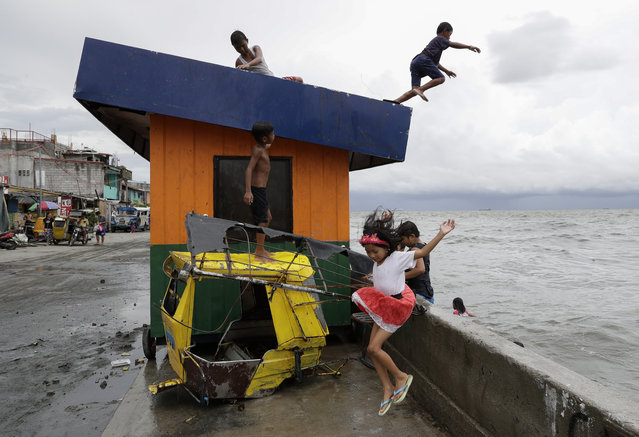
Children jump into the water despite strong waves after a strong downpour at Manila's bay, Philippines, Wednesday, July 17, 2019. Schools in metropolitan Manila have been suspended as Tropical Storm Danas, locally named Falcon, continue to enhance the southwest monsoon as it maintains its strength bringing heavy rains over parts of Luzon and Visayas according to the Philippine Atmospheric Geophysical and Astronomical Services Administration. (Photo by Aaron Favila/AP Photo)

Children jump into the water despite strong waves after a strong downpour at Manila's bay, Philippines, Wednesday, July 17, 2019. Schools in metropolitan Manila have been suspended as Tropical Storm Danas, locally named Falcon, continue to enhance the southwest monsoon as it maintains its strength bringing heavy rains over parts of Luzon and Visayas according to the Philippine Atmospheric Geophysical and Astronomical Services Administration. (Photo by Aaron Favila/AP Photo)
Details
19 Jul 2019 00:01:00
Self-titled Pricasso – real name Tim Patch, 71, – is using his very own pen*s to create his masterpiece – and claims to have made close to £500k from his saucy paintings. Here: Pricasso gets to work with his tools - and paints The Sun's newspaper correspondent Amy Nickell with his bits in London, England on November 5, 2019. (Photo by Stewart Williams/The Sun)

Self-titled Pricasso – real name Tim Patch, 71, – is using his very own pen*s to create his masterpiece – and claims to have made close to £500k from his saucy paintings. Here: Pricasso gets to work with his tools - and paints The Sun's newspaper correspondent Amy Nickell with his bits in London, England on November 5, 2019. (Photo by Stewart Williams/The Sun)
Details
17 Jan 2020 00:05:00


“Rapa das Bestas is the name of an operation that involves cutting the manes of the horses that are performed in the curros (enclosed which retain the horses) held in various locations in Galicia (Spain).

The best known is the Rapa das Bestas of Sabucedo, in the city hall of A Estrada, which lasts three days: the First Saturday, Sunday and Monday in July. In fact, the name given to the celebration (Rapa das Bestas of Sabucedo), while in most places speaking about curros, including curros de Valga, etc”. – Wikipedia

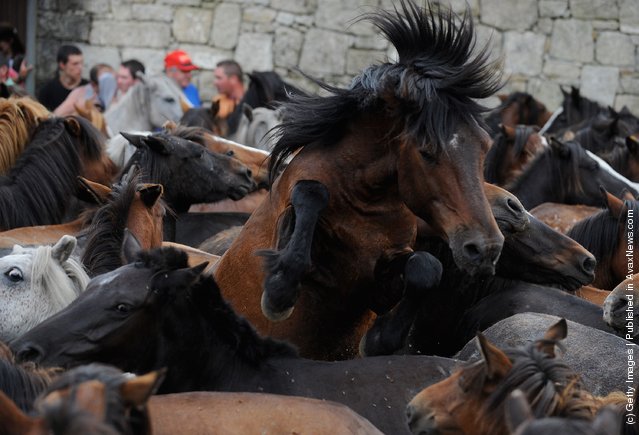
Photo: A wild horse leaps up during the Rapa das Bestas (shearing of the beasts) festival on July 2, 2011 in Sabucedo, Spain. Hundreds of wild horses are rounded up from the mountains and trimmed and marked in the corral. (Photo by Denis Doyle/Getty Images)
Details
03 Jul 2011 12:30:00
Actors dressed as Father Frost perform in the main building of the Domodedovo airport named after Mikhail Lomonosov in Moscow, Russia, 27 December 2021. Russians are preparing to celebrate New Year's Eve on 31 December and Christmas which is observed on 07 January, according to the Russian Orthodox Julian calendar, 13 days after Christmas on 25 December on the Gregorian calendar. (Photo by Sergei Ilnitsky/EPA/EFE)

Actors dressed as Father Frost perform in the main building of the Domodedovo airport named after Mikhail Lomonosov in Moscow, Russia, 27 December 2021. Russians are preparing to celebrate New Year's Eve on 31 December and Christmas which is observed on 07 January, according to the Russian Orthodox Julian calendar, 13 days after Christmas on 25 December on the Gregorian calendar. (Photo by Sergei Ilnitsky/EPA/EFE)
Details
28 Dec 2021 09:03:00
A toque macaque is eating flowers in the water at the pilgrimage site in Polonnaruwa, Sri Lanka, on January 13, 2024. The toque macaque (Macaca sinica), a reddish-brown-colored Old World monkey, is endemic to Sri Lanka, where it is known as the rilewa or rilawa. It is named for the whorl of hair at the crown of its head, which resembles a brimless toque cap. (Photo by Thilina Kaluthotage/NurPhoto/Rex Features/Shutterstock)

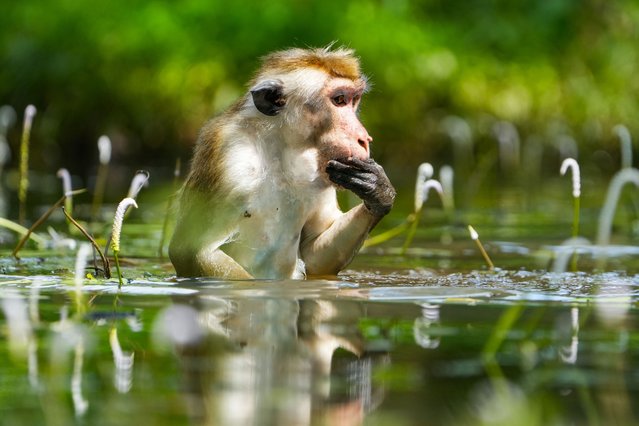
A toque macaque is eating flowers in the water at the pilgrimage site in Polonnaruwa, Sri Lanka, on January 13, 2024. The toque macaque (Macaca sinica), a reddish-brown-colored Old World monkey, is endemic to Sri Lanka, where it is known as the rilewa or rilawa. It is named for the whorl of hair at the crown of its head, which resembles a brimless toque cap. (Photo by Thilina Kaluthotage/NurPhoto/Rex Features/Shutterstock)
Details
10 Feb 2024 09:30:00
People gather for the second annual “Cat Beauty Festival” organized by Royal Veterinary Hospital in Sulaymaniyah, Iraq on July 2, 2025. Around 200 cats participated in the event, where the first round was determined by social media votes. The winner, a cat named “Gule Rana”, was selected by a jury. The festival aims to promote animal love and raise awareness about feline care. (Photo by Fariq Faraj Mahmood/Anadolu via Getty Images)

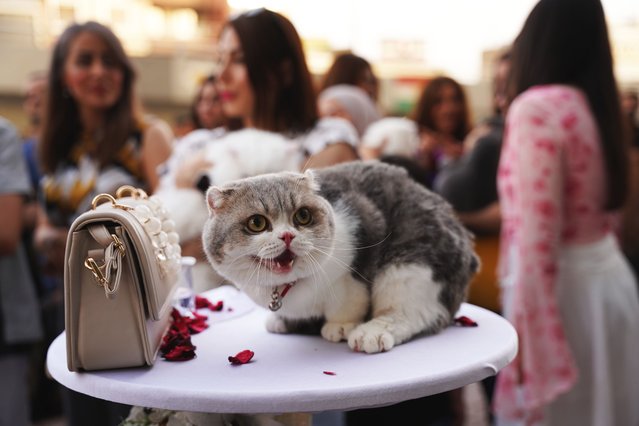
People gather for the second annual “Cat Beauty Festival” organized by Royal Veterinary Hospital in Sulaymaniyah, Iraq on July 2, 2025. Around 200 cats participated in the event, where the first round was determined by social media votes. The winner, a cat named “Gule Rana”, was selected by a jury. The festival aims to promote animal love and raise awareness about feline care. (Photo by Fariq Faraj Mahmood/Anadolu via Getty Images)
Details
28 Aug 2025 03:53:00
The Lun-class Ekranoplane was used by the Soviet Navy starting in 1987, and wasn't retired until the late 1990s, after the Soviet Union's fall. (Igor113)

“The Lun-class ekranoplan (NATO reporting name Duck) was a ground effect vehicle (GEV) designed by Rostislav Evgenievich Alexeev and used by the Soviet and Russian navies from 1987 until sometime in the late 1990s. It “flew” using the lift generated by the ground effect of its large wings when close to the surface of the water – about four metres or less. Although they might look similar and/or have related technical characteristics, ekranoplans like the Lun are not aircraft, seaplanes, hovercraft, or hydrofoils – ground effect is a separate technology altogether. The International Maritime Organization classifies these vehicles as maritime ships. The name Lun comes from the Russian for harrier”. – Wikipedia (Photo by Igor113)
Details
08 Aug 2014 10:51:00
Workers carry baskets of hand-picked tea leaves at the Makaibari Tea Estate in Kurseong, West Bengal, India, on Monday, September 8, 2014. The 155-year-old Makaibari Tea Estate recently sold it's Darjeeling tea, named Silver Tips Imperial, for $1,850 a kilo to buyers from the U.K., the U.S. and Japan, becoming the most expensive Indian tea ever sold. (Photo by Sanjit Das/Bloomberg)

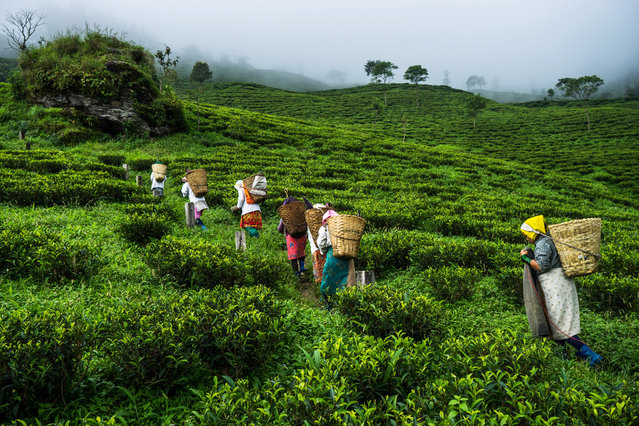
Workers carry baskets of hand-picked tea leaves at the Makaibari Tea Estate in Kurseong, West Bengal, India, on Monday, September 8, 2014. The 155-year-old Makaibari Tea Estate recently sold it's Darjeeling tea, named Silver Tips Imperial, for $1,850 a kilo to buyers from the U.K., the U.S. and Japan, becoming the most expensive Indian tea ever sold. (Photo by Sanjit Das/Bloomberg)
Details
19 Oct 2014 12:41:00