Loading...
Done
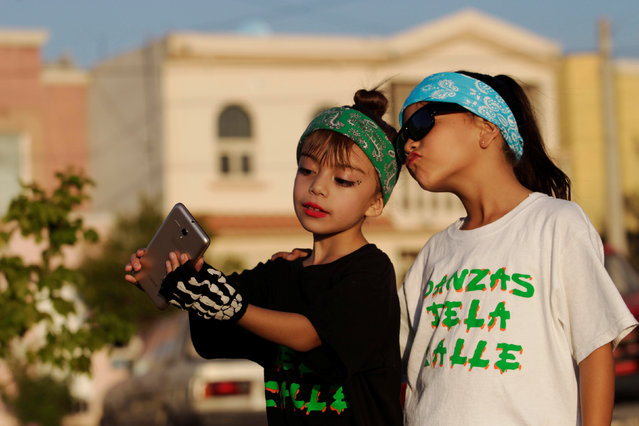
Children residents take a selfie as they wait for the police to dance, an unconventional approach to connect the police with the community in rough neighbourhoods, as part of the “Tirando Barrio” (Marking territory) programme in Saltillo, Northern Mexico September 9, 2016. T-Shirt reads “Street Dancers”. (Photo by Daniel Becerril/Reuters)

Children residents take a selfie as they wait for the police to dance, an unconventional approach to connect the police with the community in rough neighbourhoods, as part of the “Tirando Barrio” (Marking territory) programme in Saltillo, Northern Mexico September 9, 2016. T-Shirt reads “Street Dancers”. (Photo by Daniel Becerril/Reuters)
Details
13 Sep 2016 10:12:00
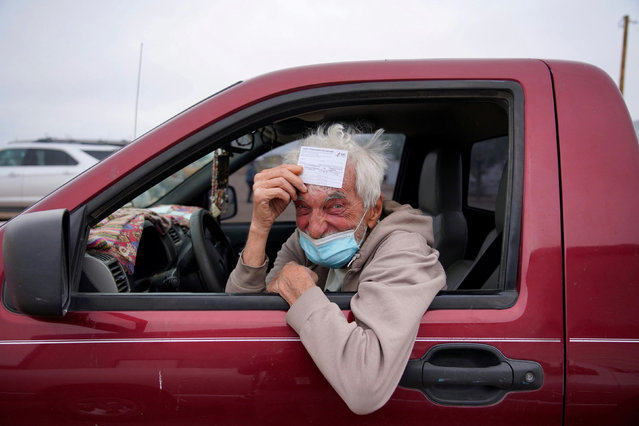
Taras Mychalewych, 75, poses for a portrait with his vaccination card after receiving his coronavirus disease (COVID-19) vaccine at a rural vaccination site in Columbus, New Mexico, U.S., April 16, 2021. (Photo by Paul Ratje/Reuters)

Taras Mychalewych, 75, poses for a portrait with his vaccination card after receiving his coronavirus disease (COVID-19) vaccine at a rural vaccination site in Columbus, New Mexico, U.S., April 16, 2021. (Photo by Paul Ratje/Reuters)
Details
19 Apr 2021 09:51:00
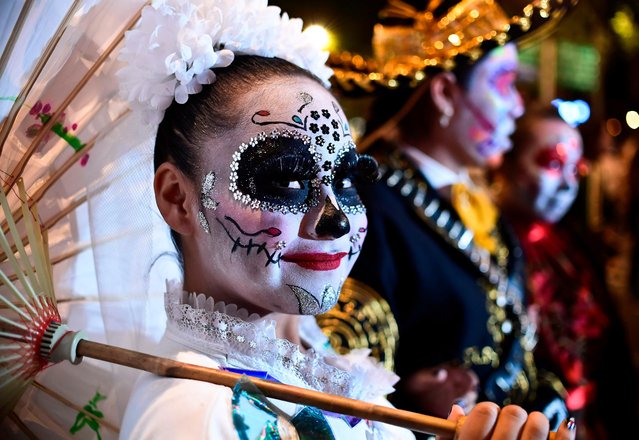
People fancy dressed as “Catrina” take part in the “Catrinas Parade” along Reforma Avenue, in Mexico City on October 22, 2017. (Photo by Ronaldo Schemidt/AFP Photo)

People fancy dressed as “Catrina” take part in the “Catrinas Parade” along Reforma Avenue, in Mexico City on October 22, 2017. Mexicans get ready to celebrate the Day of the Dead highlighting the character of La Catrina which was created by cartoonist Jose Guadalupe Posada, famous for his drawings of typical local, folkloric scenes, socio- political criticism and for his illustrations of “skeletons” or skulls, including La Catrina. (Photo by Ronaldo Schemidt/AFP Photo)
Details
24 Oct 2017 08:18:00
Migrants seeking asylum in the U.S., who returned to the Mexican side of the border to avoid deportation, play soccer in a makeshift migrant camp in Braulio Fernandez Ecological Park in Ciudad Acuna, Mexico, September 22, 2021. (Photo by Go Nakamura/Reuters)

Migrants seeking asylum in the U.S., who returned to the Mexican side of the border to avoid deportation, play soccer in a makeshift migrant camp in Braulio Fernandez Ecological Park in Ciudad Acuna, Mexico, September 22, 2021. (Photo by Go Nakamura/Reuters)
Details
23 Oct 2021 08:38:00
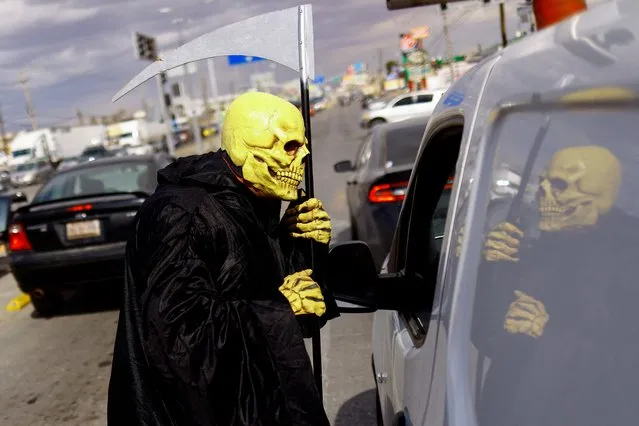
A Civil Protection employee dressed as death participates in the campaign “Beware of Monoxide, the Silent Killer”, which seeks to prevent deaths from poisoning with carbon monoxide through the use of heaters to mitigate low temperatures, on an avenue in Ciudad Juarez, Mexico on February 2, 2022. (Photo by Jose Luis Gonzalez/Reuters)

A Civil Protection employee dressed as death participates in the campaign “Beware of Monoxide, the Silent Killer”, which seeks to prevent deaths from poisoning with carbon monoxide through the use of heaters to mitigate low temperatures, on an avenue in Ciudad Juarez, Mexico on February 2, 2022. (Photo by Jose Luis Gonzalez/Reuters)
Details
04 Feb 2022 07:43:00
A couple hugs while standing near a Christmas tree made out of plastic bins and plastic hampers outside the Museum of History in Monterrey, Mexico, December 4, 2015. (Photo by Daniel Becerril/Reuters)

A couple hugs while standing near a Christmas tree made out of plastic bins and plastic hampers outside the Museum of History in Monterrey, Mexico, December 4, 2015. The humble Christmas tree has a rich history, from evergreen trees used to symbolise eternal life in Ancient Egypt to tree worship among pagan Europeans. The modern version has its origins in Germany, where the song “O Tannenbaum” is still a festive favourite. Today the traditional tree with lights and decorations appears in cities including Washington, Moscow and Beirut. Alternative constructions range from recycled rubbish in Mexico City to old window frames in Rakvere, Estonia. Whatever the shape or size, the message is the same: Merry Christmas. (Photo by Neil Hall/Reuters)
Details
23 Dec 2015 08:01:00
A woman from a group called “Las Patronas” (The bosses), a charitable organization that feeds Central American immigrants who travel atop a freight train known as “La Bestia”, passes food and water to immigrants on their way to the border with the United States, at Amatlan de los Reyes, in Veracruz state, Mexico October 22, 2016. (Photo by Daniel Becerril/Reuters)

A woman from a group called “Las Patronas” (The bosses), a charitable organization that feeds Central American immigrants who travel atop a freight train known as “La Bestia”, passes food and water to immigrants on their way to the border with the United States, at Amatlan de los Reyes, in Veracruz state, Mexico October 22, 2016. (Photo by Daniel Becerril/Reuters)
Details
18 Nov 2016 10:55:00
Mexican collector Pablo Perez, holds up a Star Wars R2-D2 toy while he displays a toy collection of Star Wars characters and items at his home in Monterrey, Mexico December 12, 2015. (Photo by Daniel Becerril/Reuters)

Mexican collector Pablo Perez, holds up a Star Wars R2-D2 toy while he displays a toy collection of Star Wars characters and items at his home in Monterrey, Mexico December 12, 2015. Perez has collected more than 3,000 toys and items from the Star Wars movie series over 10 years, local media reported. (Photo by Daniel Becerril/Reuters)
Details
15 Dec 2015 08:00:00