Loading...
Done
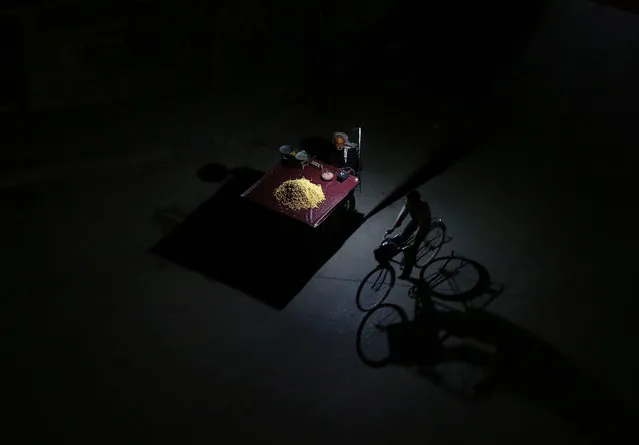
A Syrian man rides his bicycle past a man selling grains during a halt in fighting on February 29, 2016 in Douma, in the Eastern Ghouta region, east of the capital Damascus. A UN-backed ceasefire deal took hold across parts of Syria, bringing relative calm to areas where the Islamic State group and Al-Qaeda's local affiliate are not present. (Photo by Sameer Al-Doumy/AFP Photo)

A Syrian man rides his bicycle past a man selling grains during a halt in fighting on February 29, 2016 in Douma, in the Eastern Ghouta region, east of the capital Damascus. A UN-backed ceasefire deal took hold across parts of Syria, bringing relative calm to areas where the Islamic State group and Al-Qaeda's local affiliate are not present. (Photo by Sameer Al-Doumy/AFP Photo)
Details
07 Mar 2016 10:21:00
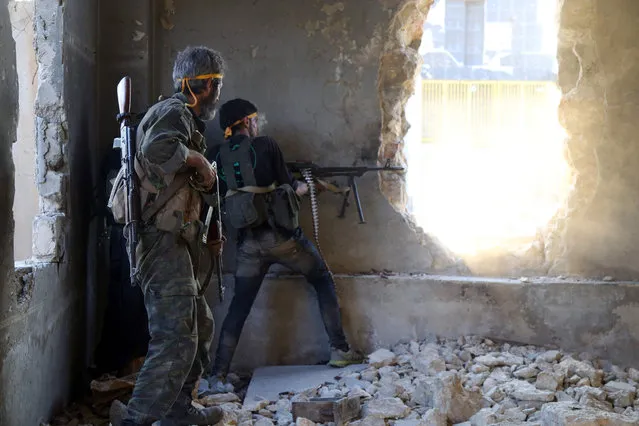
Rebel fighters fire towards positions of regime forces in Ramussa on the southwestern edges of Syria's northern city of Aleppo on August 6, 2016. Syrian rebels said they have broken a three-week government siege of second city Aleppo, turning the tables on Russian-backed regime forces who are now on the defensive. (Photo by Fadi Al-Halabi/AFP Photo)

Rebel fighters fire towards positions of regime forces in Ramussa on the southwestern edges of Syria's northern city of Aleppo on August 6, 2016. Syrian rebels said they have broken a three-week government siege of second city Aleppo, turning the tables on Russian-backed regime forces who are now on the defensive. (Photo by Fadi Al-Halabi/AFP Photo)
Details
08 Aug 2016 10:30:00
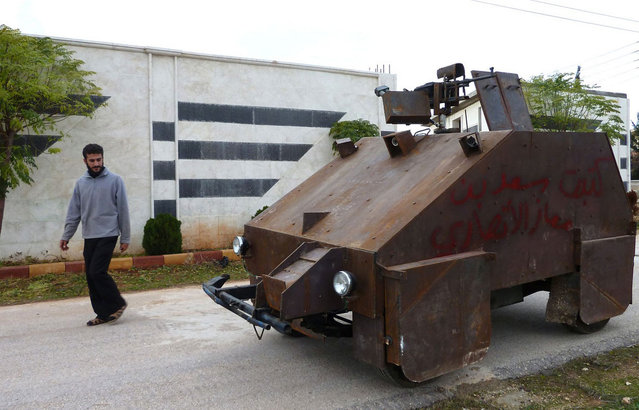
A Syrian rebel walks past Sham 2, a homemade armored vehicle, in Bishqatin, Syria, on December 8, 2012. From a distance it looks rather like a big rusty metal box but closer inspection reveals a homemade armored vehicle waiting to be deployed. Sham II, named after ancient Syria, is built from the chassis of a car and touted by rebels as “100 percent made in Syria”. (Photo by Herve Bar/AFP Photo)

A Syrian rebel walks past Sham 2, a homemade armored vehicle, in Bishqatin, Syria, on December 8, 2012. From a distance it looks rather like a big rusty metal box but closer inspection reveals a homemade armored vehicle waiting to be deployed. Sham II, named after ancient Syria, is built from the chassis of a car and touted by rebels as “100 percent made in Syria”. (Photo by Herve Bar/AFP Photo)
Details
03 Sep 2013 09:30:00
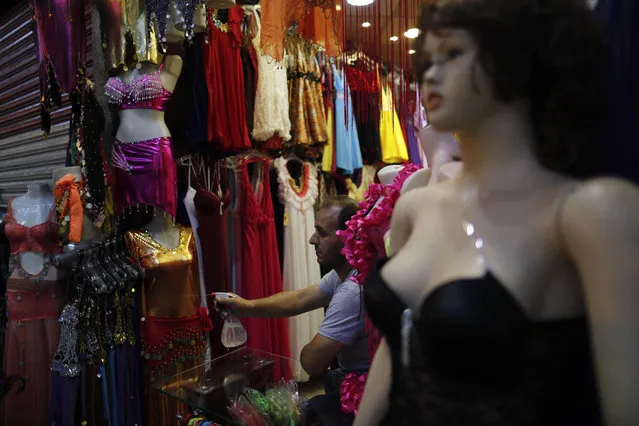
In this Thursday, July 19, 2018, photo, a Syrian shopkeeper spraying water as waits for customers at the Hamadiyah market, named after the 34th Sultan of the Ottoman Empire Abdul Hamid II, in the Old City of Damascus, Syria. The celebratory mood in government-controlled areas stems from successive military advances in the past year and an impression that President Bashar Assad, with massive support by unwavering allies Russia and Iran, has won the war or at least militarily defeated the opposition trying to topple him. (Photo by Hassan Ammar/AP Photo)

In this Thursday, July 19, 2018, photo, a Syrian shopkeeper spraying water as waits for customers at the Hamadiyah market, named after the 34th Sultan of the Ottoman Empire Abdul Hamid II, in the Old City of Damascus, Syria. The celebratory mood in government-controlled areas stems from successive military advances in the past year and an impression that President Bashar Assad, with massive support by unwavering allies Russia and Iran, has won the war or at least militarily defeated the opposition trying to topple him. (Photo by Hassan Ammar/AP Photo)
Details
13 Aug 2018 00:01:00
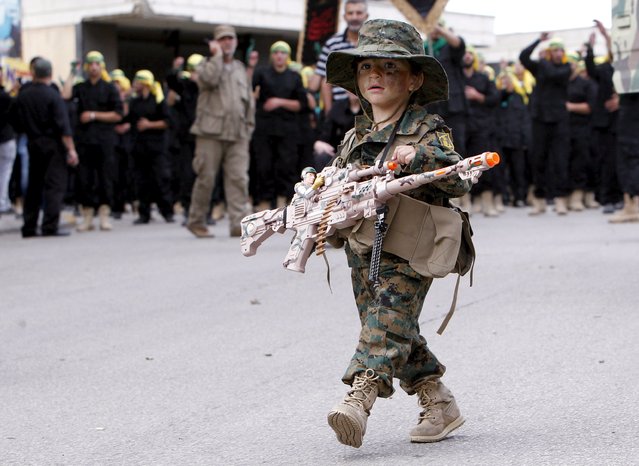
A boy wearing a Lebanon's Hezbollah military outfit and carrying a toy gun walks during the funeral of three Hezbollah fighters who were killed while fighting alongside Syrian army forces in Syria in Nabatieh town, southern Lebanon, October 27, 2015. (Photo by Ali Hashisho/Reuters)

A boy wearing a Lebanon's Hezbollah military outfit and carrying a toy gun walks during the funeral of three Hezbollah fighters who were killed while fighting alongside Syrian army forces in Syria in Nabatieh town, southern Lebanon, October 27, 2015. The fighters names are Hussein Hassan Shreifie, Ali al-Akbar Mohamad Khashfeh and Mohamad Saeed Fawaz. (Photo by Ali Hashisho/Reuters)
Details
30 Oct 2015 08:02:00
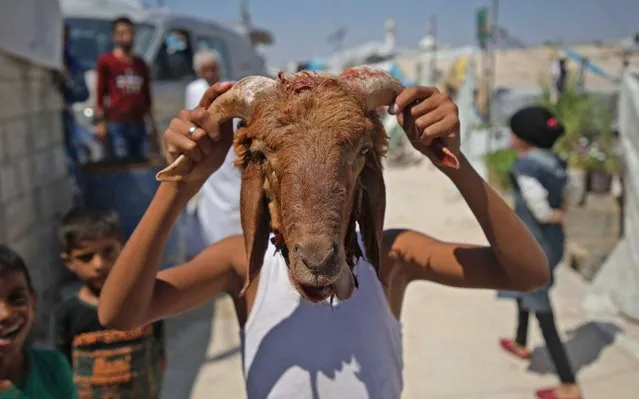
A Syrian boy plays with the head of a sacrificed sheep at a DIP camp for Interally Displaced Persons near the town of Aqrabat in Syria's northern Idlib province on August 12, 2019. Known as the “big” festival, Eid Al-Adha is celebrated each year by Muslims sacrificing various animals according to religious traditions, including cows, camels, goats and sheep. The festival marks the end of the Hajj pilgrimage to Mecca and commemorates Prophet Abraham's readiness to sacrifice his son to show obedience to God. (Photo by Aaref Watad/AFP Photo)

A Syrian boy plays with the head of a sacrificed sheep at a DIP camp for Interally Displaced Persons near the town of Aqrabat in Syria's northern Idlib province on August 12, 2019. Known as the “big” festival, Eid Al-Adha is celebrated each year by Muslims sacrificing various animals according to religious traditions, including cows, camels, goats and sheep. The festival marks the end of the Hajj pilgrimage to Mecca and commemorates Prophet Abraham's readiness to sacrifice his son to show obedience to God. (Photo by Aaref Watad/AFP Photo)
Details
15 Aug 2019 00:05:00
Cordwood Construction - Natural Building

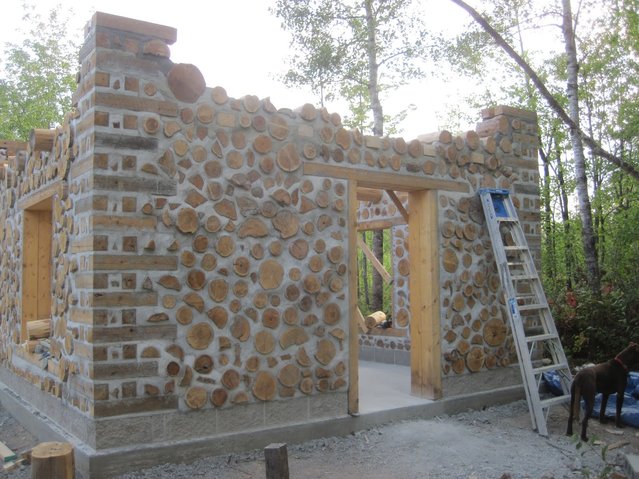
Cordwood construction is a method of natural building that originated roughly one thousand years ago in Greece and Siberia. This method involves using pieces of wood that slightly protrude from the mortar, giving the walls an attractive appearance. Usually, the walls are made 12 to 24 inches thick. However, in some parts of Canada, the walls can be as thick as 36 inches. This method appeals to many people due to its ease of construction economy of resources. Cordwood Construction can be separated into two main types: mortar-insulation-mortar (M-I-M) and Throughwall. M-I-M is a more preferable and widely used choice as it allows for better insulating properties.
Details
27 Nov 2014 15:10:00
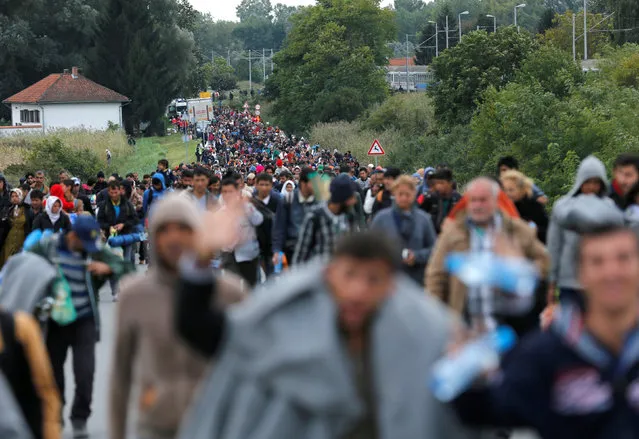
A year after hundreds of thousands of migrants and refugees snaked their way across southeastern Europe and onto television screens worldwide, the roads through the Balkans are now clear, depriving an arguably worsening tragedy of its poignant visibility. Europe's migrant crisis is at the very least numerically worse than it was last year. More people are arriving and more are dying. (Photo by Antonio Bronic/Reuters)

A year after hundreds of thousands of migrants and refugees snaked their way across southeastern Europe and onto television screens worldwide, the roads through the Balkans are now clear, depriving an arguably worsening tragedy of its poignant visibility. Reuters photographer, Antonio Bronic revisiting the people-packed locations where he and his colleagues captured last year's diaspora, found empty roads, unencumbered railway tracks and bucolic countryside. (Photo by Antonio Bronic/Reuters)


Details
12 Aug 2016 12:10:00