Loading...
Done


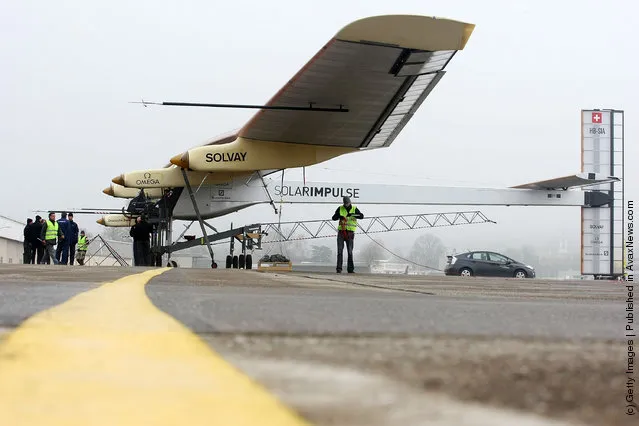
“Solar Impulse is a European long-range solar powered plane project being undertaken by Bertrand Piccard and André Borschberg. The project eventually hopes to succeed in the first circling of the earth with a piloted fixed-wing aircraft using only solar power. The first aircraft, bearing the Swiss aircraft registration code of HB-SIA, is a single-seater, capable of taking off under its own power, and intended to remain airborne up to 36 hours. This aircraft first flew an entire diurnal solar cycle, including nearly 9 hours of night flying, in a 26-hour flight on 7–8 July 2010”. – Wikipedia


Photo: Workers prepare the Solar Impulse airplane HB-SIA for a first runway test on November 19, 2009 in Dubendorf, Switzerland. Solar Impulse chairman Bertrand Piccard, psychatrist and aeronaut, who made the first non-stop round-the-world balloon flight, and CEO and former fighter pilot Andrй Borschberg plan a round-the-world flight, driven only by solar energy, for 2012. (Photo by Johannes Simon/Getty Images)
Details
16 May 2011 08:13:00
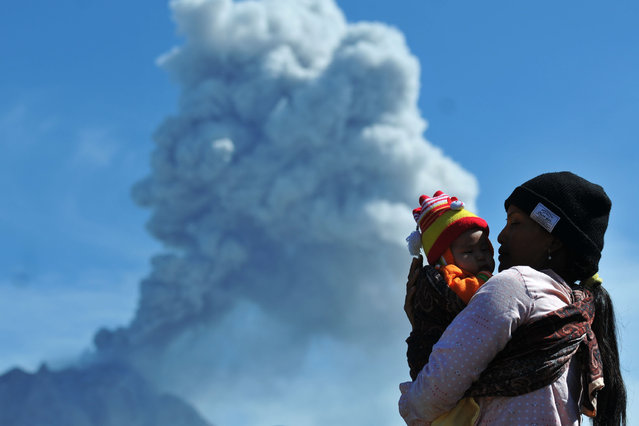
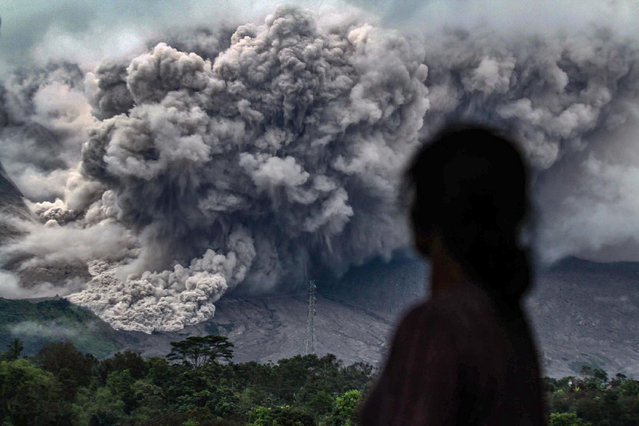
A woman carries her child as she watches Mount Sinabung volcano spewing thick volcanic ash, as seen from Karo on July 21, 2017. Sinabung roared back to life in 2010 for the first time in 400 years, after another period of inactivity it erupted once more in 2013, and has remained highly active since. (Photo by Gatha Ginting/AFP Photo)

A woman carries her child as she watches Mount Sinabung volcano spewing thick volcanic ash, as seen from Karo on July 21, 2017. Sinabung roared back to life in 2010 for the first time in 400 years, after another period of inactivity it erupted once more in 2013, and has remained highly active since. (Photo by Gatha Ginting/AFP Photo)
Details
22 Jul 2017 08:47:00
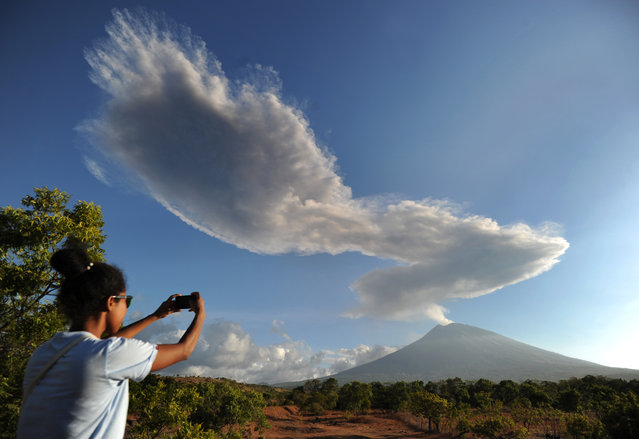
A woman takes photos as Mount Agung volcano sends up another plume of smoke, seen from the Kubu subdistrict in Karangasem Regency on Indonesia's resort island of Bali on July 5, 2018. Mount Agung roared to life again on July 2, belching a plume of ash 2,000 metres (6,500 feet) high, as well as temporarily shuttering the airport and grounding hundreds of flights after erupting the week before. (Photo by Sonny Tumbelaka/AFP Photo)

A woman takes photos as Mount Agung volcano sends up another plume of smoke, seen from the Kubu subdistrict in Karangasem Regency on Indonesia's resort island of Bali on July 5, 2018. Mount Agung roared to life again on July 2, belching a plume of ash 2,000 metres (6,500 feet) high, as well as temporarily shuttering the airport and grounding hundreds of flights after erupting the week before. (Photo by Sonny Tumbelaka/AFP Photo)
Details
07 Jul 2018 00:01:00
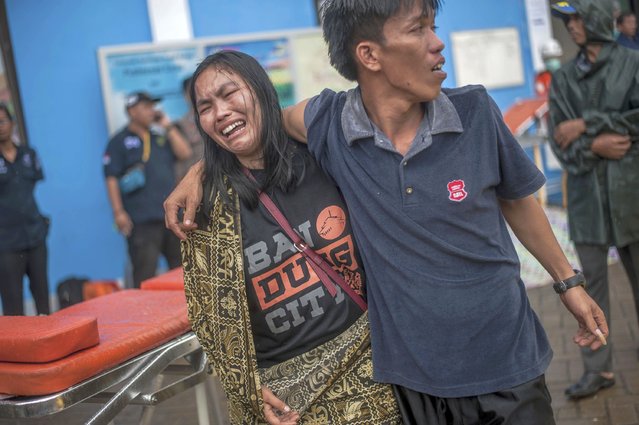
A woman reacts after identifying a relative among the bodies of tsunami victims in Carita, Indonesia, Sunday, December 23, 2018. The tsunami occurred after the eruption of a volcano around Indonesia's Sunda Strait during a busy holiday weekend, sending water crashing ashore and sweeping away hotels, hundreds of houses and people attending a beach concert. (Photo by Fauzy Chaniago/AP Photo)

A woman reacts after identifying a relative among the bodies of tsunami victims in Carita, Indonesia, Sunday, December 23, 2018. The tsunami occurred after the eruption of a volcano around Indonesia's Sunda Strait during a busy holiday weekend, sending water crashing ashore and sweeping away hotels, hundreds of houses and people attending a beach concert. (Photo by Fauzy Chaniago/AP Photo)
Details
24 Dec 2018 06:36:00
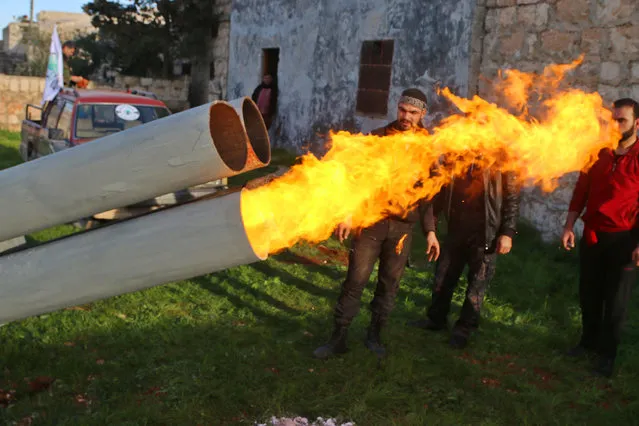
Al-Shamiyah Front fighters inspect a new locally-made cannon named “Borkan” (Volcano) as it was being launched towards forces loyal to Syria's president Bashar Al-Assad located in Aleppo artillery school, March 7, 2015. The “Borkan” is made out of four tubes attached to a loader, which can fire four shells at a time, and have a range of three kilometers (1.86 miles). (Photo by Abdalrhman Ismail/Reuters)

Al-Shamiyah Front fighters inspect a new locally-made cannon named “Borkan” (Volcano) as it was being launched towards forces loyal to Syria's president Bashar Al-Assad located in Aleppo artillery school, March 7, 2015. The “Borkan” is made out of four tubes attached to a loader, which can fire four shells at a time, and have a range of three kilometers (1.86 miles). (Photo by Abdalrhman Ismail/Reuters)
Details
24 Mar 2015 10:11:00
An Indonesian woman watches an eruption from the Mount Sinabung volcano from Tiga Pancur village, in Karo in North Sumatra on November 3, 2017. Sinabung roared back to life in 2010 for the first time in 400 years. After another period of inactivity it erupted once more in 2013, and has remained highly active since. (Photo by Ivan Damanik/AFP Photo)

An Indonesian woman watches an eruption from the Mount Sinabung volcano from Tiga Pancur village, in Karo in North Sumatra on November 3, 2017. Sinabung roared back to life in 2010 for the first time in 400 years. After another period of inactivity it erupted once more in 2013, and has remained highly active since. (Photo by Ivan Damanik/AFP Photo)
Details
13 Nov 2017 07:31:00
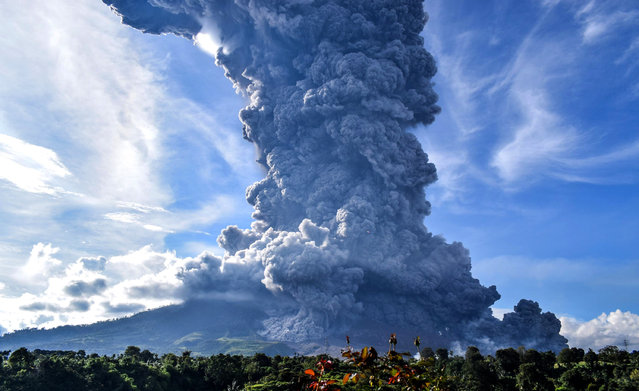
Sinabung mountain spews volcanic smoke in Tiga Pancur Village, Karo, North Sumatra, Indonesia, 09 June 2019. According to BNPB, Mount Sinabung erupted, blowing volcanic ash more than 7,000 meters high. Sinabung is one of the most active volcanos in Indonesia. It erupted in 2010 and since then killed 17 people in eruptions in 2014 and another nine people in 2016. (Photo by Sarianto Sembiring/EPA/EFE)

Sinabung mountain spews volcanic smoke in Tiga Pancur Village, Karo, North Sumatra, Indonesia, 09 June 2019. According to BNPB, Mount Sinabung erupted, blowing volcanic ash more than 7,000 meters high. Sinabung is one of the most active volcanos in Indonesia. It erupted in 2010 and since then killed 17 people in eruptions in 2014 and another nine people in 2016. (Photo by Sarianto Sembiring/EPA/EFE)
Details
12 Jun 2019 00:01:00
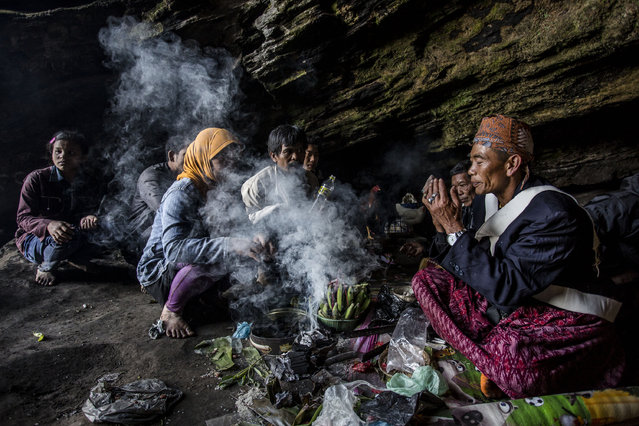
A Tenggerese shaman praying for worshippers at Widodaren cave during the Tenggerese Hindu Yadnya Kasada festival on July 31, 2015 in Probolinggo, East Java, Indonesia. The festival is the main festival of the Tenggerese people and lasts about a month. On the fourteenth day, the Tenggerese make the journey to Mount Bromo to make offerings of rice, fruits, vegetables, flowers and livestock to the mountain gods by throwing them into the volcano's caldera. (Photo by Ulet Ifansasti/Getty Images)

A Tenggerese shaman praying for worshippers at Widodaren cave during the Tenggerese Hindu Yadnya Kasada festival on July 31, 2015 in Probolinggo, East Java, Indonesia. The festival is the main festival of the Tenggerese people and lasts about a month. On the fourteenth day, the Tenggerese make the journey to Mount Bromo to make offerings of rice, fruits, vegetables, flowers and livestock to the mountain gods by throwing them into the volcano's caldera. The origin of the festival lies in the 15th century when a princess named Roro Anteng started the principality of Tengger with her husband Joko Seger, and the childless couple asked the mountain Gods for help in bearing children. The legend says the Gods granted them 24 children but on the provision that the 25th must be tossed into the volcano in sacrifice. The 25th child, Kesuma, was finally sacrificed in this way after initial refusal, and the tradition of throwing sacrifices into the caldera to appease the mountain Gods continues today. (Photo by Ulet Ifansasti/Getty Images)
Details
01 Aug 2015 12:07:00