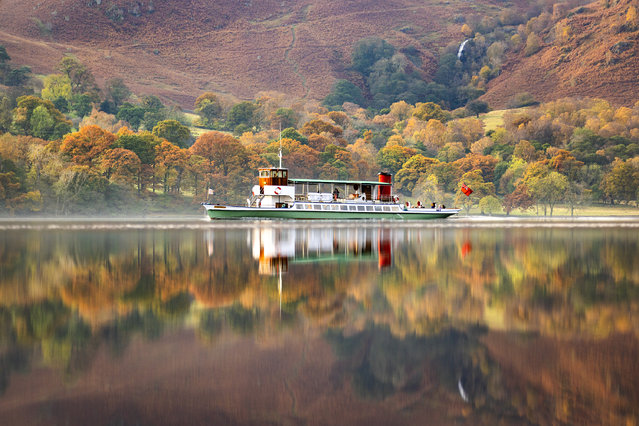
MY Raven, a former steamer now converted to diesel, cruises across Ullswater from Glenridding to Pooley Bridge in Cumbria, UK on October 25, 2024. (Photo by Andrew McCaren/London News Pictures)
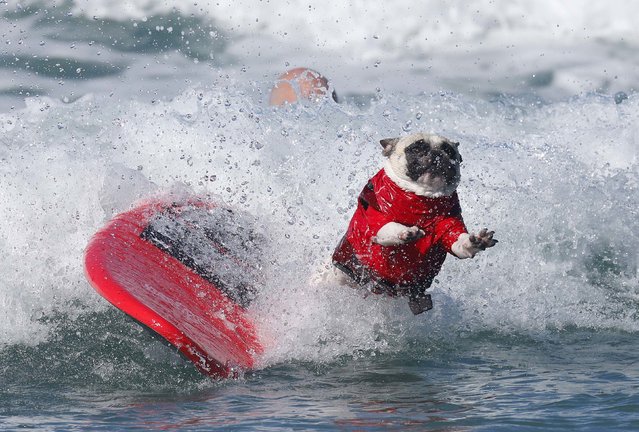
A French bulldog named Rocket takes part in the annual Surf Dog Surf-A-Thon in Del Mar, California, on Sunday, September 7, 2025. (Photo by K.C. Alfred/The San Diego Union-Tribune/Getty Images)
Roxy, a Red Labradoodle, Jaku, a Black and Tan Lurcher, Kobe, a White German Shepherd, Rocky, a Black and Tan German Shepherd, and Busy, an English Springer Spaniel Cross, queue outside an Aldi store in Hinckley, Leicestershire, UK on Monday, December 1, 2025. (Phoot by Lucy Ray/PA Media Assignments)
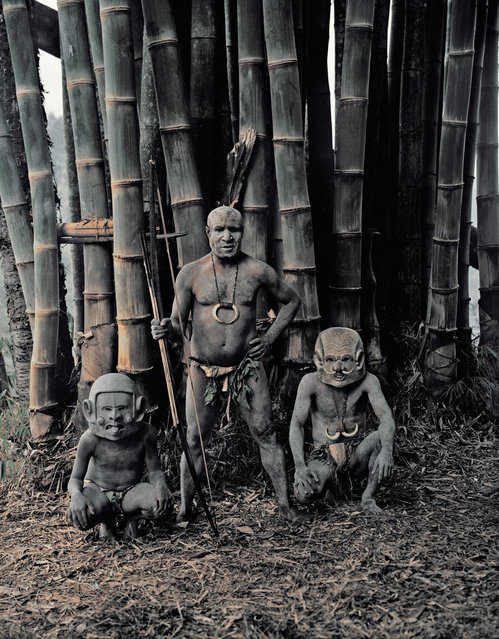
“Asaro from the Eastern Highlands”. The mudmen could not cover their faces with mud because the people of Papua New Guinea thought that the mud from the Asaro river was poisonous. So instead of covering their faces with this alleged poison, they made masks from pebbles that they heated and water from the waterfall, with unusual designs such as long or very short ears either going down to the chin or sticking up at the top, long joined eyebrows attached to the top of the ears, horns and sideways mouths. (Photo and caption by Jimmy Nelson)
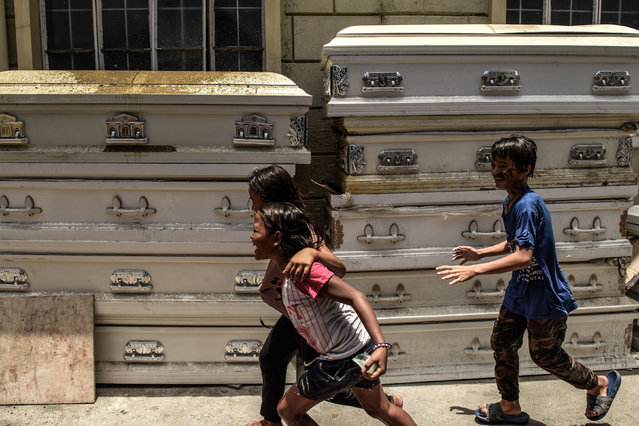
Children run past used caskets at a crematorium facility in Manila on April 29, 2020. Most of the Philippines is under quarantine to contain the spread of the coronavirus that has infected over 7,000 people and killed at least 500 in the country. (Photo by Maria Tan/AFP Photo)
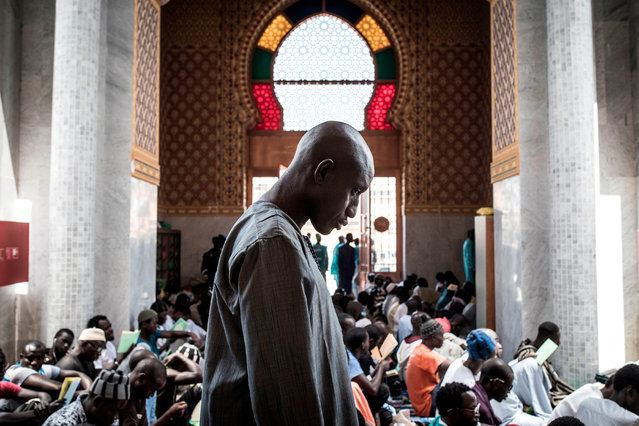
A Muslim worshipper attends a mass prayer against COVID-19, the new coronavirus, in Dakar on March 4, 2020, after two cases were confirmed in Senegal in the previous days. Across the world, 3,155 people have died from the virus. More than 92,723 have been infected in 78 countries and territories, according to AFP's latest toll based on official sources at 1700 GMT on March 3, 2020. (Photo by John Wessels/AFP Photo)
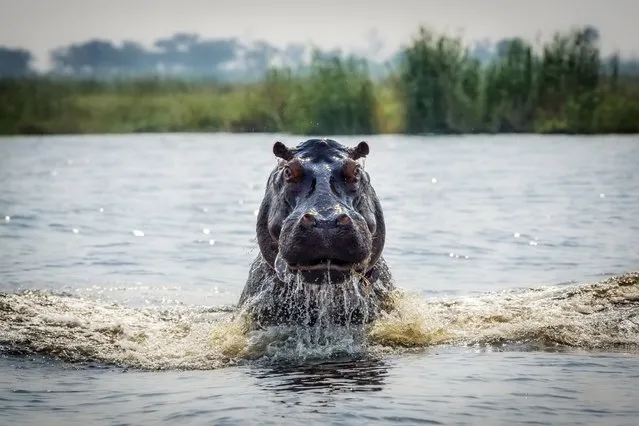
“Hippo Chase”. As we approached the camp the Selinda Reserve of northern Botswana our boat passed by a hippo resting in the water. I turned around to look back at the boat's wake and saw the hippo charging after us! The hippo must've been tired from an all-nighter because he was angry. He rose way up out of the water three times trying to chase our boat! He was coming at us with such force that he created a wake of his own. Photo location: Selinda Reserve of northern Botswana. (Photo and caption by Curtis Simmons/National Geographic Photo Contest)
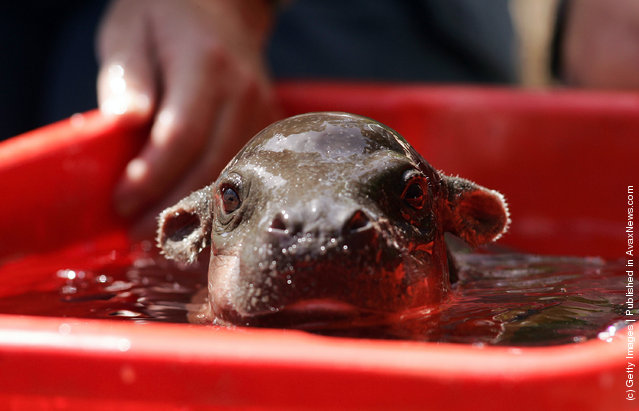
“The pygmy hippopotamus (Choeropsis liberiensis or Hexaprotodon liberiensis) is a large mammal native to the forests and swamps of western Africa (the specific name liberiensis means “of Liberia”, as this is where the vast majority live). The pygmy hippo is reclusive and nocturnal. It is one of only two extant species in the Hippopotamidae family, the other being its much larger cousin the common hippopotamus”. – Wikipedia
Photo: Monifa, a one month old baby Pygmy Hippopotamus takes a morning bath at Taronga Zoo on November 7, 2008 in Sydney, Australia. Monifa is the first Pygmy Hippopotamus to be born at Taronga Zoo in the past twenty three years. (Photo by Sergio Dionisio/Getty Images)