Loading...
Done
An injured woman is pictured near the Blue Parrot nightclub in Playa del Carmen, Quintana Ro state, Mexico where 5 people were killed, three of them foreigners, during a music festival on January 16, 2017. A shooting erupted at an electronic music festival in the Mexican resort of Playa del Carmen early Monday, leaving at least five people dead and sparking a stampede, the mayor said. Fifteen people were injured, some in the stampede, after at least one shooter opened fire before dawn at the Blue Parrot nightclub during the BPM festival. (Photo by Victor Vargas/AFP Photo)

An injured woman is pictured near the Blue Parrot nightclub in Playa del Carmen, Quintana Ro state, Mexico where 5 people were killed, three of them foreigners, during a music festival on January 16, 2017. A shooting erupted at an electronic music festival in the Mexican resort of Playa del Carmen early Monday, leaving at least five people dead and sparking a stampede, the mayor said. Fifteen people were injured, some in the stampede, after at least one shooter opened fire before dawn at the Blue Parrot nightclub during the BPM festival. (Photo by Victor Vargas/AFP Photo)
Details
17 Jan 2017 12:35:00
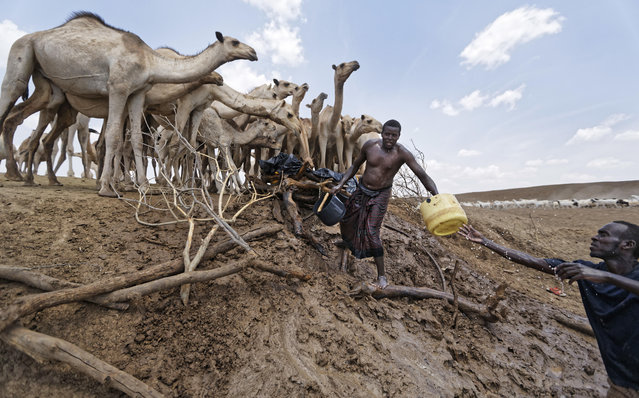
Camel herders scoop up water in plastic buckets from one of the few watering holes in the area, to water their animals near the drought-affected village of Bandarero, near Moyale town on the Ethiopian border, in northern Kenya, Friday, March 3, 2017. The U.N. humanitarian chief, Stephen O'Brien, toured Bandarero village on Friday and called on the international community to act to “avert the very worst of the effects of drought and to avert a famine to make sure we don't go from what is deep suffering to a catastrophe”. (Photo by Ben Curtis/AP Photo)

Camel herders scoop up water in plastic buckets from one of the few watering holes in the area, to water their animals near the drought-affected village of Bandarero, near Moyale town on the Ethiopian border, in northern Kenya, Friday, March 3, 2017. The U.N. humanitarian chief, Stephen O'Brien, toured Bandarero village on Friday and called on the international community to act to “avert the very worst of the effects of drought and to avert a famine to make sure we don't go from what is deep suffering to a catastrophe”. (Photo by Ben Curtis/AP Photo)
Details
05 Mar 2017 00:03:00
“Potholes” Project by Photographer Davide Luciano

“Potholes” is a series of photographs depicting the concave street cracks and holes as a collection of imaginative tableaux in the city. Captured within the backdrops of New York City, Los Angeles, Toronto and Montreal, the sets explore the urban flaws as a playground creating a multitude of uses out of the potholes. Directly engaging the street and the city, the highly imaginative series transforms the bad into good, creating a tongue-in-cheek collection that is at once contextual and surreal”. (Photo and caption by Davide Luciano)
Details
03 Dec 2013 06:15:00
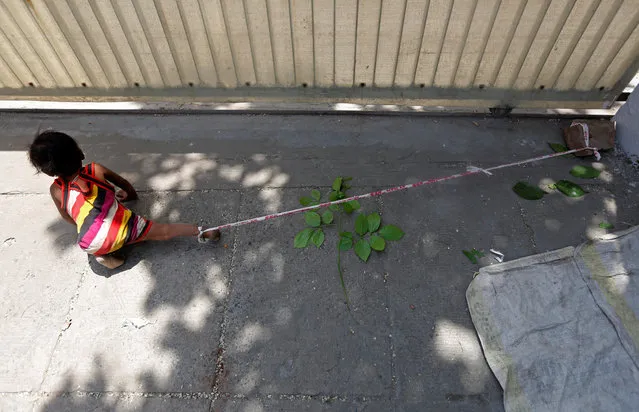
Barrier tape is tied around 15-month-old Shivani's ankle to prevent her from running away, while her mother Sarta Kalara works at a construction site nearby, in Ahmedabad, India, April 19, 2016. Kalara says she has no option but to tether her daughter Shivani to a stone despite her crying, while she and her husband work for 250 rupees ($3.8) each a shift digging holes for electricity cables in the city of Ahmedabad. There are about 40 million construction workers in India, at least one in five of them women, and the majority poor migrants who shift from site to site, building infrastructure for India's booming cities. Across the country it is not uncommon to see young children rolling in the sand and mud as their parents carry bricks or dig for new roads or luxury houses. (Photo by Amit Dave/Reuters)

Barrier tape is tied around 15-month-old Shivani's ankle to prevent her from running away, while her mother Sarta Kalara works at a construction site nearby, in Ahmedabad, India, April 19, 2016. Kalara says she has no option but to tether her daughter Shivani to a stone despite her crying, while she and her husband work for 250 rupees ($3.8) each a shift digging holes for electricity cables in the city of Ahmedabad. There are about 40 million construction workers in India, at least one in five of them women, and the majority poor migrants who shift from site to site, building infrastructure for India's booming cities. Across the country it is not uncommon to see young children rolling in the sand and mud as their parents carry bricks or dig for new roads or luxury houses. (Photo by Amit Dave/Reuters)
Details
14 Dec 2016 07:39:00
A milk custard bun made to resemble one of the popular Japanese “Kobitos” characters is squeezed during a display for the photographer at Dim Sum Icon restaurant in Hong Kong, China July 25, 2016. A dim sum restaurant in Hong Kong encourages diners to play with their food, and the result will either disgust or delight you. At Dim Sum Icon customers can squeeze a strange creature to poo or vomit on their plate before eating it. Hungry punters poke a hole into the mouth – or the rear – of the dim sum with a chopstick, squeeze it and watch the brown or white cream ooze out. (Photo by Bobby Yip/Reuters)

A milk custard bun made to resemble one of the popular Japanese “Kobitos” characters is squeezed during a display for the photographer at Dim Sum Icon restaurant in Hong Kong, China July 25, 2016. A dim sum restaurant in Hong Kong encourages diners to play with their food, and the result will either disgust or delight you. At Dim Sum Icon customers can squeeze a strange creature to poo or vomit on their plate before eating it. Hungry punters poke a hole into the mouth – or the rear – of the dim sum with a chopstick, squeeze it and watch the brown or white cream ooze out. The unique dim sums are made with a face to resemble Japanese Kobitos characters. (Photo by Bobby Yip/Reuters)
Details
31 Jul 2016 11:25:00
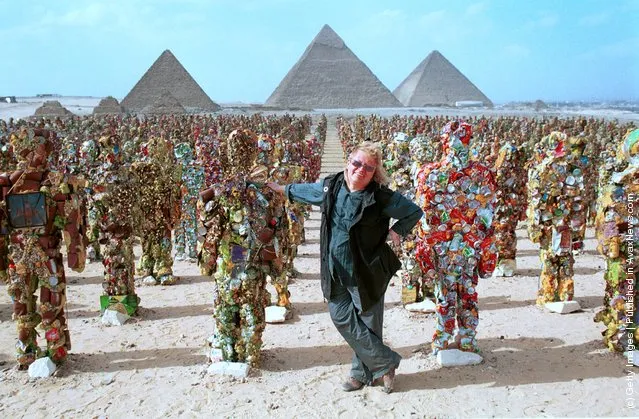
German artist Ha Schult stands with his trash people below the pyramids May 15, 2002 in Giza, Egypt

“HA Schult, born Hans-Jürgen Schult on June 24, 1939 in Parchim, Mecklenburg is a German installation, happening and conceptual artist known primarily for his object and performance art and more specifically his work with garbage”. – Wikipedia

Photo: German artist Ha Schult stands with his “trash people” below the pyramids May 15, 2002 in Giza, Egypt. Inspired by the statues of the terracotta army of Chinese Emperor Quin Shi Huangdi (247–206 B.C.), the thousand piece sulpture has stood in Red Square in Moscow, La Defense in Paris and the Great Wall in China. Schult, born in 1939 wants to bring the “trash war” to the world's attention beause trash is the greatest battle facing mankind. (Photo by Norbert Schiller/Getty Images)
Details
31 Jul 2011 13:37:00
An Israeli boy swims next to sheep belonging to a Palestinian farmer in the West Bank village of Al-Auja in the Jordan Valley on April 8, 2015 during the Jewish Passover holiday. Thousands of Israelis spent the day outdoors, picnicking and touring the country during the eight-day Passover holiday, which commemorates the Israelites' exodus from Egypt some 3,500 years ago. (Photo by Menahem Kahana/AFP Photo)

An Israeli boy swims next to sheep belonging to a Palestinian farmer in the West Bank village of Al-Auja in the Jordan Valley on April 8, 2015 during the Jewish Passover holiday. Thousands of Israelis spent the day outdoors, picnicking and touring the country during the eight-day Passover holiday, which commemorates the Israelites' exodus from Egypt some 3,500 years ago. (Photo by Menahem Kahana/AFP Photo)
Details
11 Apr 2015 10:59:00

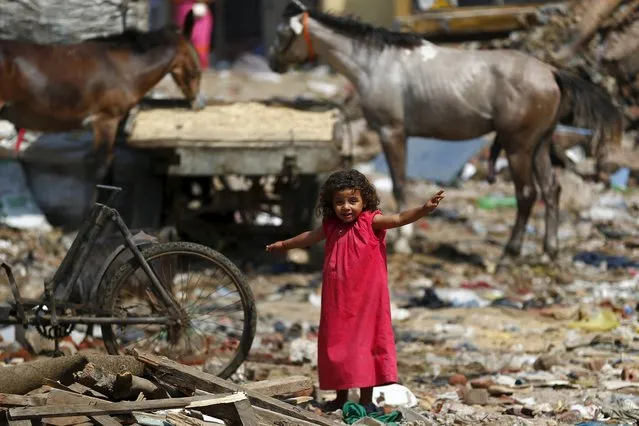
A girl plays in the Eshash el-Sudan slum in the Dokki neighbourhood of Giza, south of Cairo, Egypt September 2, 2015. (Photo by Amr Abdallah Dalsh/Reuters)

A girl plays in the Eshash el-Sudan slum in the Dokki neighbourhood of Giza, south of Cairo, Egypt September 2, 2015. Residents of the slum clashed with police in late August, when about 50 ramshackle huts were destroyed and at least 20 people were injured by teargas, local media reported, as authorities attempt to clear the area and rehouse residents. The slum dwellers, some of whom have called Eshash el-Sudan home for 50 years, say there are not enough apartments built nearby to house them. The residents of the slum eke out a living by disposing of rubbish or baking bread. Schooling is too expensive for most of their children, who play with salvaged rubbish amid shacks made out of discarded wood and leather. (Photo by Amr Abdallah Dalsh/Reuters)
Details
11 Sep 2015 12:47:00