Loading...
Done


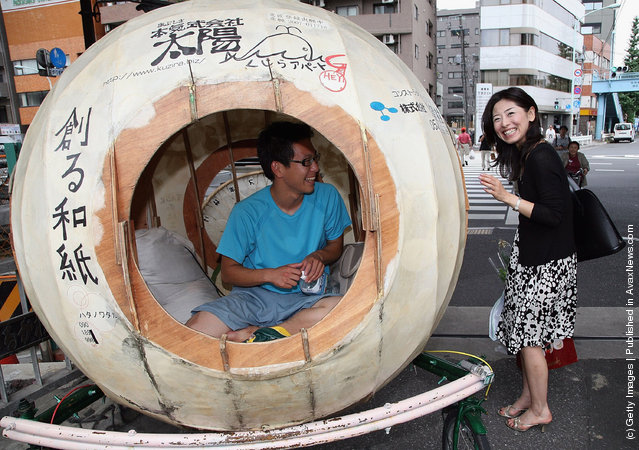
Gohei Hayashi of Kyoto University is seen in side his movable eco and healing house, “Kujira (Whale) House” July 21, 2007 in Tokyo, Japan. The house is made from Japanese paper, bamboo and tatami mat. Hayashi has travelled 500 km from Japan's ancient city, Kyoto to Tokyo with his eco house to promote his house which can be placed both out inside and outside to provide a private space. The Kujira house is available at the price of 800,000 yen (roughly US$6600). (Photo by Koichi Kamoshida/Getty Images)
Details
23 May 2011 06:45:00
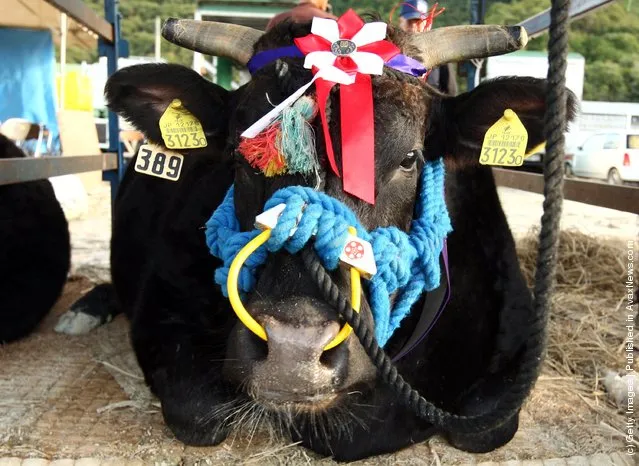
Auction Takes Place To Decide The Most Expensive Beef In Hyogo

A cow rests in a pen during the 93rd Hyogo Prefecture Livestock Industry Promoting Event on October 23, 2011 in Kobe, Japan. Hyogo is the center of producing fine beef such as Kobe beef and Tajima beef, and the highest hammer price of the auction was 5,001,000 Japanese yen (65,578.28 U.S. Dollars). Livestock Industry Promoting Event organizing official said, Fukushima nuclear accident and economy crises affected become les the price of Kobe and Tajima beef in this year. (Photo by Buddhika Weerasinghe/Getty Images)
Details
27 Oct 2011 12:01:00
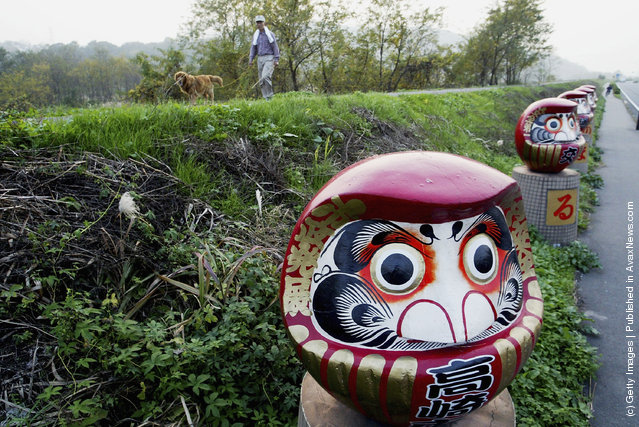
Daruma Dolls

A series of Japanese good luck charms, called “Daruma”, are lined up ahead of the major national elections November 9, 2003 in Takasaki, Japan. The Daruma is said to bring exceptional good luck in all walks of life, but is used especially during election time by all candidates. People think that if they face a difficult situation, as symbolized by the doll that returns to its original position when knocked over, they will always bounce back. (Photo by Koichi Kamoshida/Getty Images)
Details
05 Dec 2011 13:09:00
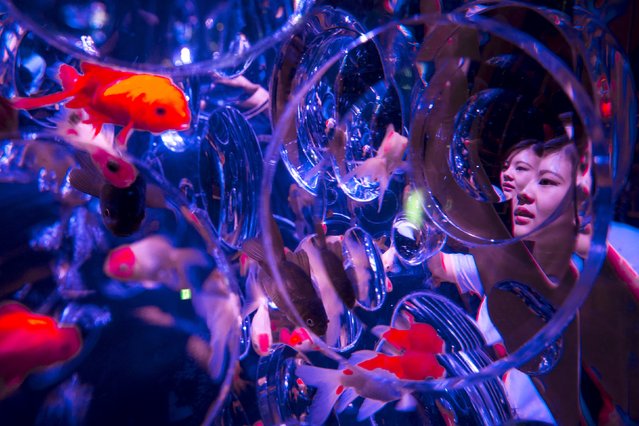
A woman looks at goldfish through the warped wall of a fish tank at the Art Aquarium exhibition in Tokyo July 10, 2015. (Photo by Thomas Peter/Reuters)

A woman looks at goldfish through the warped wall of a fish tank at the Art Aquarium exhibition in Tokyo July 10, 2015. Several thousand goldfish are displayed in dozens of uniquely shaped tanks, using LED lights, projection mapping and music in a show that was produced by Japanese designer Hidetomo Kimura. (Photo by Thomas Peter/Reuters)
Details
11 Jul 2015 13:47:00
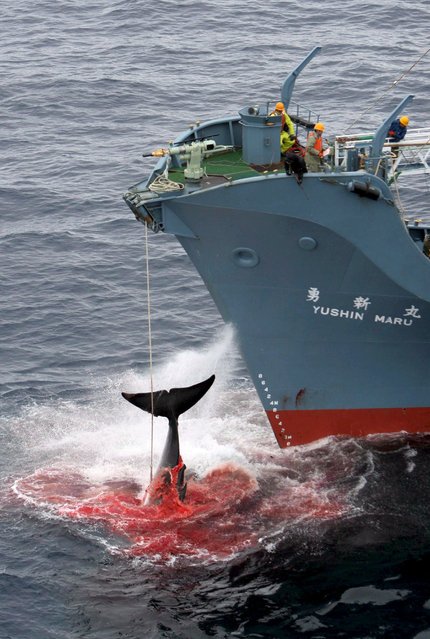
A file photograph dated 07 January 2006 and released by Greenpeace, showing the Yushin Maru, a factory ship in a Japanese whaling fleet, injuring a whale with it's first harpoon attempt. A UN court in The Hague on 31 March 2014 halted Japan's much-criticized whaling programme, ruling that it contravenes a 1986 moratorium on whale hunting. Japan must end its 'research whaling' programme, the International Court of Justice (ICJ) said. (Photo by Kate Davison/EPA)

A file photograph dated 07 January 2006 and released by Greenpeace, showing the Yushin Maru, a factory ship in a Japanese whaling fleet, injuring a whale with it's first harpoon attempt. A UN court in The Hague on 31 March 2014 halted Japan's much-criticized whaling programme, ruling that it contravenes a 1986 moratorium on whale hunting. Japan must end its 'research whaling' programme, the International Court of Justice (ICJ) said. Japan said the programme was for scientific research and permitted under international conventions. Australia had brought the case to the ICJ in 2010, charging that Japan was breaching international law by killing hundreds of whales every year for commercial purposes. Japan was “deeply disappointed” by the ruling, an unnamed government official was quoted by the Kyodo News agency as saying. But the official said Japan would stand by the ruling. (Photo by Kate Davison/EPA)
Details
01 Apr 2014 08:38:00
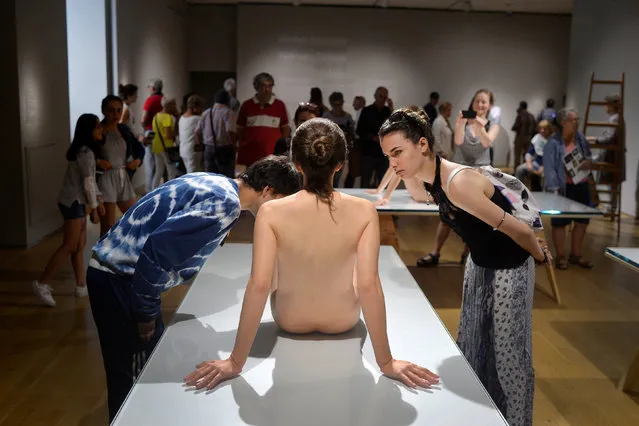
Visitors observe the sculpture “That Girl” by U.S. artist Paul McCarthy, at the Hyperrealist Sculpture 1973-2016 exhibition in the Museum of Bellas Artes in Bilbao, northern Spain, July 27, 2016. (Photo by Vincent West/Reuters)

Visitors observe the sculpture “That Girl” by U.S. artist Paul McCarthy, at the Hyperrealist Sculpture 1973-2016 exhibition in the Museum of Bellas Artes in Bilbao, northern Spain, July 27, 2016. (Photo by Vincent West/Reuters)
Details
29 Jul 2016 12:15:00
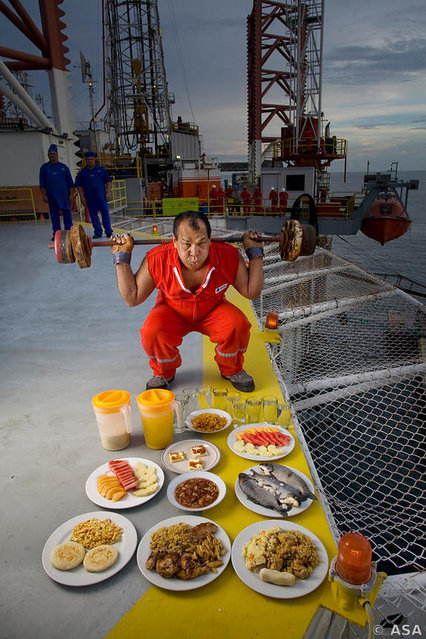
What the World Eats By Peter Menzel And Faith D'Aluisio Part 1

A stunning photographic collection featuring portraits of people from 30 countries and the food they eat in one day. In this fascinating study of people and their diets, 80 profiles are organized by the total number of calories each person puts away in a day. Featuring a Japanese sumo wrestler, a Massai herdswoman, world-renowned Spanish chef Ferran Adria, an American competitive eater, and more, these compulsively readable personal stories also include demographic particulars, including age, activity level, height, and weight. Essays from Harvard primatologist Richard Wrangham, journalist Michael Pollan, and others discuss the implications of our modern diets for our health and for the planet. This compelling blend of photography and investigative reportage expands our understanding of the complex relationships among individuals, culture, and food.
Details
23 Apr 2014 14:34:00


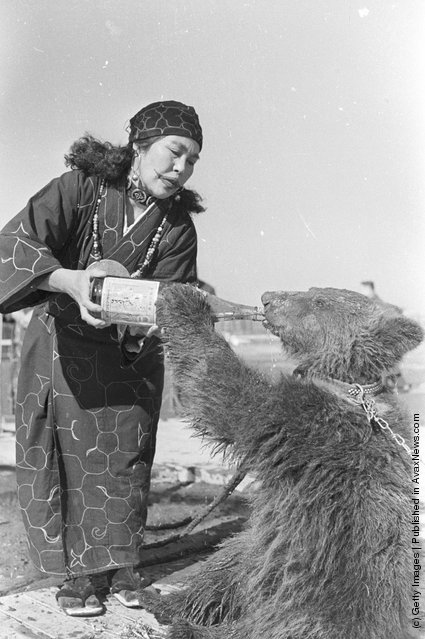
“The Ainu (アイヌ?), also called Aynu, Aino (アイノ), and in historical texts Ezo (蝦夷), are indigenous people or groups in Japan and Russia. Historically they spoke the Ainu language and related varieties and lived in Hokkaidō, the Kuril Islands, and much of Sakhalin. Most of those who identify themselves as Ainu still live in this same region, though the exact number of living Ainu is unknown. This is due to ethnic issues in Japan resulting in those with Ainu backgrounds hiding their identities and confusion over mixed heritages. In Japan, because of intermarriage over many years with Japanese, the concept of a 'pure Ainu' ethnic group is no longer feasible. Official estimates of the population are of around 25,000, while the unofficial number is upwards of 200,000 people”. – Wkipedia

Photo: A captive bear drinking from a large bottle held by an Ainu tribeswoman. (Photo by Evans/Three Lions/Getty Images). Circa 1955
Details
24 Mar 2011 14:01:00