Loading...
Done
Carsten Holler Experience Exhibit Draws Large Crowds To New Museum

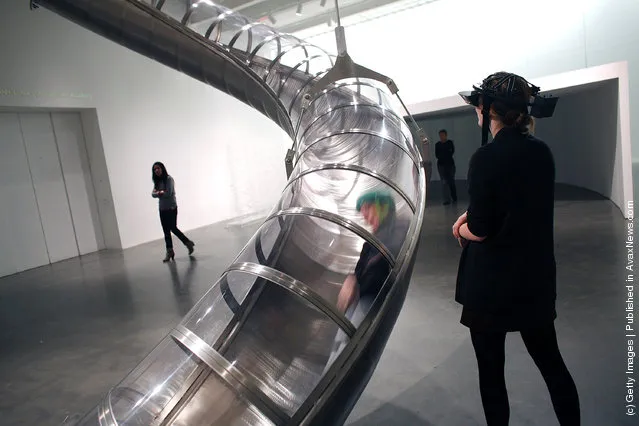
A visitor to the New Museum walks through the “Carsten Holler: Experience”, exhibition at the museum on December 14, 2011 in New York City. The show, which has been called an art world amusement park, includes a 102-foot slide that corkscrews down from the fourth floor to the second; an installation of flashing lights that is supposed to make you hallucinate and a sensory-deprivation tank that is meant to resemble the Dead Sea. (Photo by Spencer Platt/Getty Images)
Details
17 Dec 2011 12:10:00
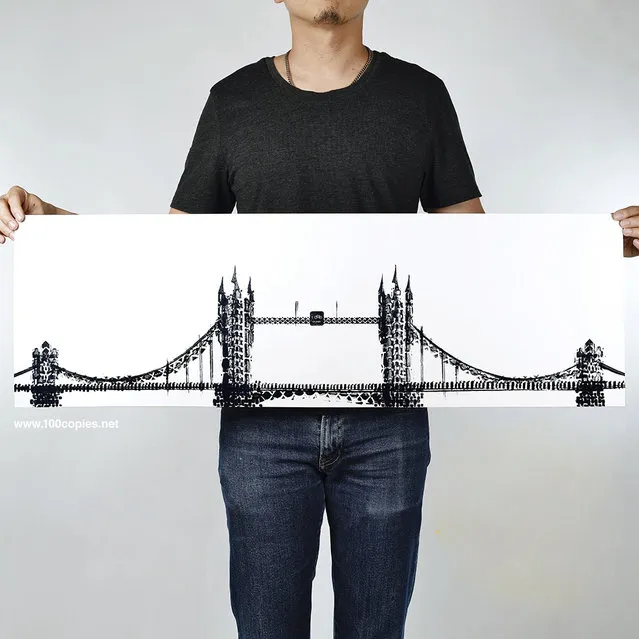
The Unforbidden Cyclist By Thomas Yang

Image patterning has existed for hundreds of years; however, before Thomas Yang no one has ever thought of putting paint on the bicycle wheels and using it as a patterning tool to create very interesting-looking pictures. Being an avid cyclist and an artist, Thomas Yang has decided to combine the two, creating the 100copies. The name of this project not only alludes to the fact that only one hundred copies of those pictures were going to be made, but also to the fact that the pictures themselves consist of hundreds of repeating shapes. And even though the project is called 100copies, no two pictures are alike due to the nature of their creation, making them truly unique. (Photo by Thomas Yang)
Details
11 Nov 2014 12:00:00
Afghanistan: Dogs of War Part 1

Throughout the course of the long war in Afghanistan, Coalition troops have relied on thousands of military working dogs to help keep them safe, and make their jobs easier. The dogs are trained to detect explosives, to find illegal drugs, to search for missing comrades, or target enemy combatants. Not only are they active on the front lines, but behind the lines they serve as therapy dogs, service dogs, and loyal companions. They also share the same risks as the ground troops, suffering injuries and sometimes death on the battlefields. Gathered here are images of these dogs and their handlers in Afghanistan and back home, from over the past several years, part of the ongoing series here on Afghanistan.
Details
03 Jun 2014 21:02:00
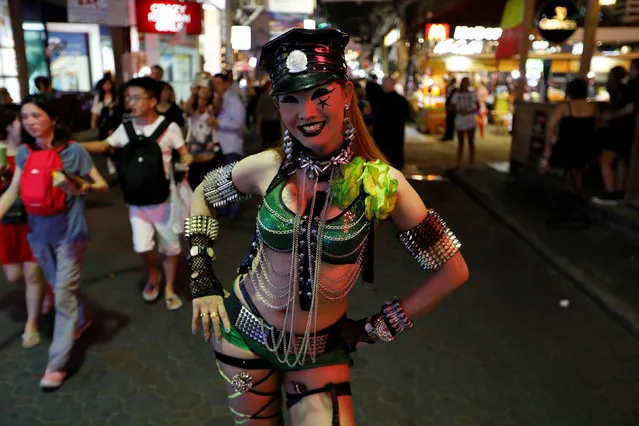
A woman promotes a go-go dance bar in Pattaya, Thailand March 25, 2017. With mascots dressed as smiling fish and a police rock band, Thai authorities launched a “Happy Zone” at the weekend to improve the image of a city notorious for sеx tourism. Stung by foreign headlines portraying the seaside resort of Pattaya as “Sin City” and “The World’s Sеx Capital”, Thailand’s junta has begun a new effort to re-brand it. Businesses in the Happy Zone are asked to make the area feel safer, there are increased security patrols, police launched a mobile phone app for visitors to summon them if an emergency occurs. (Photo by Jorge Silva/Reuters)

A woman promotes a go-go dance bar in Pattaya, Thailand March 25, 2017. With mascots dressed as smiling fish and a police rock band, Thai authorities launched a “Happy Zone” at the weekend to improve the image of a city notorious for sеx tourism. Stung by foreign headlines portraying the seaside resort of Pattaya as “Sin City” and “The World’s Sеx Capital”, Thailand’s junta has begun a new effort to re-brand it. Businesses in the Happy Zone are asked to make the area feel safer, there are increased security patrols, police launched a mobile phone app for visitors to summon them if an emergency occurs. (Photo by Jorge Silva/Reuters)
Details
28 Mar 2017 09:20:00
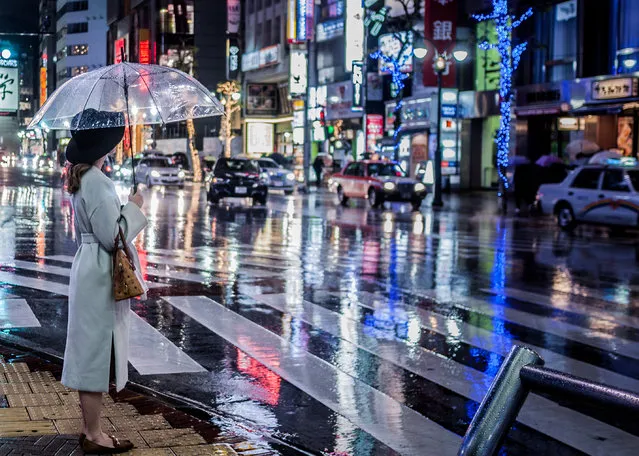
Runner-up. “The heavens opened and the streets around Shibuya, Tokyo, were suddenly drenched in even more colour and movement. I was taking photos (my friend was holding the umbrella) when I noticed this woman at the crossing. I’m pleased with the futuristic feel of the image”. MICK RYAN, JUDGE: “A rich spectrum of colour, neon lights, a glistening street and a woman with an umbrella all combine with great composition to make this a very appealing photograph. Quite nearly perfection, if it wasn’t for the slightly distracting objects top left and bottom right”. (Photo by Katherine Bridgestock/The Guardian)

Runner-up. “The heavens opened and the streets around Shibuya, Tokyo, were suddenly drenched in even more colour and movement. I was taking photos (my friend was holding the umbrella) when I noticed this woman at the crossing. I’m pleased with the futuristic feel of the image”. (Photo by Katherine Bridgestock/The Guardian)
Details
08 Mar 2018 00:01:00
The workers begin to search for gold at 10 am and work until sunset, often working second jobs in the day in order to survive. (Photo by Borja Sanchez-Trillo/Getty Images)

Two workers shovel mud from the river as they look for gold on March 25, 2014 in Lampang, Thailand. Thai villagers from Wang Nuea, North of Thailand, look for gold in the river every year during the drought season. They are able to make an average around USD 15 per day, however two years ago they reached USD 200 in one day due to the river level dropping so much. The workers begin to search for gold at 10 AM and work until sunset, often working second jobs in the day in order to survive. (Photo by Borja Sanchez-Trillo/Getty Images)
Details
27 Mar 2014 06:09:00
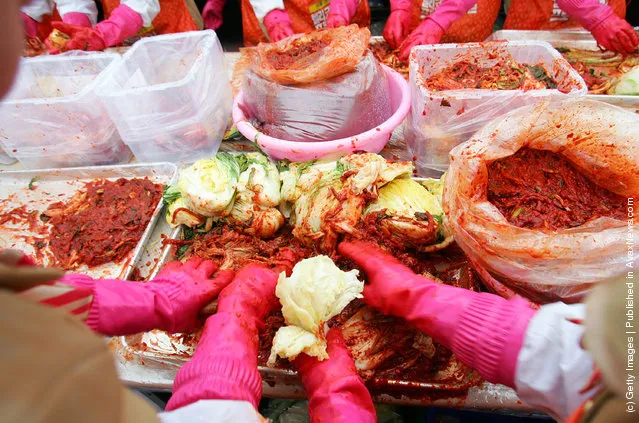
Kimchi

“Kimchi, also spelled gimchi, kimchee, or kim chee, is a traditional fermented Korean dish made of vegetables with varied seasonings. There are hundreds of varieties of kimchi made with a main vegetable ingredient such as napa cabbage, radish, green onions or cucumber. It is the most common banchan, or side dish, in Korean cuisine. Kimchi is also a main ingredient for many popular Korean dishes such as kimchi stew (kimchi jjigae), kimchi soup (kimchiguk), and kimchi fried rice (kimchi bokkeumbap)”. – Wikipedia

Photo: South Korean housewives, among more than two thousand who gathered for an event sponsored by state officials to help the needy, make kimchi, the traditional pungent vegetable dish on the grounds in front of Seoul City Hall on November 20 in Seoul, South Korea. (Photo by Chung Sung-Jun/Getty Images)
Details
21 Dec 2011 13:24:00
Art by Christian Faur

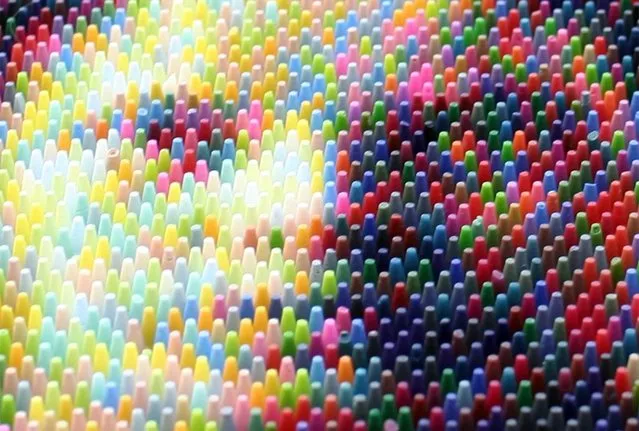
Christian Faur is an artist based in Granville, Ohio. Looking for a new technique, he experimented with painting with wax, but he didn’t feel the results were satisfactory.Then, at Christmas in 2005, his young daughter opened a box of 120 Crayola crayons he’d bought her, and everything clicked into place. Faur decided he would create pictures out of the crayons themselves, packing thousands of them together so they become like the colored pixels on a TV screen. He starts each work by scanning a photo into a computer and breaking the image down into colored blocks He then draws a grid that shows him exactly where to place each crayon The finished artworks are packed tightly into wooden frames. He actually makes the crayons himself, hand-casting each one in a mould.
Details
28 Jul 2012 10:03:00