Loading...
Done
Chinese Villagers Zip Line

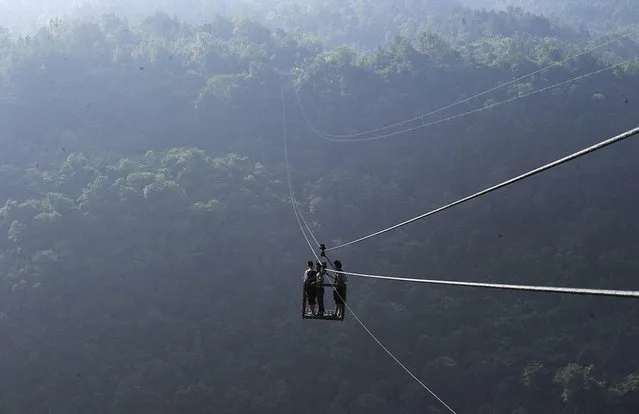
This cable ropeway suspended between cliffs is the only access to Yushan village in Hubei Province, Chin, which has a population of just over 200 people. The ropeway was built in 1997; before that villagers faced a walk of several days to get to the next nearest village. The ropeway, which is powered by a diesel engine, is 1,000 metres long and 400 metres above the valley floor.
Details
14 Mar 2014 15:22:00
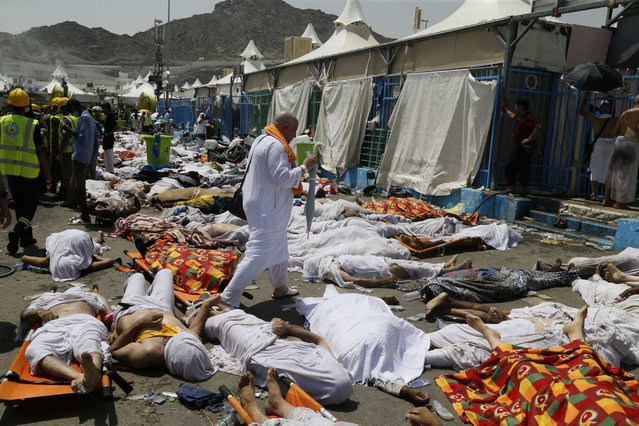
A muslim pilgrim walks through the site where dead bodies are gathered in Mina, Saudi Arabia during the annual hajj pilgrimage on Thursday, September 24, 2015. (Photo by AP Photo)

A muslim pilgrim walks through the site where dead bodies are gathered in Mina, Saudi Arabia during the annual hajj pilgrimage on Thursday, September 24, 2015. Hundreds were killed and injured, Saudi authorities said. The crush happened in Mina, a large valley about five kilometers (three miles) from the holy city of Mecca that has been the site of hajj stampedes in years past. (Photo by AP Photo)
Details
25 Sep 2015 08:01:00
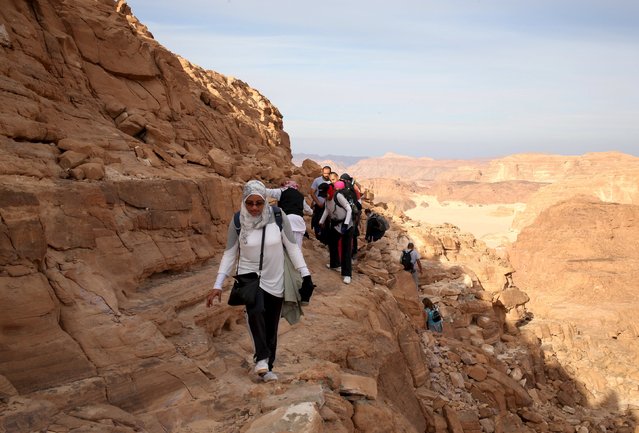
Hikers walk to reach the top of Naqba Rum area in South Sinai, Egypt, November 20, 2015. (Photo by Asmaa Waguih/Reuters)

Hikers walk to reach the top of Naqba Rum area in South Sinai, Egypt, November 20, 2015. Bedouins in the "Sinai is Safe" group guided more than 100 hikers over a 25 km (15 mile) trek over the trails of the White Canyon and the Closed Canyon. The NGO aims to challenge mainstream perceptions of the area by encouraging Nile Valley residents to explore the untamed wilderness with the Bedouin tribes. (Photo by Asmaa Waguih/Reuters)
Details
03 Dec 2015 08:00:00
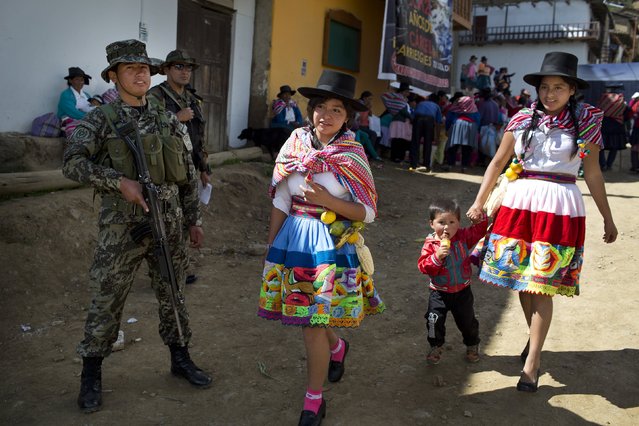
Women walk next to soldiers in Surcubamba, Peru, Thursday, May 21, 2015. (Photo by Rodrigo Abd/AP Photo)

Women walk next to soldiers in Surcubamba, Peru, Thursday, May 21, 2015. The Joint Command of the Peruvian Armed Forces organized a humanitarian mission to Surcubamba, where health care was provided to families from nearby villages in this region called VRAEM, the acronym for Valley of the Apurimac, Ene and Mantaro rivers, where sixty percent of Peru's cocaine originates. (Photo by Rodrigo Abd/AP Photo)
Details
24 May 2015 09:38:00
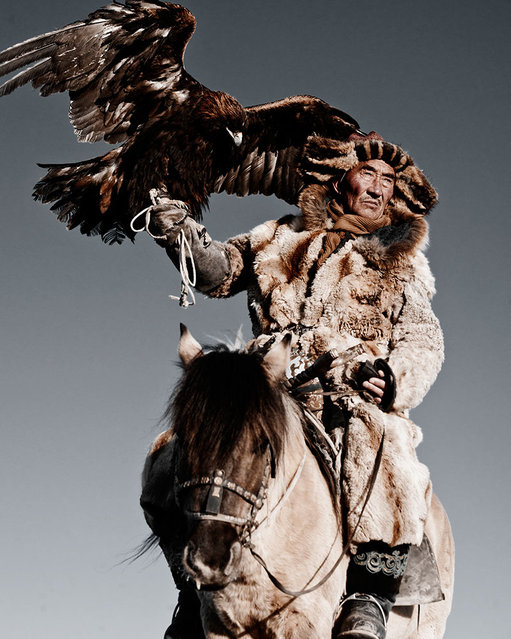
Fine Horses And Fierce Eagles Are The wings Of The Kazakh

The Kazakhs are the descendants of Turkic, Mongolic and Indo-Iranian tribes and Huns that populated the territory between Siberia and the Black Sea. They are a semi-nomadic people and have roamed the mountains and valleys of western Mongolia with their herds since the 19th century. The ancient art of eagle hunting is one of many traditions and skills that the Kazakhs have, in recent decades, been able to hold on to. They rely on their clan and herds, believing in pre-Islamic cults of the sky, the ancestors, fire and the supernatural forces of good and evil spirits.
Details
20 Feb 2014 12:12:00
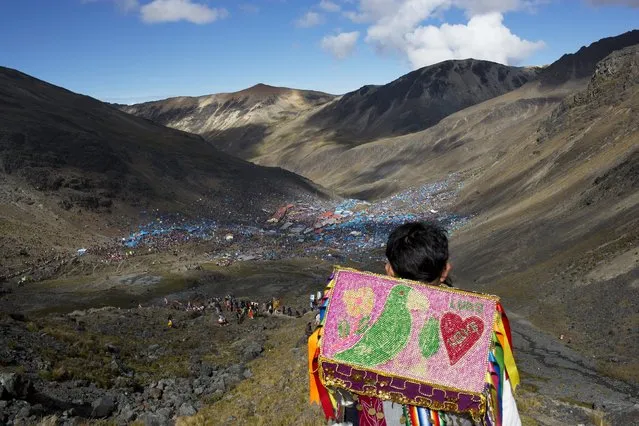
In this May 24, 2016 photo, a young boy descends the Qullqip'unqu mountain looking out at the tens of thousands of pilgrims gathered to celebrate the three-day festival Qoyllur Rit’i, translated from the Quechua language as Snow Star, in the Andean Sinakara Valley, in Peru's Cusco region. The celebration that mixes Catholic and indigenous beliefs honors Jesus as well as the area’s glacier, which is considered sacred among some indigenous people. While the native celebration is far older, the Christian part of the ritual stretches back to the 1700s, when Jesus is said to have appeared to a young shepherd in the form of another boy. (Photo by Rodrigo Abd/AP Photo)

In this May 24, 2016 photo, a young boy descends the Qullqip'unqu mountain looking out at the tens of thousands of pilgrims gathered to celebrate the three-day festival Qoyllur Rit’i, translated from the Quechua language as Snow Star, in the Andean Sinakara Valley, in Peru's Cusco region. The celebration that mixes Catholic and indigenous beliefs honors Jesus as well as the area’s glacier, which is considered sacred among some indigenous people. While the native celebration is far older, the Christian part of the ritual stretches back to the 1700s, when Jesus is said to have appeared to a young shepherd in the form of another boy. (Photo by Rodrigo Abd/AP Photo)
Details
04 Jun 2016 11:52:00
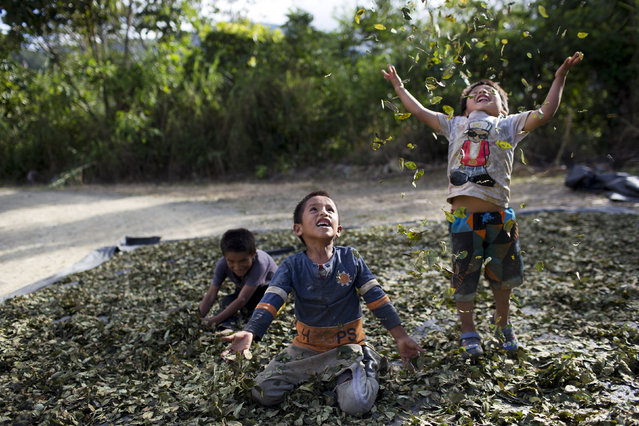
In this March 13, 2015 photo,  Yohan, 4, from left, Cristian, 7, and Angelo, 6, playfully toss coca leaves into the air, singing: “I have a lot of money, look at all the money I have”, in La Mar, province of Ayacucho, Peru. Hauling cocaine out of the remote valley is about the only way to earn decent cash in this region where a farmhand earns less than $10 a day. Beyond extinguishing young lives, the practice has packed Peru's highland prisons with cocaine backpackers while their bosses evade incarceration. (Photo by Rodrigo Abd/AP Photo)

In this March 13, 2015 photo, Yohan, 4, from left, Cristian, 7, and Angelo, 6, playfully toss coca leaves into the air, singing: “I have a lot of money, look at all the money I have”, in La Mar, province of Ayacucho, Peru. Hauling cocaine out of the remote valley is about the only way to earn decent cash in this region where a farmhand earns less than $10 a day. Beyond extinguishing young lives, the practice has packed Peru's highland prisons with cocaine backpackers while their bosses evade incarceration. (Photo by Rodrigo Abd/AP Photo)
Details
12 May 2015 12:40:00
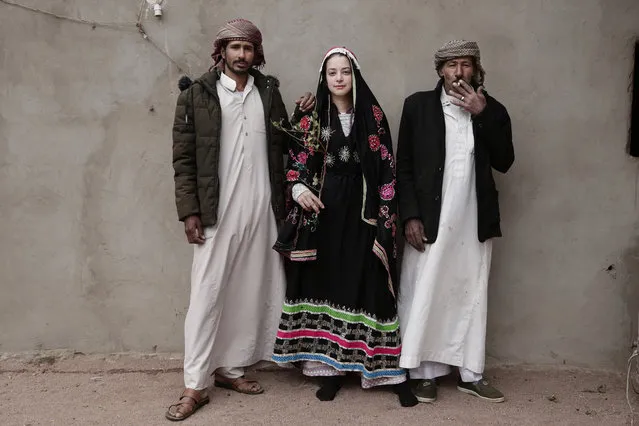
In this March 31, 2019 photo, an Egyptian student borrows a Bedouin wedding dress to pose for a photograph with Bedouin men from the Hamada tribe, in Wadi Sahw, Abu Zenima, in South Sinai, Egypt. Four Bedouin women are for the first time leading tours in Egypt’s Sinai Peninsula, breaking new ground in their deeply conservative community, where women almost never work outside the home or interact with outsiders.  The tourists can only be women, and the tours can’t go overnight. Each day before the sun sets, the group returns to the Hamada’s home village in Wadi Sahu, a narrow desert valley. (Photo by Nariman El-Mofty/AP Photo)

In this March 31, 2019 photo, an Egyptian student borrows a Bedouin wedding dress to pose for a photograph with Bedouin men from the Hamada tribe, in Wadi Sahw, Abu Zenima, in South Sinai, Egypt. Four Bedouin women are for the first time leading tours in Egypt’s Sinai Peninsula, breaking new ground in their deeply conservative community, where women almost never work outside the home or interact with outsiders. The tourists can only be women, and the tours can’t go overnight. Each day before the sun sets, the group returns to the Hamada’s home village in Wadi Sahu, a narrow desert valley. (Photo by Nariman El-Mofty/AP Photo)
Details
11 Apr 2019 00:01:00