Loading...
Done
Xiren Wang, Lili Wat, and Sitong Chen join the pageant’s opening routine, dancing to “The Boys”, a song by K-Pop group «Girls’ Generation». While the women come from a range of professional backgrounds – including economics, nursing, and acting – every contestant is looking for her big break into the entertainment industry. (Photo and caption by John Brecher/Sahra Vang Nguyen/NBC News)

Xiren Wang, Lili Wat, and Sitong Chen join the pageant’s opening routine, dancing to “The Boys”, a song by K-Pop group «Girls’ Generation». While the women come from a range of professional backgrounds – including economics, nursing, and acting – every contestant is looking for her big break into the entertainment industry. Most contestants said they would prefer to have a career in the U.S. but would go wherever the opportunity lies. (Photo and caption by John Brecher/Sahra Vang Nguyen/NBC News)
Details
03 Sep 2014 10:50:00


“The Southern Tamandua, Collared Anteater or Lesser Anteater (Tamandua tetradactyla) is a species of anteater from South America. It is a solitary animal, found in many habitats from mature to highly disturbed secondary forests and arid savannas. It feeds on ants, termites and bees. It has very strong foreclaws that can be used to break insect nests or to defend itself”. – Wikipedia

Photo: A three-month-old baby Southern Tamandua “Konbu” lies on its mother Tae's back at Sunshine International Aquarium on July 7, 2009 in Tokyo, Japan. Baby Southern Tamandua feels safe and comfortable holding onto something and normally stays on the mother's back until around 3 months old. (Photo by Junko Kimura/Getty Images)
Details
19 May 2011 10:31:00
A harp seal pup

“The harp seal or saddleback seal is a species of earless seal native to the northernmost Atlantic Ocean and adjacent parts of the Arctic Ocean. Newborn pups weigh around 11 kilograms (24 lb) and are 80–85 centimetres (31–33 in) long. After birth, the mother only feeds that pup. During the 12 day nursing period, the mother does not eat, losing up to 3 kilograms (7 lb) per day. Harp seal milk contains up to 48% fat, so pups gain over 2.2 kilograms (4.9 lb) per day. During this time, the juvenile's “greycoat” grows in beneath the white neonatal coat, and it weighs 80 pounds (36 kg)”. – Wikipedia

Photo: A harp seal pup lies on an ice floe in the Gulf of Saint Lawrence March 24, 2008 in Charlottetown, Canada. (Photo by Joe Raedle/Getty Images)
Details
19 Sep 2011 15:49:00
LAPD chopper flies in a foregraund of the Super Moon in Los Angeles, California on May 05, 2012

LAPD chopper flies in a foregraund of the Super Moon in Los Angeles, California on May 05, 2012. Tonight's moon is set to appear 14 percent larger and 30 percent brighter from our perspective on Earth. The Supermoon lines up much closely with perigee – the moon's closest point to Earth. The 2012 May full moon falls some six minutes after perigee, the moon's closest point to Earth for this month. At perigee, the moon lies only 221,802 miles (356,955 kilometers ) away. Later this month, on May 19, the moon will swing out to apogee – its farthest point for the month – at 252,555 miles (406,448 kilometers) distant. (Photo by AFP/File, Joe Klamar)
Details
08 May 2012 10:54:00
Kawakanih Yawalapiti, 9, Upper Xingu region of Mato Grosso, Brazil, 2018: Kawakanih lives with her tribe, the Yawalapiti, in Xingu national park, a preserve in the Amazon basin of Brazil. The Yawalapiti collect seeds to preserve species unique to their ecosystem, which lies between the rain forest and savannah. Kawakanih’s diet is simple, consisting mainly of fish, cassava, porridge, fruit and nuts. “It takes five minutes to catch dinner”, says Kawakanih. “When you’re hungry, you just go to the river with your net”. (Photo by Gregg Segal/The Guardian)

Photographer Gregg Segal travelled the world to document children and the food they eat in a week. Partly inspired by the increasing problems of childhood obesity, he tracked traditional regional diets as yet unaffected by globalisation, and ironically, found that the healthiest diets were often eaten by the least well off. (Photo by Gregg Segal/The Guardian)
Details
03 Jul 2019 00:03:00
The Hoegh Osaka ro-ro cargo ship, operated by Hoegh Autoliners AS, sits grounded on Bramble Bank in the Solent near Cowes, on the Isle of Wight, U.K., on Monday, January 5, 2015. (Photo by Simon Dawson/Bloomberg)

The “Hoegh Osaka” ro-ro cargo ship, operated by Hoegh Autoliners AS, sits grounded on Bramble Bank in the Solent near Cowes, on the Isle of Wight, U.K., on Monday, January 5, 2015. The car transporter was deliberately grounded after developing a list, shortly after it left the Port of Southampton. (Photo by Simon Dawson/Bloomberg)
Details
06 Jan 2015 11:44:00
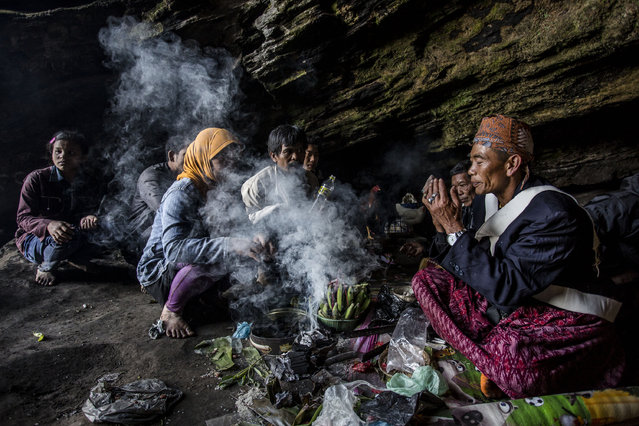
A Tenggerese shaman praying for worshippers at Widodaren cave during the Tenggerese Hindu Yadnya Kasada festival on July 31, 2015 in Probolinggo, East Java, Indonesia. The festival is the main festival of the Tenggerese people and lasts about a month. On the fourteenth day, the Tenggerese make the journey to Mount Bromo to make offerings of rice, fruits, vegetables, flowers and livestock to the mountain gods by throwing them into the volcano's caldera. (Photo by Ulet Ifansasti/Getty Images)

A Tenggerese shaman praying for worshippers at Widodaren cave during the Tenggerese Hindu Yadnya Kasada festival on July 31, 2015 in Probolinggo, East Java, Indonesia. The festival is the main festival of the Tenggerese people and lasts about a month. On the fourteenth day, the Tenggerese make the journey to Mount Bromo to make offerings of rice, fruits, vegetables, flowers and livestock to the mountain gods by throwing them into the volcano's caldera. The origin of the festival lies in the 15th century when a princess named Roro Anteng started the principality of Tengger with her husband Joko Seger, and the childless couple asked the mountain Gods for help in bearing children. The legend says the Gods granted them 24 children but on the provision that the 25th must be tossed into the volcano in sacrifice. The 25th child, Kesuma, was finally sacrificed in this way after initial refusal, and the tradition of throwing sacrifices into the caldera to appease the mountain Gods continues today. (Photo by Ulet Ifansasti/Getty Images)
Details
01 Aug 2015 12:07:00
Passengers with their pet dogs take a pet-friendly train on the Jinyidong Line of the Jinhua Rail Transit on June 22, 2025 in Jinhua, Zhejiang Province of China. (Photo by Shi Bufa/VCG via Getty Images)

Passengers with their pet dogs take a pet-friendly train on the Jinyidong Line of the Jinhua Rail Transit on June 22, 2025 in Jinhua, Zhejiang Province of China. (Photo by Shi Bufa/VCG via Getty Images)
Details
25 Jul 2025 02:35:00