Loading...
Done
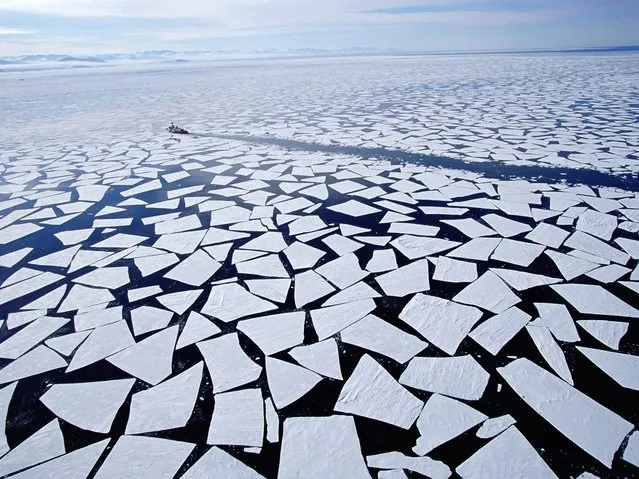
McMurdo Station Antarctic

McMurdo Station is a U.S. Antarctic research centre located on the southern tip of Ross Island, which is in the New Zealand-claimed Ross Dependency on the shore of McMurdo Sound in Antarctica. It is operated by the United States through the United States Antarctic Program, a branch of the National Science Foundation. The station is the largest community in Antarctica, capable of supporting up to 1,258 residents, and serves as the United States Antarctic science facility. All personnel and cargo going to or coming from Amundsen–Scott South Pole Station first pass through McMurdo.
Details
05 Sep 2013 10:18:00


“The McDonnell Douglas KC-10 Extender is an air-to-air tanker aircraft in service with the United States Air Force derived from the civilian DC-10-30 airliner. The KC-10 was the second consecutive McDonnell Douglas transport aircraft to be selected by the US Air Force following the C-9 Nightingale. The similar KDC-10 is in service with the Royal Netherlands Air Force.”

Photo: A B-52G Stratofortress aircraft takes off with another B-52G close behind. Three cells of six B-52 and KC-10 Extender aircraft will takeoff seconds apart under combat conditions during the minimum interval takeoff exercise. The exercise is a part of an operational readiness inspection by the Strategic Air Command Inspector General Team. (Photo by USAF). 1998
Details
15 Mar 2011 09:23:00
Grumpy Cat attends the World Premiere Of "Cinderella" on Sunday, March 1, 2015, in Los Angeles. (Photo by Todd Williamson/Invision/AP)

Grumpy Cat attends the World Premiere Of "Cinderella" on Sunday, March 1, 2015, in Los Angeles. (Photo by Todd Williamson/Invision/AP)
Details
07 Mar 2015 11:02:00


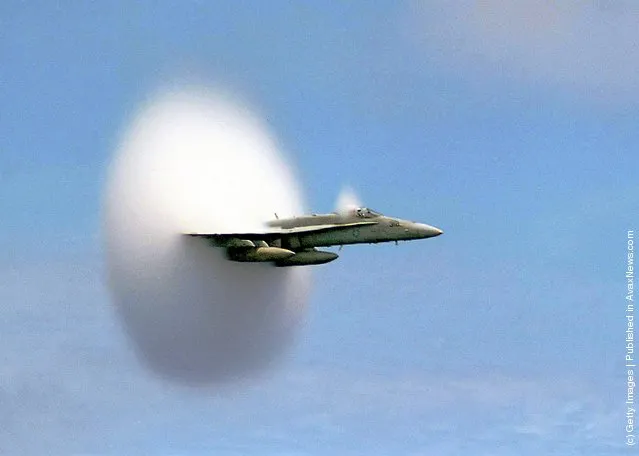
An F/A-18 Hornet assigned to Strike Fighter Squadron One Five One (VFA-151) emerges from a cloud created when it broke the sound barrier in the skies over the Pacific Ocean, July 7, 1999. (Photo by John Gay/US Navy)
Details
25 May 2011 10:33:00
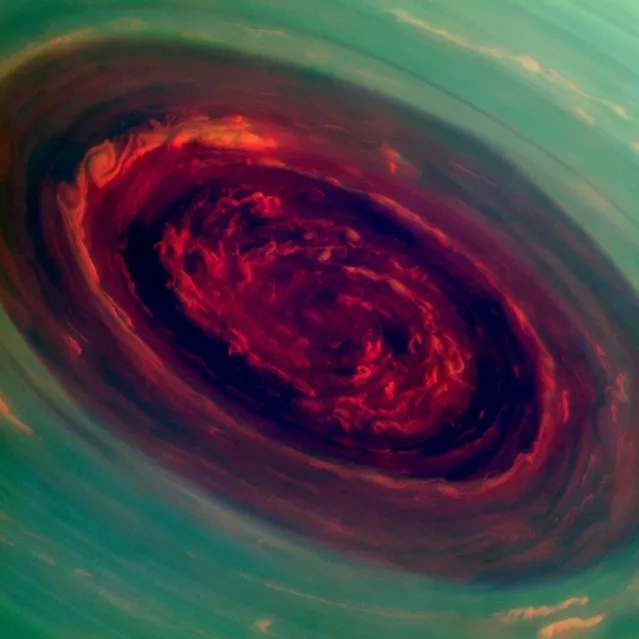
The spinning vortex of Saturn's north polar storm resembles a deep red rose of giant proportions surrounded by green foliage in this false-color image from NASA's Cassini spacecraft. (Photo by NASA/JPL-Caltech/SSI)

NASA's Cassini spacecraft has provided scientists the first close-up, visible-light views of a behemoth hurricane swirling around Saturn's north pole. In high-resolution pictures and video, scientists see the hurricane's eye is about 1,250 miles (2,000 kilometers) wide, 20 times larger than the average hurricane eye on Earth. Thin, bright clouds at the outer edge of the hurricane are traveling 330 mph(150 meters per second). The hurricane swirls inside a large, mysterious, six-sided weather pattern known as the hexagon. Photo: The spinning vortex of Saturn's north polar storm resembles a deep red rose of giant proportions surrounded by green foliage in this false-color image from NASA's Cassini spacecraft. (Photo by NASA/JPL-Caltech/SSI)
Details
31 May 2015 09:11:00
Chelsea pensioner Mike Smith in the rear of one of two Spitfires flying over Sussex during a surprise flight organised by the Taxi Charity for Military Veterans on Tuesday, September 12, 2023. (Photo by Gareth Fuller/PA Images via Getty Images)

Chelsea pensioner Mike Smith in the rear of one of two Spitfires flying over Sussex during a surprise flight organised by the Taxi Charity for Military Veterans on Tuesday, September 12, 2023. (Photo by Gareth Fuller/PA Images via Getty Images)
Details
17 Nov 2023 04:42:00
People dance to celebrate Midsummer Eve during sunset at the Amager Strandpark in Copenhagen, Denmark, June 23, 2021. (Photo by Hannah McKay/Reuters)

People dance to celebrate Midsummer Eve during sunset at the Amager Strandpark in Copenhagen, Denmark, June 23, 2021. (Photo by Hannah McKay/Reuters)
Details
10 Jul 2021 08:58:00
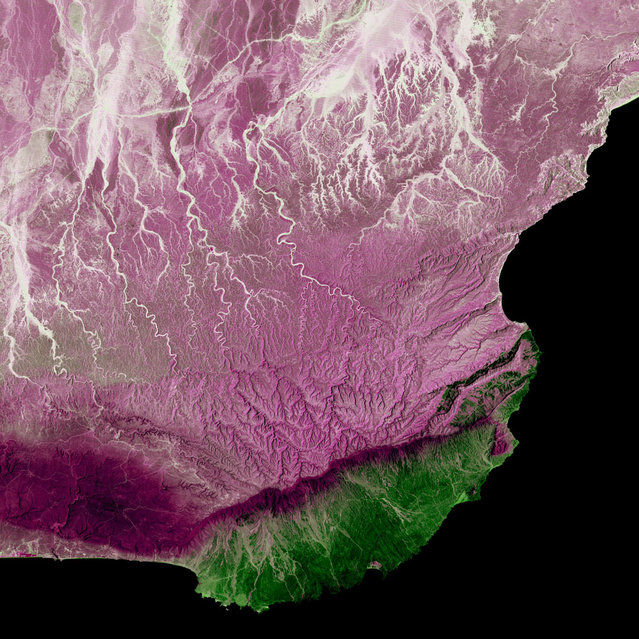
Dhofar Region, Oman. Much of Oman is desert, but the Arabian Sea coast in the Dhofar region represents a startling difference in climate. This coastal region catches the monsoon rains, or khareef, during the summer months. Drenching rains fall primarily on the mountainous ridge that separates the lush, fertile areas along the coast from the arid interior, recharging streams, waterfalls and springs that provide plentiful water supplies in the fertile lowlands for the remainder of the year. Image taken by Landsat 5 on April 2, 2005. (Photo by USGS/NASA)

Dhofar Region, Oman. Much of Oman is desert, but the Arabian Sea coast in the Dhofar region represents a startling difference in climate. This coastal region catches the monsoon rains, or khareef, during the summer months. Drenching rains fall primarily on the mountainous ridge that separates the lush, fertile areas along the coast from the arid interior, recharging streams, waterfalls and springs that provide plentiful water supplies in the fertile lowlands for the remainder of the year. Image taken by Landsat 5 on April 2, 2005. (Photo by USGS/NASA)
Details
25 Dec 2012 11:13:00