Loading...
Done
Covered in prayer shawls, Ultra-Orthodox Jewish men participate in a blessing during the holiday of Sukkot, in front of the Western Wall, the holiest site where Jews can pray in Jerusalem's Old City, Wednesday, September 30, 2015. The Cohanim, believed to be descendants of priests who served God in the Jewish Temple before it was destroyed, perform a blessing ceremony of the Jewish people three times a year during the festivals of Passover, Shavuot and Sukkot. (Photo by Oded Balilty/AP Photo)

Covered in prayer shawls, Ultra-Orthodox Jewish men participate in a blessing during the holiday of Sukkot, in front of the Western Wall, the holiest site where Jews can pray in Jerusalem's Old City, Wednesday, September 30, 2015. The Cohanim, believed to be descendants of priests who served God in the Jewish Temple before it was destroyed, perform a blessing ceremony of the Jewish people three times a year during the festivals of Passover, Shavuot and Sukkot. (Photo by Oded Balilty/AP Photo)
Details
03 Oct 2015 08:00:00
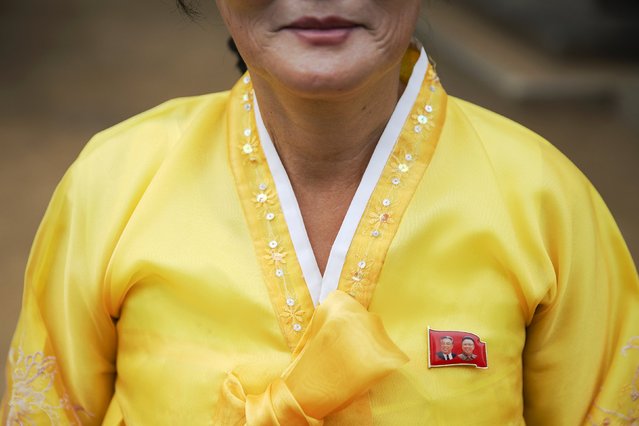
A woman in traditional clothes wears a pin showing North Korea's founder Kim Il-sung (L) and former leader Kim Jong-il, on her dress as she welcomes foreign reporters to a temple during a government organised tour just outside Pyongyang October 8, 2015. North Korea is getting ready to celebrate the 70th anniversary of the founding of its ruling Workers' Party of Korea on October 10. (Photo by Damir Sagolj/Reuters)

A woman in traditional clothes wears a pin showing North Korea's founder Kim Il-sung (L) and former leader Kim Jong-il, on her dress as she welcomes foreign reporters to a temple during a government organised tour just outside Pyongyang October 8, 2015. North Korea is getting ready to celebrate the 70th anniversary of the founding of its ruling Workers' Party of Korea on October 10. (Photo by Damir Sagolj/Reuters)
Details
11 Oct 2015 08:04:00
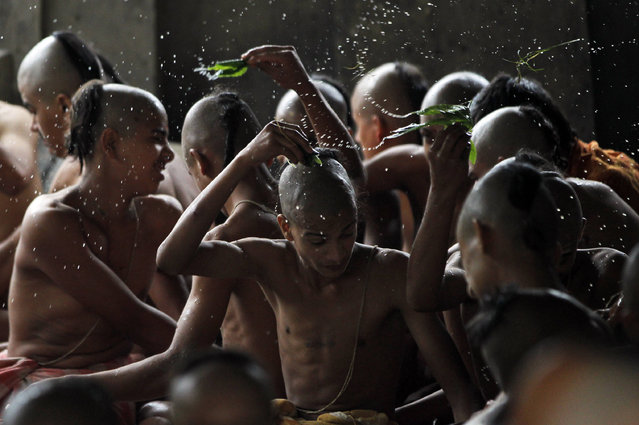
Nepalese Hindu priests perform rituals during Janai Purnima festival at Pashupatinath temple in Kathmandu, Nepal, Thursday, August 18, 2016. During this festival Hindus take holy baths and perform annual change of the Janai, a sacred cotton string worn around their chest or tied on the wrist, in the belief that it will protect and purify them. (Photo by Niranjan Shrestha/AP Photo)

Nepalese Hindu priests perform rituals during Janai Purnima festival at Pashupatinath temple in Kathmandu, Nepal, Thursday, August 18, 2016. During this festival Hindus take holy baths and perform annual change of the Janai, a sacred cotton string worn around their chest or tied on the wrist, in the belief that it will protect and purify them. (Photo by Niranjan Shrestha/AP Photo)
Details
19 Aug 2016 11:48:00
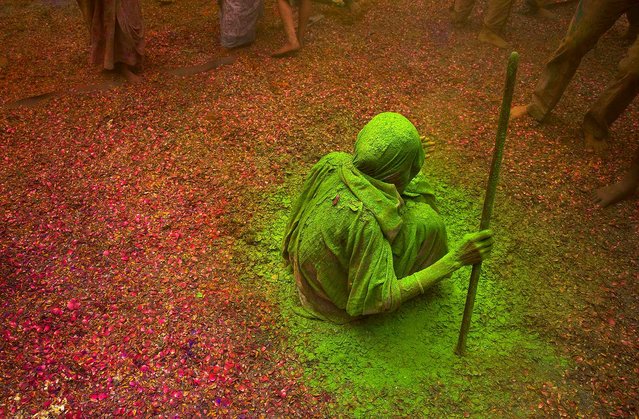
An Indian Hindu widow smeared with colors sits and watches others playing during Holi celebrations at the Gopinath temple, 180 kilometres (112 miles) south-east of New Delhi, India Monday, March 21, 2016. (Photo by Manish Swarup/AP Photo)

An Indian Hindu widow smeared with colors sits and watches others playing during Holi celebrations at the Gopinath temple, 180 kilometres (112 miles) south-east of New Delhi, India Monday, March 21, 2016. A few years ago this joyful celebration was forbidden for Hindu widows. Like hundreds of thousands of observant Hindu women they would have been expected to live out their days in quiet worship, dressed only in white, their very presence being considered inauspicious for all religious festivities. (Photo by Manish Swarup/AP Photo)
Details
22 Mar 2016 11:24:00
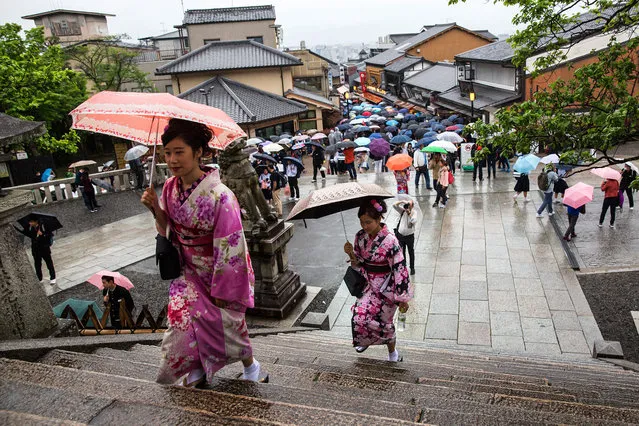
Tourists dressed in yukatas, a light, unlined, summer kimono made of cotton instead of the traditional silk, climb steps to visit a temple on April 27, 2016 in Kyoto, Japan. Now the seventh largest city in Japan, Kyoto was once the Imperial capital for more than one thousand years, it is now the capital city of Kyoto Prefecture and a major part of the Kyoto-Osaka-Kobe metropolitan area. (Photo by Carl Court/Getty Images)

Tourists dressed in yukatas, a light, unlined, summer kimono made of cotton instead of the traditional silk, climb steps to visit a temple on April 27, 2016 in Kyoto, Japan. Now the seventh largest city in Japan, Kyoto was once the Imperial capital for more than one thousand years, it is now the capital city of Kyoto Prefecture and a major part of the Kyoto-Osaka-Kobe metropolitan area. (Photo by Carl Court/Getty Images)
Details
21 May 2016 10:48:00
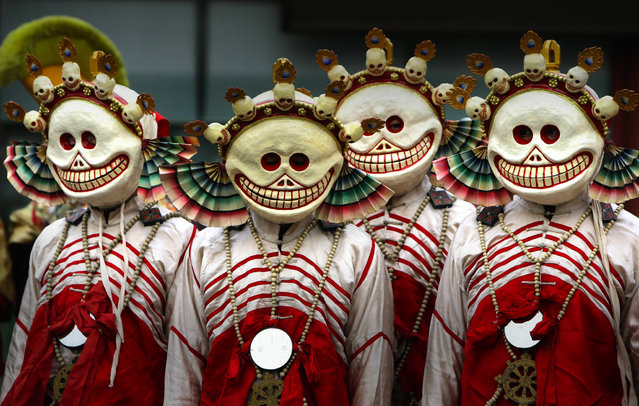
Monks dressed as Tibetan Buddhism characters attend a religious ceremony, known as “Da Gui” or beating ghost, to celebrate the upcoming Tibetan New Year which starts on March 1 at Yonghegong Lama Temple, in Beijing February 28, 2014. This Tibetan ceremony is held annually at the end of the first lunar month with mask dancing to expel ghosts, according to a press release. (Photo by Jason Lee/Reuters)

Monks dressed as Tibetan Buddhism characters attend a religious ceremony, known as “Da Gui” or beating ghost, to celebrate the upcoming Tibetan New Year which starts on March 1 at Yonghegong Lama Temple, in Beijing February 28, 2014. This Tibetan ceremony is held annually at the end of the first lunar month with mask dancing to expel ghosts, according to a press release. (Photo by Jason Lee/Reuters)
Details
01 Mar 2014 13:07:00
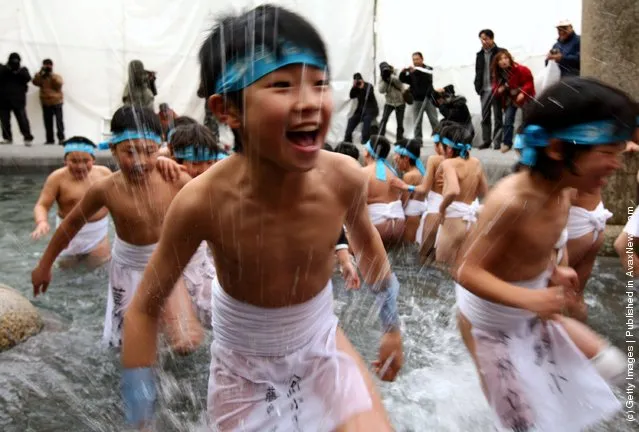
Japanese children wear loincloths as they splash about in freezing cold water during Saidaiji Naked Festival, at Saidaiji Temple

“A Hadaka Matsuri (“Naked Festival”) is a type of Japanese festival, or matsuri, in which participants wear a minimum amount of clothing; usually just a Japanese loincloth (called fundoshi), sometimes with a short happi coat, and rarely completely naked. Whatever the clothing, it is considered to be above vulgar, or everyday, undergarments, and on the level of holy Japanese shrine attire. Naked festivals are held in dozens of places throughout Japan every year, usually in the summer or winter. The most famous festival is held in Okayama, where the festival originated. Every year, over 9,000 men participate in this festival”. – Wikipedia

Photo: Japanese men wear loincloths as they splash about in freezing cold water during Saidaiji Naked Festival, at Saidaiji Temple on February 18, 2012 in Okayama, Japan. (Photo by Buddhika Weerasinghe/Getty Images)
Details
19 Feb 2012 12:18:00
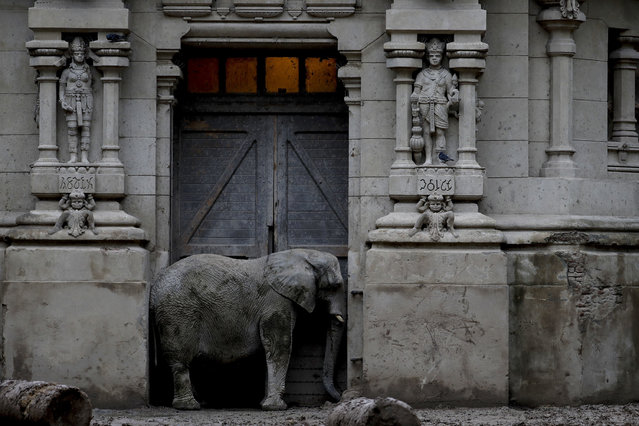
In this May 12, 2017 photo, Pupy, an African elephant, stands in the doorway of his enclosure at the former city zoo now known as Eco Parque in Buenos Aires, Argentina. A year ago the 140-year old Buenos Aires zoo closed its doors and was transformed into a park. The first director decided that the animals should be housed in buildings that reflected their countries of origin. A replica of a Hindu temple was built for the Asian elephants. (Photo by Natacha Pisarenko/AP Photo)

In this May 12, 2017 photo, Pupy, an African elephant, stands in the doorway of his enclosure at the former city zoo now known as Eco Parque in Buenos Aires, Argentina. A year ago the 140-year old Buenos Aires zoo closed its doors and was transformed into a park. The first director decided that the animals should be housed in buildings that reflected their countries of origin. A replica of a Hindu temple was built for the Asian elephants. (Photo by Natacha Pisarenko/AP Photo)
Details
25 May 2017 08:42:00