Loading...
Done
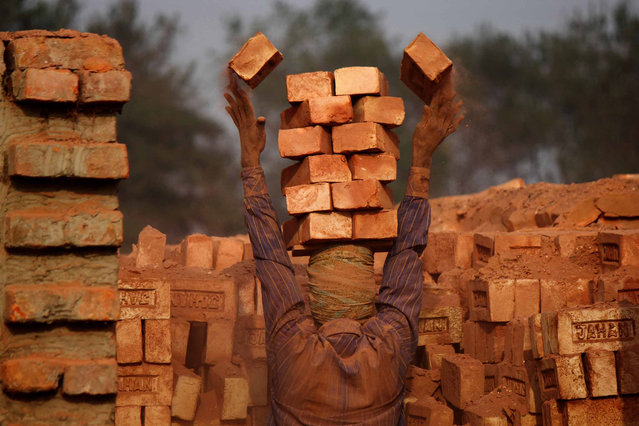
CGAP Photo Contest – South Asia Regional Winner: Bricks Worker, Bangladesh. A private enterprise worker is working at a brick field. These small businesses are creating new job opportunities for many poor people. (Photo by Moksumul Haque)

The shoemaker in Turkey, the potato seller in Vietnam, and the weaver in Bolivia are among the billions of low-income entrepreneurs who make the world go round. They are also the type of people who can benefit significantly from microfinance. Every year, the Consultative Group To Assist The Poor (or CGAP) hosts a photo contest asking entrants to submit photos based around the idea of microfinance.The purpose of the contest is to give amateur and professional photographers a chance to show the different ways that poor households manage their financial lives and make their lives better through financial inclusion. Photo: South Asia Regional Winner – “Bricks Worker”, Bangladesh. A private enterprise worker is working at a brick field. These small businesses are creating new job opportunities for many poor people. (Photo by Moksumul Haque)
Details
14 Aug 2014 10:58:00
What 200 Calories Looks Like In Different Foods Part 3

Some foods have significantly more Calories than others but what does the difference actually look like. Each of the photographs below represents 200 Calories of the particular type of food; the images are sorted from low to high calorie density. When you consider that an entire plate of broccoli contains the same number of Calories as a small spoonful of peanut butter, you might think twice the next time you decide what to eat. According to the U.S. Department of Agriculture, the average adult needs to consume about 2000 – 2500 Calories to maintain their weight. In other words, you have a fixed amount of Calories to "spend" each day; based on the following pictures, which would you eat?


See Also: Ppart 1 _ Part 2
Details
02 Aug 2014 09:53:00
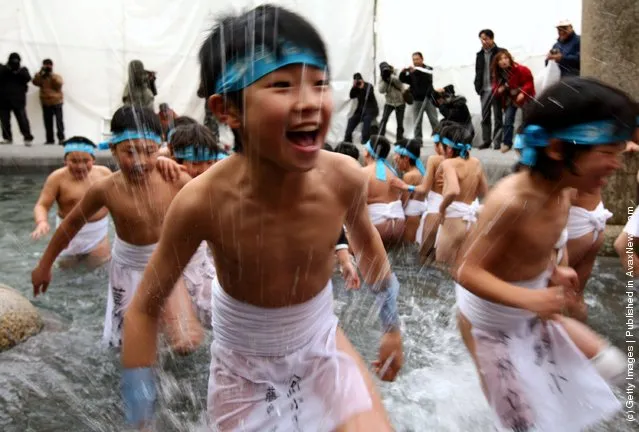
Japanese children wear loincloths as they splash about in freezing cold water during Saidaiji Naked Festival, at Saidaiji Temple

“A Hadaka Matsuri (“Naked Festival”) is a type of Japanese festival, or matsuri, in which participants wear a minimum amount of clothing; usually just a Japanese loincloth (called fundoshi), sometimes with a short happi coat, and rarely completely naked. Whatever the clothing, it is considered to be above vulgar, or everyday, undergarments, and on the level of holy Japanese shrine attire. Naked festivals are held in dozens of places throughout Japan every year, usually in the summer or winter. The most famous festival is held in Okayama, where the festival originated. Every year, over 9,000 men participate in this festival”. – Wikipedia

Photo: Japanese men wear loincloths as they splash about in freezing cold water during Saidaiji Naked Festival, at Saidaiji Temple on February 18, 2012 in Okayama, Japan. (Photo by Buddhika Weerasinghe/Getty Images)
Details
19 Feb 2012 12:18:00
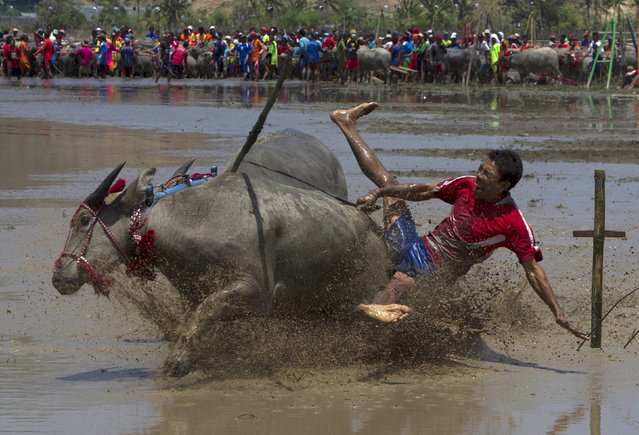
A jockey falls off during a traditional Barapan Kebo or buffalo races, in Taliwang, on the island of Sumbawa, West Nusa Tenggara, Indonesia November 22, 2015. (Photo by Sigit Pamungkas/Reuters)

A jockey falls off during a traditional Barapan Kebo or buffalo races, in Taliwang, on the island of Sumbawa, West Nusa Tenggara, Indonesia November 22, 2015. Around 250 pairs of water buffalo took part in the Barapan Kebo ahead of the planting season, for prizes which included a top prize of a pilgrimage to Mecca. (Photo by Sigit Pamungkas/Reuters)
Details
24 Nov 2015 08:08:00
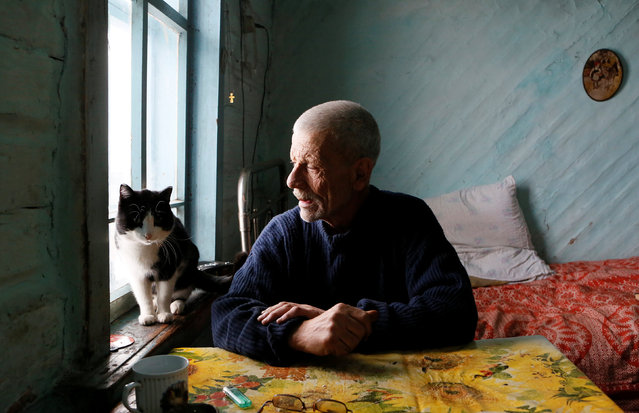
Mikhail Baburin, 66, talks to his cat Marquis at his house in the remote Siberian village of Mikhailovka, Krasnoyarsk region, Russia, December 5, 2016. (Photo by Ilya Naymushin/Reuters)

Mikhail Baburin, 66, talks to his cat Marquis at his house in the remote Siberian village of Mikhailovka, Krasnoyarsk region, Russia, December 5, 2016. Baburin, a former Navy man, barge worker and employee of a military plant in Krasnoyarsk, is the last inhabitant of Mikhailovka, which was founded in the 19th century by migrants from Russia's Mordovia region. He moved in 2000 to Mikhailovka where he was born and has lived there all alone for the last 10 years with only domestic animals. (Photo by Ilya Naymushin/Reuters)
Details
07 Dec 2016 12:22:00
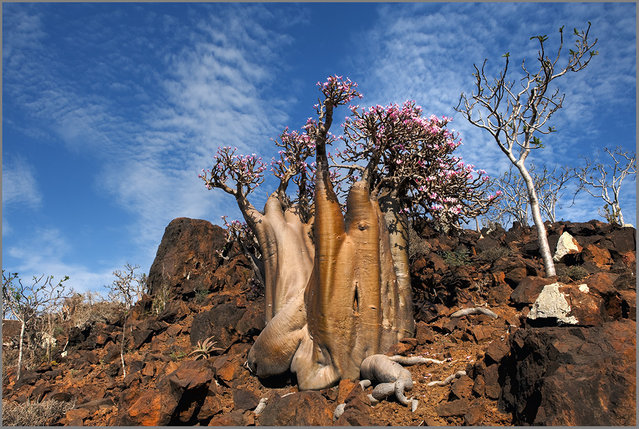
The Wonder Land of Socotra, Yemen

The largest island, also called Socotra, is about 95% of the landmass of the archipelago. It lies some 240 kilometres (150 mi) east of the Horn of Africa and 380 kilometres (240 mi) south of the Arabian Peninsula. The island is very isolated and through the process of speciation, a third of its plant life is found nowhere else on the planet. It has been described as the most alien-looking place on Earth. The island measures 132 kilometres (82 mi) in length and 49.7 kilometres (30.9 mi) in width.
Details
25 Sep 2013 09:11:00
World's first forest in the sky, the Bosco Verticale green twin towers

A concept illustration of the world's first forest in the sky, the Bosco Verticale green twin towers currently under construction in Milan, Italy. Towering over the city skyline the world's first forest in the sky will be a sight to behold. With tree equal to one hectare of forest spanning 27 floors these 365 and 260 foot emerald twin towers will be home to an astonishing 730 trees, 5,000 shrubs and 11,000 ground cover plants. (Photo by Boeri Studio)
Details
27 Oct 2011 11:11:00
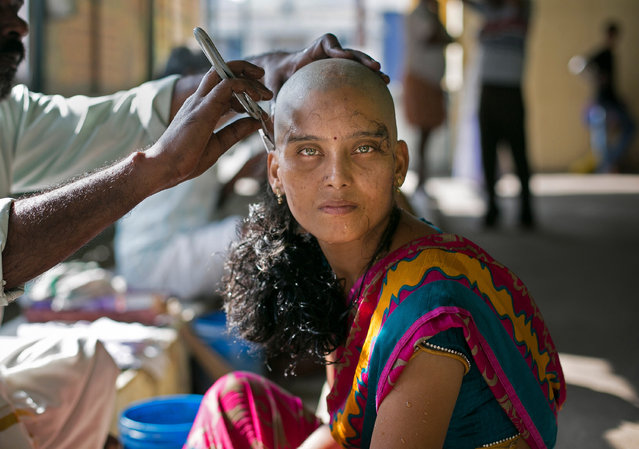
28 year old Rupa has her hair shaven to donate to the Gods at the Thiruthani Murugan Temple November 10, 2016 in Thiruttani, India. Rupa donated her hair with the wish that her daughter's illness is cured. The process of shaving ones hair and donating it to the Gods is known as tonsuring. It is common for Hindu believers to tonsure their hair at a temple as a young child, and also to celebrate a wish coming true, such as the birth of a baby or the curing of an illness. The “temple hair”, as it's known, is then auctioned off to a processing plant and then sold as pricey wigs and weaves in the US, Europe and Africa. (Photo by Allison Joyce/Getty Images)

28 year old Rupa has her hair shaven to donate to the Gods at the Thiruthani Murugan Temple November 10, 2016 in Thiruttani, India. Rupa donated her hair with the wish that her daughter's illness is cured. The process of shaving ones hair and donating it to the Gods is known as tonsuring. It is common for Hindu believers to tonsure their hair at a temple as a young child, and also to celebrate a wish coming true, such as the birth of a baby or the curing of an illness. The “temple hair”, as it's known, is then auctioned off to a processing plant and then sold as pricey wigs and weaves in the US, Europe and Africa. (Photo by Allison Joyce/Getty Images)
Details
21 Nov 2016 10:30:00