A rescue worker holds an injured boy after what activists said were airstrikes carried out by the Russian air force in Idlib city, Syria December 20, 2015. (Photo by Ammar Abdullah/Reuters)
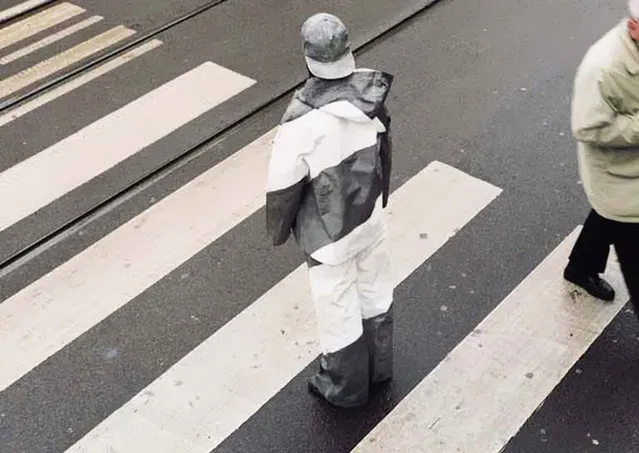
“The artist herself produces the camouflage suit. For each photo, for each environment of her choice, she designs a new suit, which again and again has to be made with the greatest precision, or the illusive effect will not work. By uniting the figure with the background, Desiree Palmen reaches a surprising visual effect that requests a special effort for the observing eye: it must disentangle what is flat and what is spatial.”
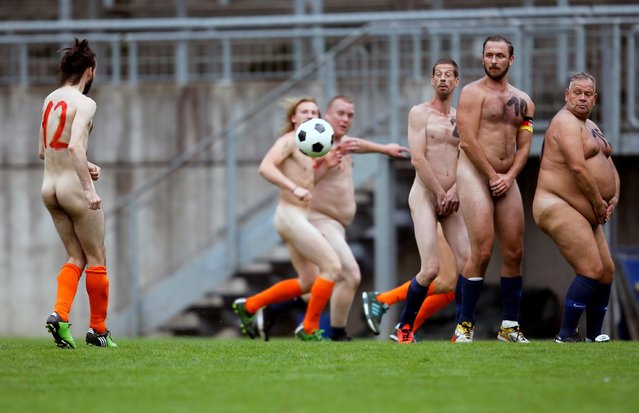
Naked footballers participate in a Germany v Netherlands soccer match in protest against what they say is increasing commercialization of professional football, in Wuppertal, Germany on September 6, 2020. (Photo by Leon Kuegeler/Reuters)
A worker puts up an advertising billboard for a recruiting company, featuring what resembles US President Donald Trump, in Zagreb, Croatia, Saturday, November 7, 2020. (Photo by Darko Bandic/AP Photo)
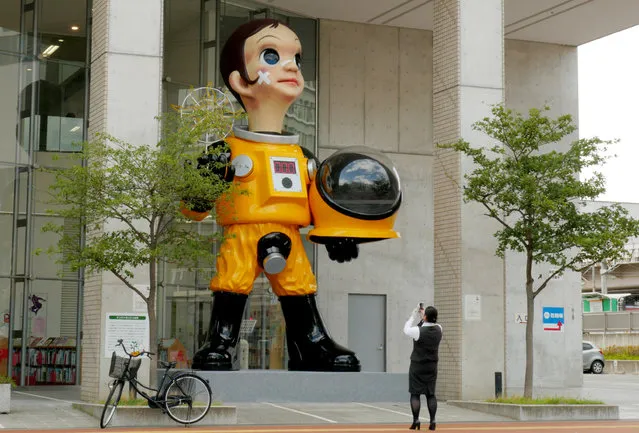
A woman takes a picture of a statue of a child wearing what appears to be a hazardous material suit in Fukushima, Japan on August 14, 2018. (Photo by Kwiyeon Ha/Reuters)
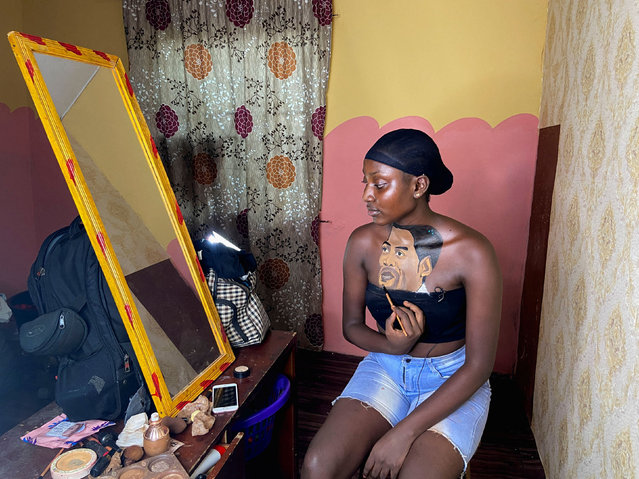
Nigerian make-up artist, Mary Oni, creates artwork on her chest using make-up, in her home in Lagos, Nigeria on January 26, 2022. (Photo by Seun Sanni/Reuters)
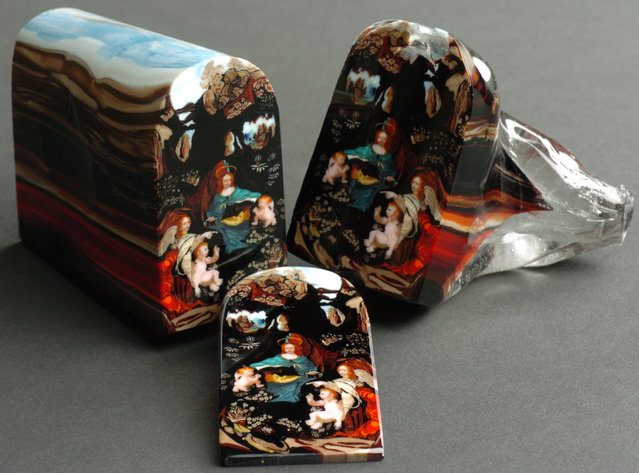
California-based glass artist Loren Stump specializes in a form of glasswork called murrine, where rods of glass are melted together and then sliced to reveal elaborate patterns and forms. While the murrina process appeared in the Mideast some 4,000 years ago, Stump has perfected his own technique over the past 35 years to the point where he can now layer entire portraits and paintings in glass before slicing them to see the final results. His most complex piece to date is a detailed interpretation of Leonardo da Vinci’s Virgin of the Rocks, which involved hundreds of glass components that were melted into a final piece.
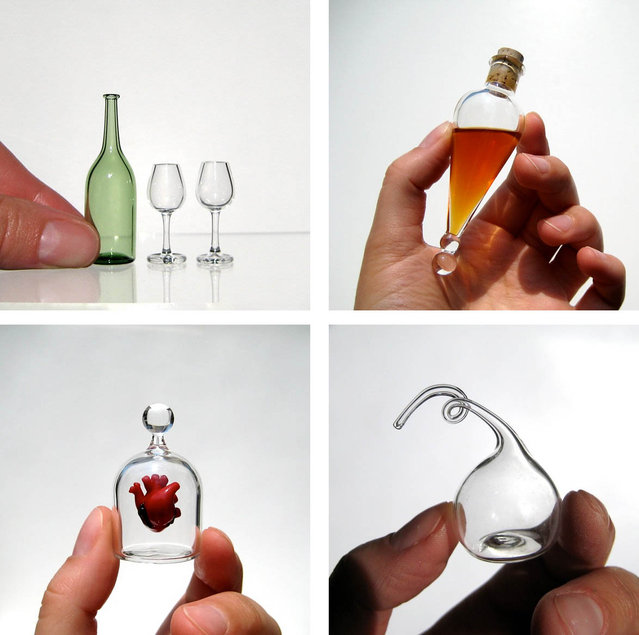
Glass artist Kiva Ford draws from his vast experience in scientific glassblowing to create perfect miniatures of wine glasses, beakers, and ribbon-striped vases, some scarcely an inch tall. A member of the American Scientific Glassblowers Society, Kiva creates instruments for scientists who require one-of-a-kind designs for various experiments. The same techniques and tools used for scientific equipment also apply to his artistic practice including the miniature works you see here, as well as larger sculptures, and ornate drinkware.