Loading...
Done
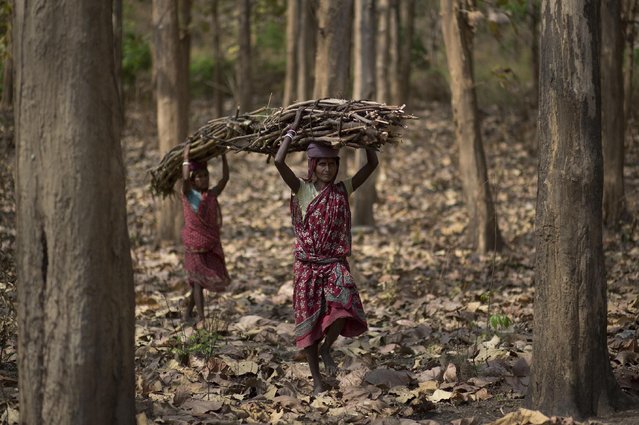
In this Tuesday, March 31, 2015 photo, Indian women walk carrying firewood they collected from a forest at Gobhali village on the outskirts of Gauhati, India. Every evening, hundreds of millions of Indian women hover over crude stoves making dinner for their families. They feed the flames with polluting fuels like kerosene or cow dung, and breathe the acrid smoke wafting from the fires. (Photo by Anupam Nath/AP Photo)

In this Tuesday, March 31, 2015 photo, Indian women walk carrying firewood they collected from a forest at Gobhali village on the outskirts of Gauhati, India. Every evening, hundreds of millions of Indian women hover over crude stoves making dinner for their families. They feed the flames with polluting fuels like kerosene or cow dung, and breathe the acrid smoke wafting from the fires. (Photo by Anupam Nath/AP Photo)
Details
16 Apr 2015 12:29:00
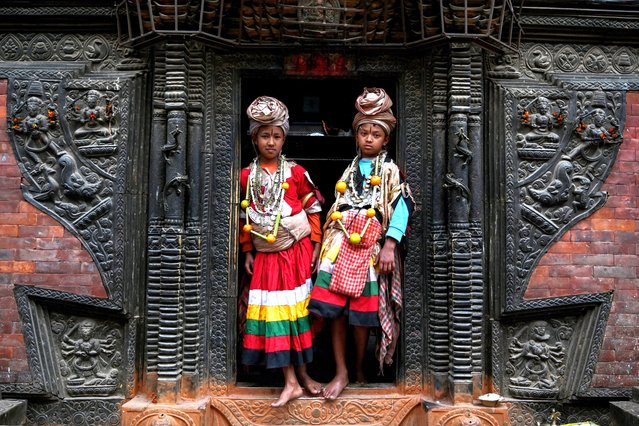
Traditional dancers with their masks look on before their performance during “Nawa Durga Nach” Hindu dance festival in Bhaktapur on the outskirts of Kathmandu on March 28, 2024. (Photo by Prakash Mathema/AFP Photo)

Traditional dancers with their masks look on before their performance during “Nawa Durga Nach” Hindu dance festival in Bhaktapur on the outskirts of Kathmandu on March 28, 2024. (Photo by Prakash Mathema/AFP Photo)
Details
08 Jun 2024 02:47:00
A member of the mainly Christian “anti-balaka” (anti-machete) militia trains in the Boeing neighbourhood of Bangui, Central African Republic, on February 24, 2014. (Photo by Fred Dufour/AFP Photo)

A member of the mainly Christian “anti-balaka” (anti-machete) militia trains in the Boeing neighbourhood of Bangui, Central African Republic, on February 24, 2014. (Photo by Fred Dufour/AFP Photo)
Details
01 Mar 2014 12:48:00
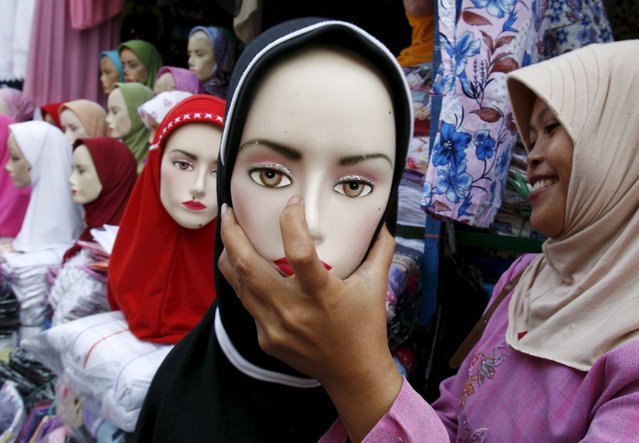
An Indonesian vendor fixes a headscarf on a mannequin at a market in Jakarta in this December 21, 2006 file photo. (Photo by Reuters/Beawiharta)

An Indonesian vendor fixes a headscarf on a mannequin at a market in Jakarta in this December 21, 2006 file photo. (Photo by Reuters/Beawiharta)
Details
23 May 2016 10:03:00
“Woman with Umbrella in Rain” by Raimund von Stillfried. Artist: Kusakabe Kimbei (Japanese, 1841–1934), 1870s. (Photo courtesy of The Metropolitan Museum of Art)

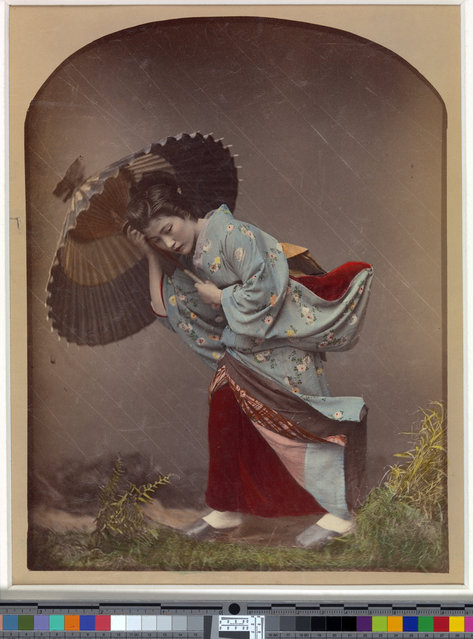
“Woman with Umbrella in Rain” by Raimund von Stillfried. Artist: Kusakabe Kimbei (Japanese, 1841–1934), 1870s. Commercial photography studios in Meiji-era Japan were renowned for the subtlety and refinement of their coloring techniques. This hand-tinted image of a young woman caught in a heavy rainstorm achieved its naturalistic effect by knitting together multiple strands of artifice: the greenery in the foreground was a studio prop; the flaps of the kimono were suspended by thin wires to create the impression of a strong wind; and long, diagonal marks were made on the negative to suggest streaks of rain. (Photo courtesy of The Metropolitan Museum of Art)
Details
12 May 2013 10:13:00
Each of them appears caught in contemplation or ennui as everyday life goes on around them. (Photo by Alec Dawson)

In his series of untitled photographs Nobody Claps Anymore, the Mexican-American photographer Alec Dawson portrays ordinary people in their homes in a downbeat, ultra-stylised manner. Staring into space as they watch TV or water the garden, the real-life subjects of photographer hint at vast reserves of boredom and regret. (Photo by Alec Dawson)
Details
26 Mar 2016 12:53:00
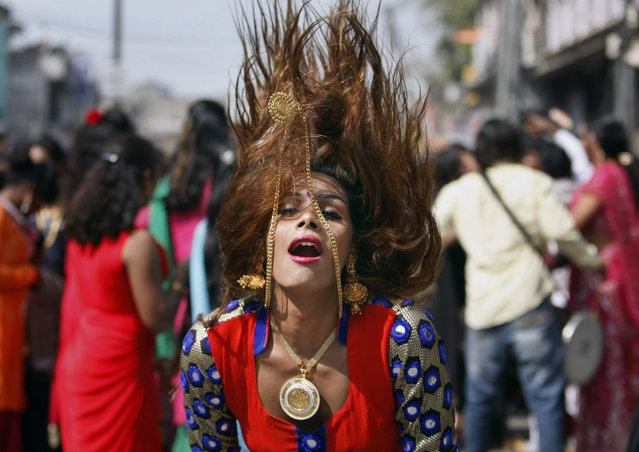
A eunuch dances during a rally to mark the congregation of thousands of eunuchs from different parts of India, in Jammu, India, Friday, March 13, 2015. The term eunuchs is used in India to describe transvestites, transsexuals and others who identify themselves as neither male nor female but as a member of a third gender. They traditionally survive by begging, dancing at weddings or blessing newborn babies and are frequently subjected to discrimination. (Photo by Channi Anand/AP Photo)

A eunuch dances during a rally to mark the congregation of thousands of eunuchs from different parts of India, in Jammu, India, Friday, March 13, 2015. The term eunuchs is used in India to describe transvestites, transsexuals and others who identify themselves as neither male nor female but as a member of a third gender. They traditionally survive by begging, dancing at weddings or blessing newborn babies and are frequently subjected to discrimination. (Photo by Channi Anand/AP Photo)
Details
21 Mar 2015 12:33:00
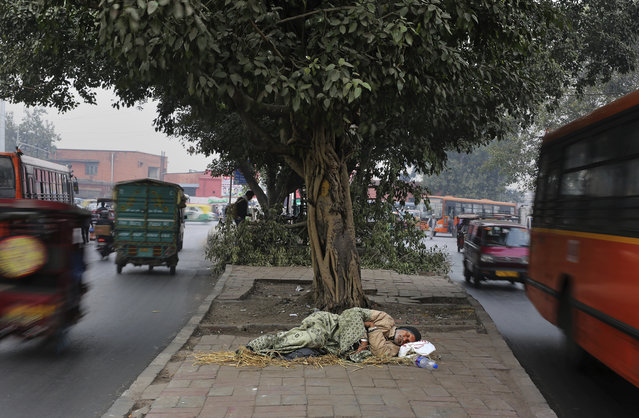
In this January 16, 2019, file photo, a homeless man sleeps on a median strip in New Delhi, India. In India, some 270 million people – nearly 22 percent of the country's population – live in poverty, making giveaways particularly attractive to voters. The Modi government in its interim budget in January announced farmers would be paid 6,000 rupees ($85) annually, benefiting as many as 120 million households and income tax relief to the middle class. (Photo by Altaf Qadri/AP Photo/File)

In this January 16, 2019, file photo, a homeless man sleeps on a median strip in New Delhi, India. In India, some 270 million people – nearly 22 percent of the country's population – live in poverty, making giveaways particularly attractive to voters. The Modi government in its interim budget in January announced farmers would be paid 6,000 rupees ($85) annually, benefiting as many as 120 million households and income tax relief to the middle class. (Photo by Altaf Qadri/AP Photo/File)
Details
09 May 2019 00:03:00