Loading...
Done
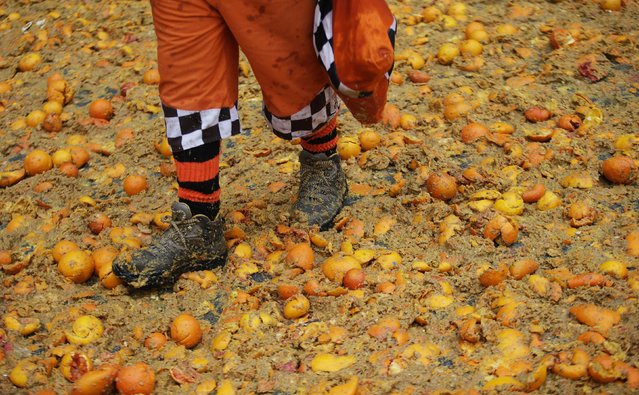
A member of a rival team walks during an annual carnival battle with oranges in the northern Italian town of Ivrea February 15, 2015. Dressed up as Middle Age kings' guards, a group of men ride in a horse-drawn carriage and pelt “foot soldiers” with oranges as thousands of people gather to re-enact a Middle Age battle when the townsfolk of Ivrea overthrew an evil king. (Photo by Max Rossi/Reuters)

A member of a rival team walks during an annual carnival battle with oranges in the northern Italian town of Ivrea February 15, 2015. Dressed up as Middle Age kings' guards, a group of men ride in a horse-drawn carriage and pelt “foot soldiers” with oranges as thousands of people gather to re-enact a Middle Age battle when the townsfolk of Ivrea overthrew an evil king. In a strange twist, instead of swords and cross bows, these days the weapons of choice are oranges. (Photo by Max Rossi/Reuters)
Details
16 Feb 2015 13:06:00
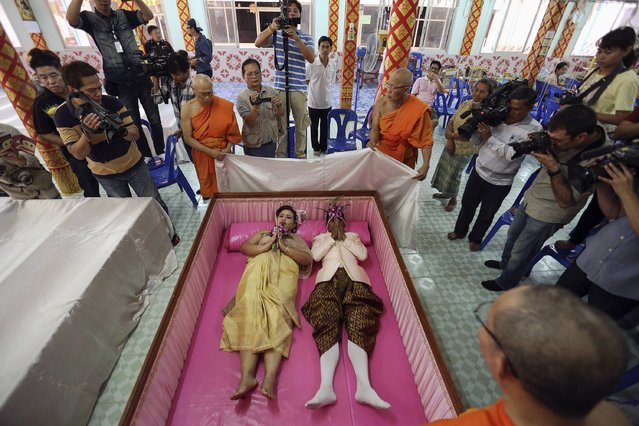
People take pictures and Buddhist monk chants as a groom and a bride lay inside a pink coffin during their wedding ceremony at Wat Takien temple in Nonthaburi province, on the outskirts of Bangkok February 14, 2015. (Photo by Damir Sagolj/Reuters)

People take pictures and Buddhist monk chants as a groom and a bride lay inside a pink coffin during their wedding ceremony at Wat Takien temple in Nonthaburi province, on the outskirts of Bangkok February 14, 2015. Ten Thai couples laid in the pink coffin starting 9:09 AM on Saturday during the wedding ceremony organised by the Buddhist temple on Valentine's Day. Couples believe laying briefly in the coffin will get rid of bad luck and usher happiness into their lives. (Photo by Damir Sagolj/Reuters)
Details
16 Feb 2015 13:36:00
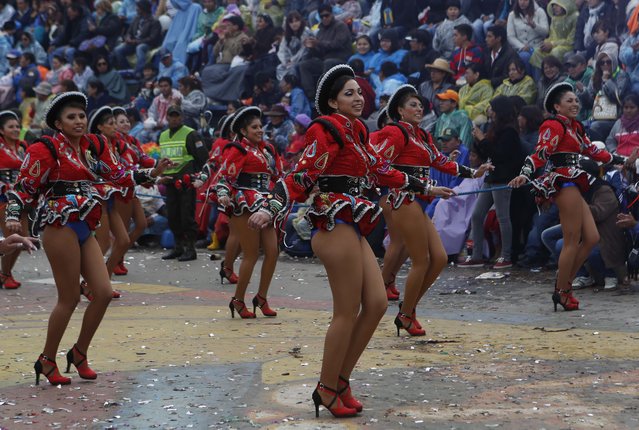
Caporal dancers perform during the carnival celebrations in Oruro, Bolivia, Saturday February 14, 2015. The Carnival of Oruro which is a religious festival dating back more than 2000 years in an ongoing pagan-catholic blend of religious practice in the region, and is one of UNESCO's Masterpieces of the Oral and Intangible Heritage of Humanity. (Photo by Juan Karita/AP Photo)

Caporal dancers perform during the carnival celebrations in Oruro, Bolivia, Saturday February 14, 2015. The Carnival of Oruro which is a religious festival dating back more than 2000 years in an ongoing pagan-catholic blend of religious practice in the region, and is one of UNESCO's Masterpieces of the Oral and Intangible Heritage of Humanity. (Photo by Juan Karita/AP Photo)
Details
17 Feb 2015 12:25:00
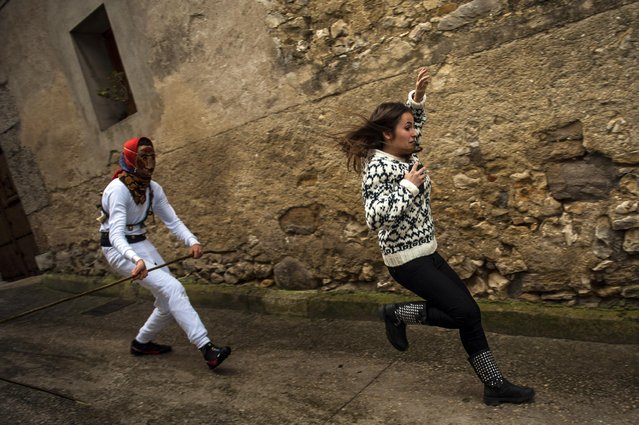
In this photo taken on Sunday, February 15, 2015 a girl runs away from a “Mamuxarro” during the carnival, in the small town of Unanu, northern Spain. While Rio de Janeiro may boast the world’s most famous carnival, the festive period of masquerades and wild and colorful costumes that precedes the Christian religious season of Lent is also a permanent and popular fixture for celebration in Spain and Portugal, with each country having its own strange and unique way of doing it. (Photo by Alvaro Barrientos/AP Photo)

In this photo taken on Sunday, February 15, 2015 a girl runs away from a “Mamuxarro” during the carnival, in the small town of Unanu, northern Spain. In the northern Spanish ancient village of Unamu, people dress up as “Mamuxarro”, folkloric figures in white with a red sash and a metal mask to cover their faces as they pursue townsfolk with sticks. According to custom, their “victims” (usually young women) must kneel and kiss the mamuxarro’s knee after he makes the sign of the cross on their forehead. (Photo by Alvaro Barrientos/AP Photo)
Details
22 Feb 2015 10:51:00
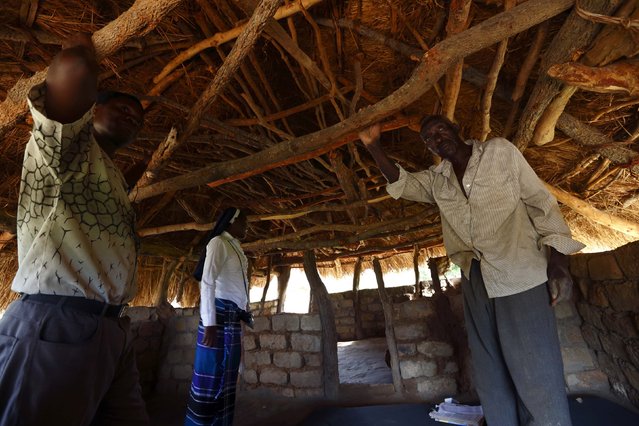
HIV-positive 71-year-old Sylverio Hachiploa (R) talks with caregivers Glandwel Muleya (L) and Sister Abigail Mwaka Mazuba (C) in his thatched hut during a visit by a home-based care team in the village of Nedwmba, south of the Chikuni Mission in the south of Zambia February 23, 2015. (Photo by Darrin Zammit Lupi/Reuters)

HIV-positive 71-year-old Sylverio Hachiploa (R) talks with caregivers Glandwel Muleya (L) and Sister Abigail Mwaka Mazuba (C) in his thatched hut during a visit by a home-based care team in the village of Nedwmba, south of the Chikuni Mission in the south of Zambia February 23, 2015. The caregivers in the Jesuit-run home-based care project at the Chikuni Mission run a capacity-building and empowerment project at the household level, offering training and assistance in crop-growing and animal rearing, as well as offering companionship, pastoral care and monitoring of the antiretroviral treatment compliance of HIV-AIDS patients. (Photo by Darrin Zammit Lupi/Reuters)
Details
25 Feb 2015 09:04:00
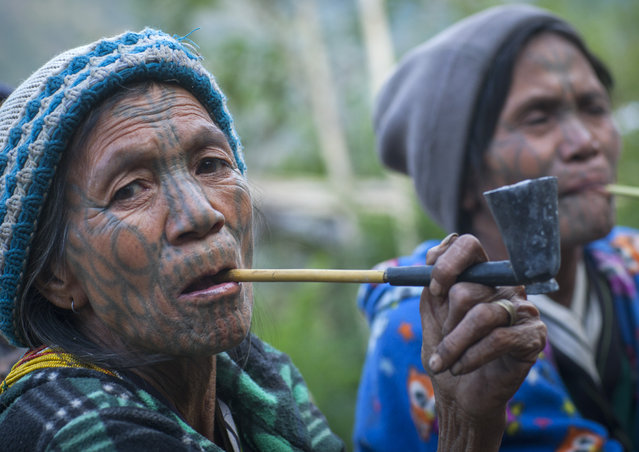
A group of tattooed women from the Muun tribe who inhabit the hills of the Arakan state. The design, known as the letter B-pattern, is common in the Mindat area. It is composed of dots, lines and occasionally circles, in February, 2015, in Myanmar, Burma. (Photo by Eric Lafforgue/Barcroft Media)

A group of tattooed women from the Muun tribe who inhabit the hills of the Arakan state. The design, known as the letter B-pattern, is common in the Mindat area. It is composed of dots, lines and occasionally circles, in February, 2015, in Myanmar, Burma. With spider webs, B-patterns and crossed lines painstakingly inked on their faces these stunning photographs show the tattooed women of Burma. French photographer Eric Lafforgue travelled to the Chin, Rakhine and Arakan states of northwestern Myanmar to capture the rare facial designs. (Photo by Eric Lafforgue/Barcroft Media)
Details
16 Mar 2015 10:54:00
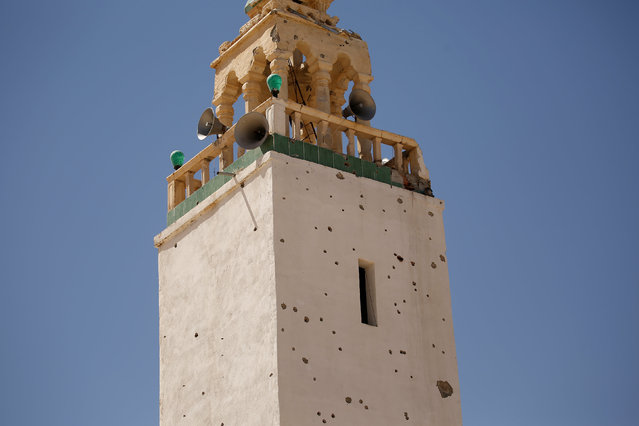
A minaret, that was damaged during fighting between Islamic State jihadists and government forces, is seen in Ben Guerdane, near the Libyan border, Tunisia April 10, 2016. After a U.S. air strike killed a Tunisian jihadist commander in western Libya in late February, dozens of Islamic State fighters sneaked across the border into Tunisia and attacked an army barracks and police bases in the town of Ben Guerdane. (Photo by Zohra Bensemra/Reuters)

A minaret, that was damaged during fighting between Islamic State jihadists and government forces, is seen in Ben Guerdane, near the Libyan border, Tunisia April 10, 2016. After a U.S. air strike killed a Tunisian jihadist commander in western Libya in late February, dozens of Islamic State fighters sneaked across the border into Tunisia and attacked an army barracks and police bases in the town of Ben Guerdane. (Photo by Zohra Bensemra/Reuters)
Details
26 May 2016 12:29:00
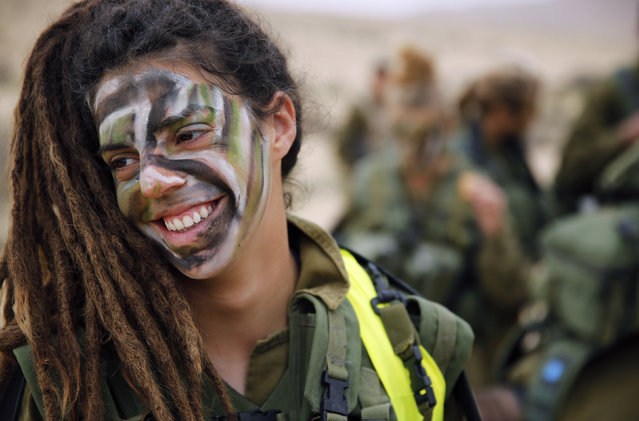
An Israeli soldier of the Caracal battalion smiles during a 23-kilometer march marking the end of their training in Israel's Negev desert, near Kibbutz Sde Boker February 14, 2013. The “Caracal” battalion, two-thirds of whose members are women, was established in 2004 with the purpose of incorporating female soldiers in combat units. The main mission of Caracal is routine patrols on Israel's border with Egypt to intercept infiltrators and smuggling from the Sinai desert. (Photo by Darren Whiteside/Reuters)

An Israeli soldier of the Caracal battalion smiles during a 23-kilometer march marking the end of their training in Israel's Negev desert, near Kibbutz Sde Boker February 14, 2013. The “Caracal” battalion, two-thirds of whose members are women, was established in 2004 with the purpose of incorporating female soldiers in combat units. The main mission of Caracal is routine patrols on Israel's border with Egypt to intercept infiltrators and smuggling from the Sinai desert. (Photo by Darren Whiteside/Reuters)
Details
23 Sep 2014 13:22:00