Loading...
Done
Professor Xie Yong works on an art installation of a beaver, which is made out of plastic and around 300,000 needles, in Shenyang, Liaoning province, July 23, 2013. The needles, according to Xie, represent the pain felt by animals when their fur is taken off to produce clothing. (Photo by Reuters/Stringer)

Professor Xie Yong works on an art installation of a beaver, which is made out of plastic and around 300,000 needles, in Shenyang, Liaoning province, July 23, 2013. The needles, according to Xie, represent the pain felt by animals when their fur is taken off to produce clothing. (Photo by Reuters/Stringer)
Details
27 Jul 2013 09:15:00
US actress Tiffany Haddish attends a photocall for the film “The Card Counter” presented in competition during the 78th Venice Film Festival, on September 2, 2021 at Venice Lido. (Photo by Yara Nardi/Reuters)

US actress Tiffany Haddish attends a photocall for the film “The Card Counter” presented in competition during the 78th Venice Film Festival, on September 2, 2021 at Venice Lido. (Photo by Yara Nardi/Reuters)
Details
12 Sep 2021 06:55:00
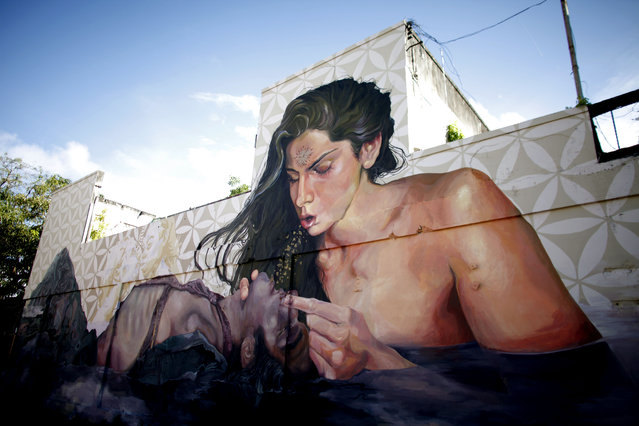
This September 22, 2014 photo, shows a building with street art murals in the Santurce neighborhood in San Juan, Puerto Rico. (Photo by Ricardo Arduengo/AP Photo)

This September 22, 2014 photo, shows a building with street art murals in the Santurce neighborhood in San Juan, Puerto Rico. (Photo by Ricardo Arduengo/AP Photo)
Details
30 Sep 2014 08:53:00
Nigerians take a photo in their traditional clothes during Eid al-Fitr prayers in Lagos, Nigeria on May 2, 2022. Muslims gather to perform Eid al-Fitr prayers held in Nigeria, the country with the largest Muslim population in Africa. (Photo by Adeyinka Yusuf/Anadolu Agency via Getty Images)

Nigerians take a photo in their traditional clothes during Eid al-Fitr prayers in Lagos, Nigeria on May 2, 2022. Muslims gather to perform Eid al-Fitr prayers held in Nigeria, the country with the largest Muslim population in Africa. (Photo by Adeyinka Yusuf/Anadolu Agency via Getty Images)
Details
22 May 2022 04:20:00
Takeoka Chisaka, Hiroshima, Japan. “One morning in August 1945, I was walking home from the night shift at a factory in Hiroshima. As I reached my door, there was a huge explosion. When I came to, my head was bleeding and I had been blasted 30m away”. (Photo and caption by Sasha Maslov)

Takeoka Chisaka, Hiroshima, Japan. “One morning in August 1945, I was walking home from the night shift at a factory in Hiroshima. As I reached my door, there was a huge explosion. When I came to, my head was bleeding and I had been blasted 30m away. The atomic bomb had detonated. When I found my mother, her eyes were badly burned. A doctor said they had to come out, but he didn’t have the proper tools so used a knife instead. It was hellish. I became a peace-worker after the war. In the 1960s, at a meeting at the UN, I met one of the people who created the atomic bomb. He apologised”. (Photo and caption by Sasha Maslov)
Details
11 May 2015 11:56:00
Spectators pose for a selfie before the running of the Melbourne Cup at the Flemington Racecourse in Melbourne, Australia, Tuesday, November 6, 2018. (Photo by Andy Brownbill/AP Photo)

Spectators pose for a selfie before the running of the Melbourne Cup at the Flemington Racecourse in Melbourne, Australia, Tuesday, November 6, 2018. (Photo by Andy Brownbill/AP Photo)
Details
06 Nov 2018 09:50:00
A racegoers cheers on her horse in Race 4 ahead of the race of the Melbourne Cup at Flemington Racecourse in Melbourne, Australia, Tuesday, November 7, 2017. (Photo by Andy Brownbill/AP Photo)

A racegoers cheers on her horse in Race 4 ahead of the race of the Melbourne Cup at Flemington Racecourse in Melbourne, Australia, Tuesday, November 7, 2017. (Photo by Andy Brownbill/AP Photo)
Details
07 Nov 2017 08:17:00
At the Krasnopresnenskaya station, the benches come from the Cathedral of Christ-Sauveur, which was built from 1839 to 1883 in memory of the victory of Russia against the army of Napoleon I. The cathedral was destroyed under Stalin in 1931, but the benches remained intact. Metro architects decided to install them in some stations. (Photo by Didier Bizet/The Washington Post)

At the Krasnopresnenskaya station, the benches come from the Cathedral of Christ-Sauveur, which was built from 1839 to 1883 in memory of the victory of Russia against the army of Napoleon I. The cathedral was destroyed under Stalin in 1931, but the benches remained intact. Metro architects decided to install them in some stations. (Photo by Didier Bizet/The Washington Post)
Details
24 Jan 2018 06:23:00