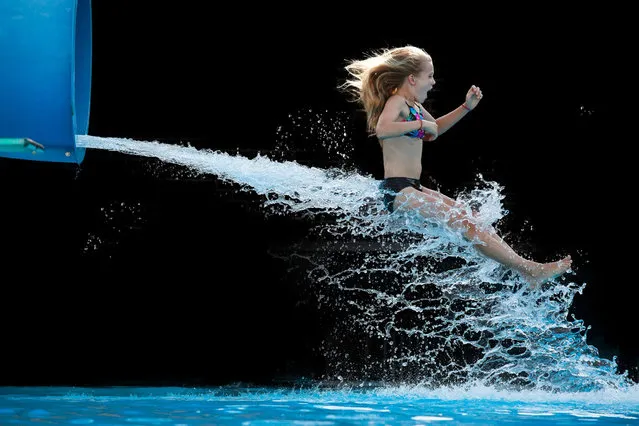
Krista Long began snapping pics of people sliding down a water slide after many visits to the local water park with her tween daughters. The result is an action-packed series that show emotions ranging, she says, “from pure joy to fear, in anticipation of the inevitable splash-down!” (Photo by Krista Long)
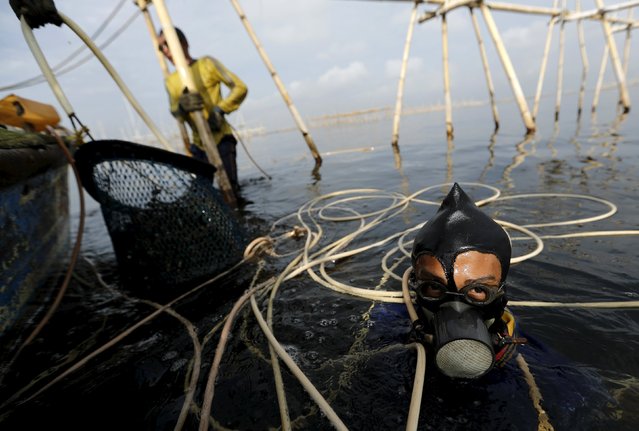
Eghy (L) uses his makeshift snorkel as his colleague lifts up green mussels to their boat in Jakarta Bay, Indonesia, April 20, 2016. (Photo by Reuters/Beawiharta)
A protester holds a poster displaying the message “Get away UK” during an anti-British demonstration in the Iranian capital that resulted in a break in at the British Embassy on November 29, 2011 in Tehran, Iran. (Photo by FarsNews/Getty Images)
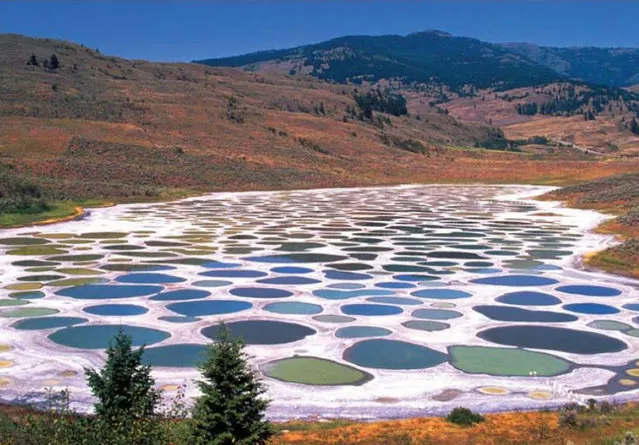
Originally known to the First Nations of the Okanagan Valley as Khiluk, which was- and remains today revered as a sacred site producing therapeutic waters. During World War I the minerals of Spotted Lake were used in manufacturing ammunition. Later the area came under the control of the Ernest Smith Family, for a term of about 40 years. In 1979 Smith attempted to create interest in a spa at the lake. The First Nations responded with an effort to buy the lake; in October 2001 they finally struck a deal. First Nations arranged the purchase of 22 hectares of land for a total of $720,000, and contributed about 20% of the cost. The Indian Affairs Department paid the remainder.
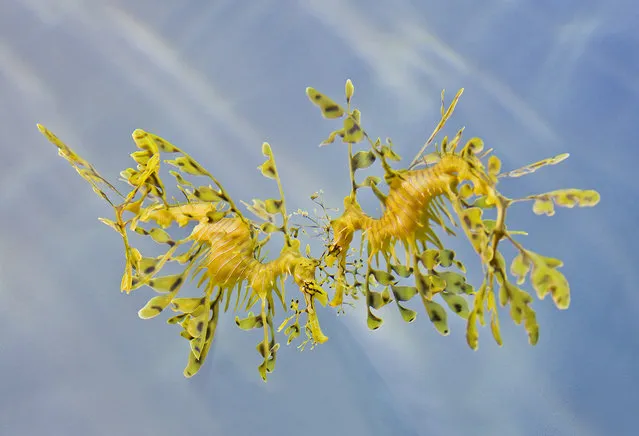
The leafy seadragon or Glauert's seadragon, Phycodurus eques, is a marine fish in the family Syngnathidae, which also includes the seahorses. It is the only member of the genus Phycodurus. It is found along the southern and western coasts of Australia. The name is derived from the appearance, with long leaf-like protrusions coming from all over the body. These protrusions are not used for propulsion; they serve only as camouflage. The leafy seadragon propels itself by means of a pectoral fin on the ridge of its neck and a dorsal fin on its back closer to the tail end. These small fins are almost completely transparent and difficult to see as they undulate minutely to move the creature sedately through the water, completing the illusion of floating seaweed.
French photographers Metra Bruno and Laurence Jeanson have created a series of portraits of people who look like they have had cosmetic surgery. But in fact they applied sticky pieces of magazine photos on the faces of their models