Loading...
Done
A child reacts as a family takes a break next to a cooling mist at the Sensoji temple as Japanese government issued heat stroke alerts in 39 of the country's 47 prefectures in Tokyo, Japan on July 22, 2024. (Photo by Issei Kato/Reuters)

A child reacts as a family takes a break next to a cooling mist at the Sensoji temple as Japanese government issued heat stroke alerts in 39 of the country's 47 prefectures in Tokyo, Japan on July 22, 2024. (Photo by Issei Kato/Reuters)
Details
29 Jul 2024 03:37:00
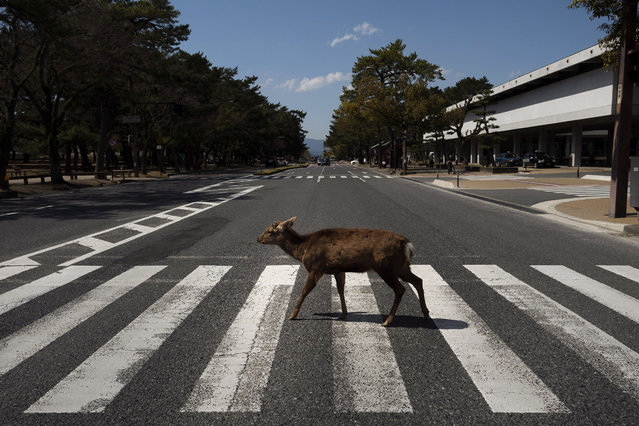
A deer walks across a pedestrian crossing in Nara, Japan, Thursday, March 19, 2020. More than 1,000 deer roam free in the ancient capital city of Japan. Despite the town's tourism decline, these wild animals are doing just fine without treats from tourists, according to a deer protection group. (Photo by Jae C. Hong/AP Photo)

A deer walks across a pedestrian crossing in Nara, Japan, Thursday, March 19, 2020. More than 1,000 deer roam free in the ancient capital city of Japan. Despite the town's tourism decline, these wild animals are doing just fine without treats from tourists, according to a deer protection group. (Photo by Jae C. Hong/AP Photo)
Details
31 Mar 2020 00:01:00
A performer wearing a lion mask performs the Ise Daikagura lion dance at the remote village of Yamanawa on February 08, 2021 in Ryuo, Japan. Ise Daikagura is a group of traditional Lion Dance performers who pray in front of farmers houses and businesses for good grain harvests and disease-free lives. Performers play sacred music using drums and flutes with two lion mask dancers. A lion mask is considered a symbol of God, who enters the house and performs in front of the Shinto God, a statue placed inside the house, mostly in the kitchen. These prayers are called “Kamodo Barai”. After the prayers, they are gifted with money, rice, sake and Japanese sweets from the householders. A group can travel for more than one hundred days to thousands of households and businesses throughout rural-villages in western Japan, and pray to those who are unable to visit the country’s most sacred shrine, the Grand Ise Shrine in Mie Prefecture. The group started its performance in the Edo era between 1603 to 1868 according to Japanese history. The Japanese government designated it as an important folk cultural national property in 1981. (Photo by Buddhika Weerasinghe/Getty Images)

A performer wearing a lion mask performs the Ise Daikagura lion dance at the remote village of Yamanawa on February 08, 2021 in Ryuo, Japan. Ise Daikagura is a group of traditional Lion Dance performers who pray in front of farmers houses and businesses for good grain harvests and disease-free lives. (Photo by Buddhika Weerasinghe/Getty Images)
Details
18 Feb 2021 09:27:00
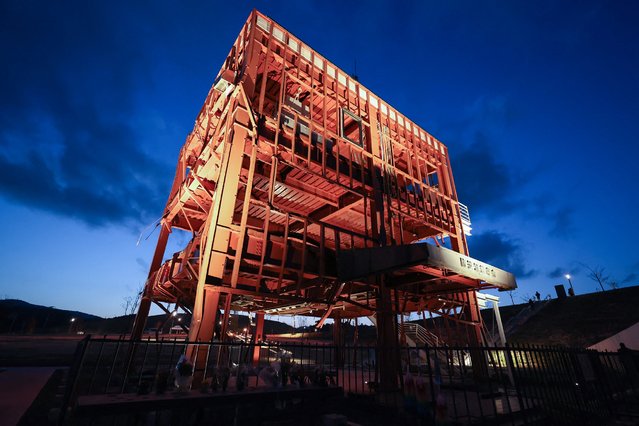
This photo taken on March 10, 2025 shows the former disaster prevention office building in Minamisanriku Town, Miyagi Prefecture, lit up on the eve of the 14th anniversary of the 2011 earthquake and tsunami disaster. (Photo by JIJI Press/AFP Photo)

This photo taken on March 10, 2025 shows the former disaster prevention office building in Minamisanriku Town, Miyagi Prefecture, lit up on the eve of the 14th anniversary of the 2011 earthquake and tsunami disaster. (Photo by JIJI Press/AFP Photo)
Details
14 Apr 2025 03:54:00


Neil Tuckett and Jamie Davidson, begin their attempt to drive a 1911 Model T Ford to the top of Ben Nevis on May 16,2011 in Fort William, Scotland. The challenge has been organised in memory of a pioneering Edinburgh car dealer Henry Alexander, who drove to the top of Ben Nevis to prove the ruggedness of the Model T. The original accent took five days with the route leading over boulders and through snow drifts. (Photo by Jeff J Mitchell/Getty Images)
Details
17 May 2011 06:06:00
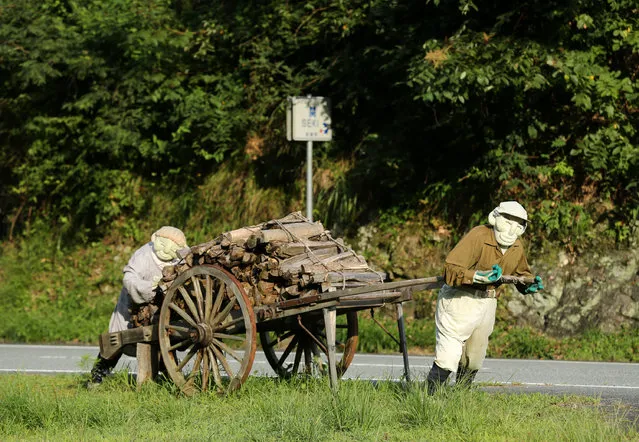
An illustration showing scarecrows pulling a firewood cart beside a road is on display at Kakashi no Sato, or the Scarecrow's Hometown on September 10, 2014 in Himeji, Japan. (Photo by Buddhika Weerasinghe/Getty Images)

An illustration showing scarecrows pulling a firewood cart beside a road is on display at Kakashi no Sato, or the Scarecrow's Hometown on September 10, 2014 in Himeji, Japan. In this district of Yasutomi in Himeji city, over 100 of scarecrows stand in farmlands and abandoned houses to illustrate the good old Japanese countryside and attract visitors. (Photo by Buddhika Weerasinghe/Getty Images)
Details
15 Sep 2014 10:37:00
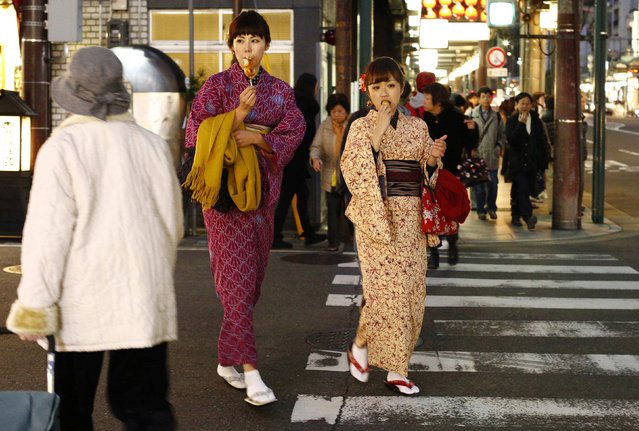
Women, dressed in traditional Japanese kimonos, cross a street in Kyoto, western Japan November 19, 2014. (Photo by Thomas Peter/Reuters)

Women, dressed in traditional Japanese kimonos, cross a street in Kyoto, western Japan November 19, 2014. (Photo by Thomas Peter/Reuters)
Details
20 Nov 2014 12:25:00
“A nocturnal Tokyo, Shinagawa”. (Satoshi Ohki)

“A nocturnal Tokyo, Shinagawa”. (Photo by Satoshi Ohki)
Details
31 May 2013 12:20:00