Loading...
Done
Shamila, 15, from an internally displaced family, adjusts her wedding dress in an old mud house yard, on her wedding day, on the outskirts of Kabul, Afghanistan, Friday, May 19, 2023. “I have no choice. If I don’t accept, my family will be hurt”, she says. Due to poverty and debt, her father had to marry her to a boy at a young age. Her father said that if I did not do this, I might have to give my daughter to someone that I owe. Now, with the money I received from the boy's family, I can pay my debt and treat my son. (Photo by Ebrahim Noroozi/AP Photo)

Shamila, 15, from an internally displaced family, adjusts her wedding dress in an old mud house yard, on her wedding day, on the outskirts of Kabul, Afghanistan, Friday, May 19, 2023. “I have no choice. If I don’t accept, my family will be hurt”, she says. Due to poverty and debt, her father had to marry her to a boy at a young age. Her father said that if I did not do this, I might have to give my daughter to someone that I owe. Now, with the money I received from the boy's family, I can pay my debt and treat my son. (Photo by Ebrahim Noroozi/AP Photo)
Details
12 Jan 2024 18:46:00
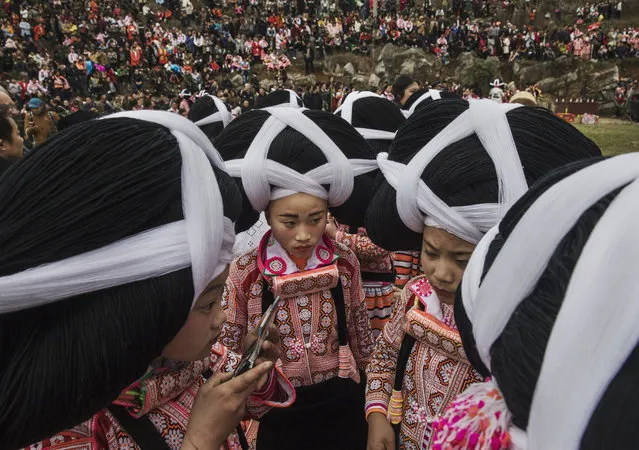
Girls of the Long Horn Miao ethnic minority group wear headdresses as they prepare gather for Tiaohua or Flower Festival as part of the Lunar New Year on February 6, 2017 in Longga village, Guizhou province, southern China. The Long Horn Miao are recognized for their declining practice of wrapping a blend of linen, wool, and the hair of their ancestors around animal horns or a wooden clip to make headdresses. Many young women say they now wear the headdresses only for special occasions and festivals, as the ornaments, which are attached by the horns to their real hair, have proved impractical for modern daily life in a fast changing world. China officially recognizes 56 different ethnic minorities, and statistics show over 7 million Chinese identifying themselves as Miao. But the small Long Horn Miao community counts only around 5000 people living in 12 villages, whose age-old traditions, language, and culture are fading. It is increasingly difficult in a modernizing China, as young people are drawn from remote rural villages to opportunities in bigger cities amongst wide-scale urbanization. Farming and labour remain the mainstays of life for the Long Horn Miao, leaving the area relatively poor in comparison with many parts of China. The government has invested significant amounts into local infrastructure and the tourism industry to try to bolster the local economy. (Photo by Kevin Frayer/Getty Images)

Girls of the Long Horn Miao ethnic minority group wear headdresses as they prepare gather for Tiaohua or Flower Festival as part of the Lunar New Year on February 6, 2017 in Longga village, Guizhou province, southern China. (Photo by Kevin Frayer/Getty Images)
Details
13 Feb 2017 00:01:00
Olive Ridley turtle hatchlings (Lepidochelys olivacea) sit in baskets and trays at the turtle camp La Gloria, before their release into the ocean in Tomatlan November 15, 2013. (Photo by Alejandro Acosta/Reuters)

Olive Ridley turtle hatchlings (Lepidochelys olivacea) sit in baskets and trays at the turtle camp La Gloria, before their release into the ocean in Tomatlan November 15, 2013. Twenty years ago, Mexico's government implemented ecological plans to protect the sea turtles from being hunted for their leather and meat and established conservation areas and a pay system for local residents to protect turtle nests. Millions of baby turtles hatch on the shores in November and December, according to an environmental group. It is estimated that in 2012, there were 20 million newborns. Hatching season is still underway, but officials say they expect there will be even more turtles born this year. (Photo by Alejandro Acosta/Reuters)
Details
25 Nov 2013 08:54:00
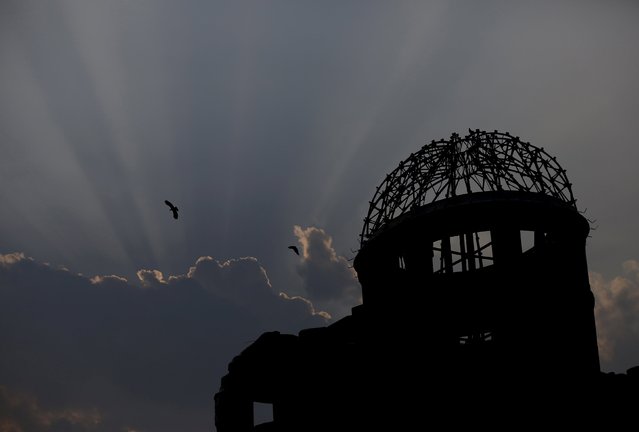
Birds fly over the Atomic Bomb Dome in Hiroshima, western Japan July 29, 2015. On August 6, 1945, the U.S. dropped the atomic bomb on Hiroshima, killing about 140,000 by the end of the year in a city of 350,000 residents, in the world's first nuclear attack. (Photo by Issei Kato/Reuters)

Birds fly over the Atomic Bomb Dome in Hiroshima, western Japan July 29, 2015. On August 6, 1945, the U.S. dropped the atomic bomb on Hiroshima, killing about 140,000 by the end of the year in a city of 350,000 residents, in the world's first nuclear attack. Three days later, a second atomic bomb was dropped on Nagasaki. Influenced by the shadows scorched into outdoor surfaces by the heat of the blasts 70 years ago, Reuters photographer Issei Kato pays homage to survivors, residents and historic buildings in both cities in a personal project that captures the shadows of today. (Photo by Issei Kato/Reuters)
Details
04 Aug 2015 12:01:00
Traditional trumpeters perform during the durbar festival on the second day of Eid-al-Fitr celebrations in Nigeria's northern city of Kano, July 7, 2016. (Photo by Akintunde Akinleye/Reuters)

Traditional trumpeters perform during the durbar festival on the second day of Eid-al-Fitr celebrations in Nigeria's northern city of Kano, July 7, 2016. The Durbar festival begins with prayers, followed by a parade of the Emir and his entourage on horses, accompanied by music players, and ending at the Emir's palace. The Durbar festival had been in hausaland for more than 500 years. It was introduced by sarki muhammadu rumfa of kano in the late 14th century, as a way of demonstrating military power and skills before going to war. The festival is also an opportunity for local leaders to pay homage to emir throughout the jahi cheering. (Photo by Akintunde Akinleye/Reuters)
Details
09 Jul 2016 09:35:00
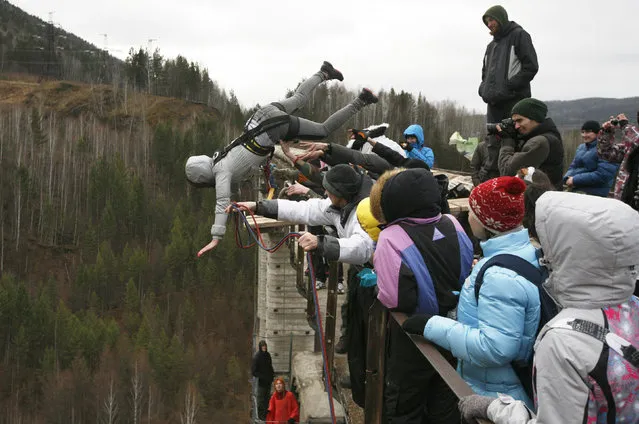
A member of the “Exit Point” amateur rope-jumping group jumps from a 44-metre high (144-ft) waterpipe bridge in the Siberian Taiga area outside Krasnoyarsk, November 3, 2013. (Photo by Ilya Naymushin/Reuters)

A member of the “Exit Point” amateur rope-jumping group jumps from a 44-metre high (144-ft) waterpipe bridge in the Siberian Taiga area outside Krasnoyarsk, November 3, 2013. Fans of rope-jumping, a kind of extreme sport involving a jump from a high point using an advanced leverage system combining mountaineering and rope safety equipment, marked the end of the group's jumping season and recent Halloween festivities. (Photo by Ilya Naymushin/Reuters)
Details
21 Apr 2014 09:57:00
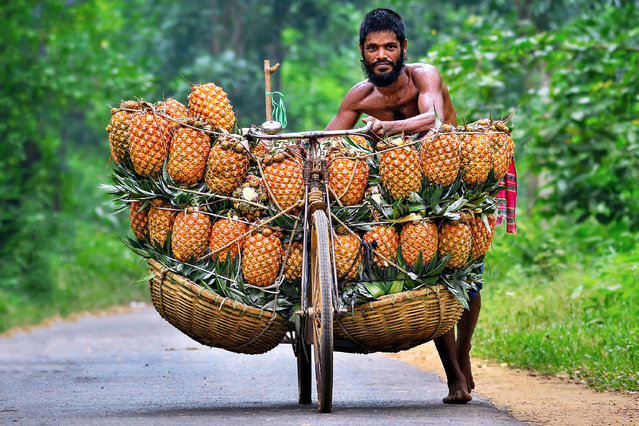
Cyclists desperately try to keep their heavily-laden bicycles upright as they arrive at a market with baskets full of pineapples on August 23, 2018. The men travel up to 12 and a half miles with two baskets tied to the sides of their bikes, carrying between 50 and 100 pineapples to sell. Each of the bicycles is so heavily laden with fruit it is impossible for the men to actually ride their bikes, instead having to walk alongside them. When they arrive at the market place in Madhupur, Bangladesh, buyers will pay up to 30 Taka for a pineapple – the equivalent of around 28 pence. (Photo by Abdul Momin/Solent News & Photo Agency UK)

Cyclists desperately try to keep their heavily-laden bicycles upright as they arrive at a market with baskets full of pineapples on August 23, 2018. The men travel up to 12 and a half miles with two baskets tied to the sides of their bikes, carrying between 50 and 100 pineapples to sell. Each of the bicycles is so heavily laden with fruit it is impossible for the men to actually ride their bikes, instead having to walk alongside them. When they arrive at the market place in Madhupur, Bangladesh, buyers will pay up to 30 Taka for a pineapple – the equivalent of around 28 pence. (Photo by Abdul Momin/Solent News & Photo Agency UK)
Details
21 Sep 2018 00:03:00
Takahiro Shito, 47, and his wife Sayomi Shito, 46, pray with their children Tomoka, 14, and Kenya 16, and their great uncle Akinori Takahashi, 76, as they pay respects to their daughter Chisato,12, buried in a nearby cemetery, victim of the Okowa Elementary School tragedy, who was killed during last year's tsunami on March 11, 2012 near Ishinomaki, Japan

Takahiro Shito, 47, and his wife Sayomi Shito, 46, pray with their children Tomoka, 14, and Kenya 16, and their great uncle Akinori Takahashi, 76, as they pay respects to their daughter Chisato,12, buried in a nearby cemetery, victim of the Okowa Elementary School tragedy, who was killed during last year's tsunami on March 11, 2012 near Ishinomaki, Japan. Teachers at the school weren't trained for tsunami evacuation and didn't to lead the children up the snow covered mountain behind the school after the tsunami warning was sounded. Out of 108 students at the school, 74 died and four remain missing; 10 of the school's 13 teachers were also killed. (Photo by Daniel Berehulak /Getty Images)
Details
11 Mar 2012 09:47:00