Loading...
Done
Roof-topping enthusiast Daniel Lau takes a selfie with high-rise buildings down below as he stands on the top of a skyscraper in Hong Kong, China on August 15, 2017. Welcome to “roof-topping”, where daredevils take pictures of themselves standing on the tops of tall buildings, or in some cases even dangling from them, without any safety equipment. A craze that began in Russia has now taken hold in Hong Kong, one of the world's most vertical cities, with dramatic results. “I'm an explorer”, said Daniel Lau, one of the three who climbed to the top of The Center. A student, he said roof-topping was “a getaway from my structured life”. “Before doing this, I lived like an ordinary person, having a boring life”, he said. “I wanted to do something special, something memorable. I want to let people see Hong Kong, the place they are living, from a new perspective”. Mr Lau said he had been inspired by Russian climbers and that he was unafraid of the vertiginous heights he scales. (Photo by ImagineChina/Rex Features/Shutterstock)

Roof-topping enthusiast Daniel Lau takes a selfie with high-rise buildings down below as he stands on the top of a skyscraper in Hong Kong, China on August 15, 2017. A craze that began in Russia has now taken hold in Hong Kong, one of the world's most vertical cities. Mr Lau said he had been inspired by Russian climbers and that he was unafraid of the vertiginous heights he scales. (Photo by ImagineChina/Rex Features/Shutterstock)
Details
16 Aug 2017 07:23:00
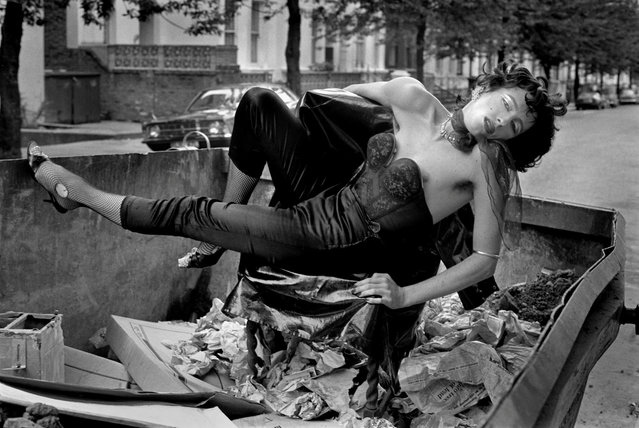
“A very delicate person, beneath the flamboyance”. Jasper, Ladbroke Grove, 1977. “In the 1970s, Australia was rather cut off. I’d always wanted to live abroad, so I moved to Rome and then London. I was an art historian, but started studying photography part-time. I was interested in the demi-monde culture and began mixing in all sorts of circles. Jasper was a rather wonderful character. He was from Sydney, but he was living downstairs from me in Ladbroke Grove, in a flat rented to some gay friends. It was fairly eclectic. Jasper was always playing around with clothes and makeup. If he was looking particularly wonderful, I might get out my lights and take a shot. Or he might put makeup on me. He wasn’t always in drag, but he was permanently in diva mode, dependably louche, funny and naughty. I think all that comes across in the image. He was actually a very delicate person, though, beneath the wit and flamboyance. Jasper floated through London all too briefly. His real name was Peter MacMahon, but to us he was only ever Jasper Havoc, an alter ego he’d created while part of a transvestite troupe called Sylvia and the Synthetics. They were legendary in Sydney gay culture. On this day, we’d been taking some pictures inside and had gone out into the streets to fool around some more. Jasper was wearing a corset and fishnets ensemble, with other bits and pieces, and we joked about him being trashy as he lay in the skip. We just took the shot for ourselves. It wasn’t done with any publication in mind, or anything else. This was way before the internet and people didn’t share images. If you dressed up, it was just for that moment”. (Photo by Jane England)

“A very delicate person, beneath the flamboyance”. Jasper, Ladbroke Grove, 1977. “In the 1970s, Australia was rather cut off. I’d always wanted to live abroad, so I moved to Rome and then London. I was an art historian, but started studying photography part-time. I was interested in the demi-monde culture and began mixing in all sorts of circles. Jasper was a rather wonderful character...”. (Photo by Jane England)
Details
26 Jun 2017 09:04:00
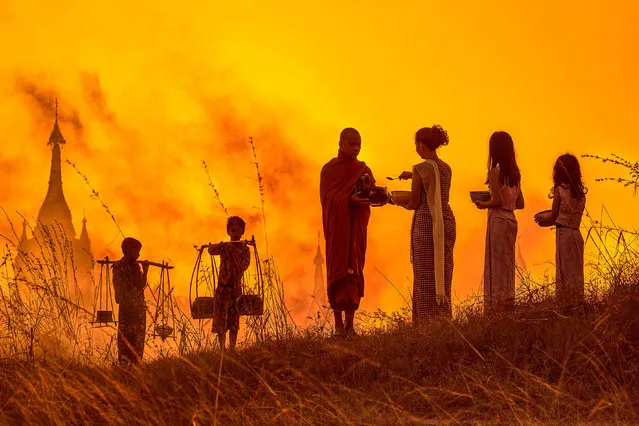
Family Donation by Si Thu Ye Myint (Myanmar, Winner). Myin Twin village in upper Myanmar. (Photo by Si Thu Ye Myint/Sony World Photography)

Family Donation by Si Thu Ye Myint (Myanmar, Winner). Myin Twin village in upper Myanmar. (Photo by Si Thu Ye Myint/Sony World Photography)
Details
28 Feb 2023 04:53:00
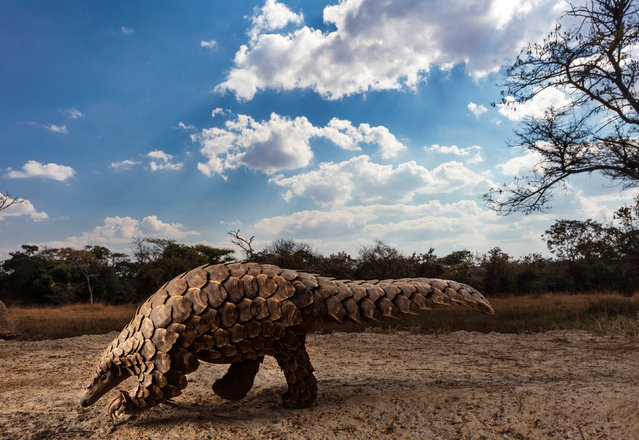
Pangolins in Crisis: Brent Stirton, South Africa; 1st place, Natural world and wildlife. “Pangolins are the world’s most illegally trafficked mammals, with an estimated one million trafficked to Asia in the last 10 years. Their scales are used in traditional Chinese and Vietnamese medicine, and their meat is sold as a high-priced delicacy. As a result, pangolins are listed as critically endangered and anyone who trades or consumes them is breaking the law. This body of work exposes the trade, while exploring aspects of illegality and celebrating the people who are trying to save these animals”. (Photo by Brent Stirton/Sony World Photography Awards 2020)

Pangolins in Crisis: Brent Stirton, South Africa; 1st place, Natural world and wildlife. “Pangolins are the world’s most illegally trafficked mammals, with an estimated one million trafficked to Asia in the last 10 years. Their scales are used in traditional Chinese and Vietnamese medicine, and their meat is sold as a high-priced delicacy. As a result, pangolins are listed as critically endangered and anyone who trades or consumes them is breaking the law. This body of work exposes the trade, while exploring aspects of illegality and celebrating the people who are trying to save these animals”. (Photo by Brent Stirton/Sony World Photography Awards 2020)
Details
11 Jun 2020 00:05:00
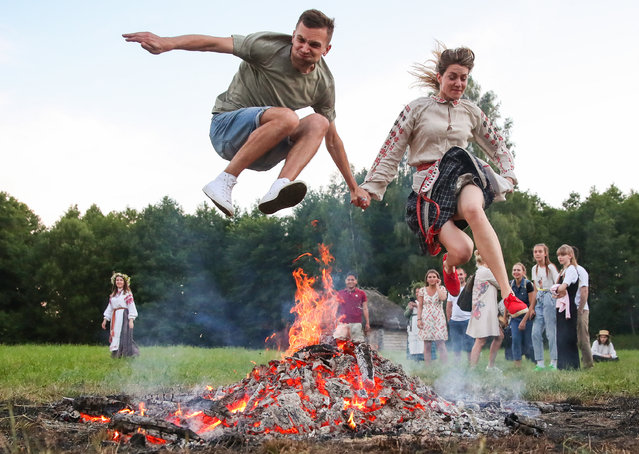
A man and a woman jump over a bonfire during Ivan Kupala Day celebrations held by the Belarusian State Museum of Folk Architecture and Rural Lifestyle in the village of Ozertso near Minsk, Belarus on July 4, 2020. Ivan Kupala Day, also known as Ivana-Kupala or Kupala Night, is a traditional pagan holiday celebrated in eastern Slavic cultures. Various rituals are traditionally performed on Kupala Night, including making flower wreaths, fortune-telling, jumping over bonfires, and burning a wheel-like effigy symbolizing the sun. (Photo by Natalia Fedosenko/TASS)

A man and a woman jump over a bonfire during Ivan Kupala Day celebrations held by the Belarusian State Museum of Folk Architecture and Rural Lifestyle in the village of Ozertso near Minsk, Belarus on July 4, 2020. Ivan Kupala Day, also known as Ivana-Kupala or Kupala Night, is a traditional pagan holiday celebrated in eastern Slavic cultures. Various rituals are traditionally performed on Kupala Night, including making flower wreaths, fortune-telling, jumping over bonfires, and burning a wheel-like effigy symbolizing the sun. (Photo by Natalia Fedosenko/TASS)
Details
23 Jan 2021 09:53:00
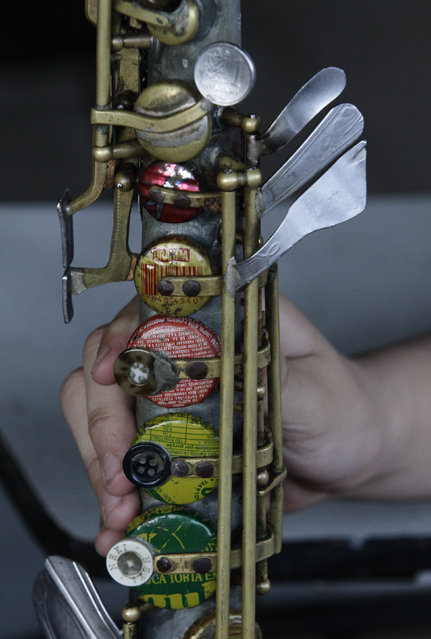
A student of the Orchestra of Recycled Instruments of Cateura holds an instrument made from recycled material by craftsman Nicolas Gomez, in Cateura, near Asuncion, May 9, 2013. The orchestra is the brainchild of its conductor Favio Chavez, who wanted to help the children of garbage pickers at the local landfill, and the instruments are made from salvaged materials by craftsman Gomez. (Photo by Jorge Adorno/Reuters)

A student of the Orchestra of Recycled Instruments of Cateura holds an instrument made from recycled material by craftsman Nicolas Gomez, in Cateura, near Asuncion, May 9, 2013. The orchestra is the brainchild of its conductor Favio Chavez, who wanted to help the children of garbage pickers at the local landfill, and the instruments are made from salvaged materials by craftsman Gomez. The orchestra now involves 30 schoolchildren who have toured countries in Latin America, North America and Europe to play music ranging from Beethoven and Mozart to the Beatles and Paraguayan folk songs. (Photo by Jorge Adorno/Reuters)
Details
12 Jul 2013 09:23:00
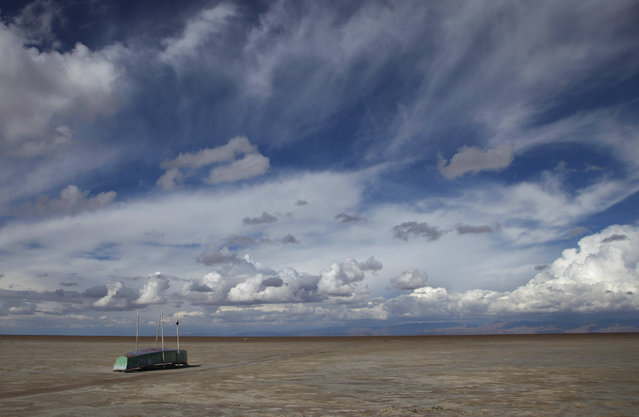
In this January 12, 2016 photo, an abandoned boat lies on the dried up lake bed of Lake Poopo, on the outskirts of Untavi, Bolivia. Drought caused by the recurrent El Nino meteorological phenomenon is considered the main driver of the lake's demise. Along with glacial melting, authorities say another factor is the diversion of water from Poopo's tributaries, mostly for mining but also for agriculture. (Photo by Juan Karita/AP Photo)

In this January 12, 2016 photo, an abandoned boat lies on the dried up lake bed of Lake Poopo, on the outskirts of Untavi, Bolivia. Drought caused by the recurrent El Nino meteorological phenomenon is considered the main driver of the lake's demise. Along with glacial melting, authorities say another factor is the diversion of water from Poopo's tributaries, mostly for mining but also for agriculture. (Photo by Juan Karita/AP Photo)
Details
21 Jan 2016 12:33:00
Jackpot! Boys like their toys :). Singapore, 2009. (Photo by Piotr Golebiowski)

“Jackpot! Boys like their toys :)”. Singapore, 2009. (Photo and caption by Piotr Golebiowski)
Details
04 Oct 2013 11:59:00