Loading...
Done
A woman with coloured powder smeared on her face smile as she celebrates Holi, the Festival of Colours, in Kathmandu, Nepal, March 22, 2016. (Photo by Navesh Chitrakar/Reuters)

A woman with coloured powder smeared on her face smile as she celebrates Holi, the Festival of Colours, in Kathmandu, Nepal, March 22, 2016. (Photo by Navesh Chitrakar/Reuters)
Details
23 Mar 2016 12:11:00
A devotee with his body painted poses as he waits to perform during a ritual as part of the annual Shiva Gajan religious festival at Sona Palasi village, in West Bengal, India, April 11, 2016. Devotees offer sacrifices and perform acts of devotion during the festival in the hopes of winning the favour of Hindu god Shiva and ensuring the fulfillment of their wishes, and also to mark the end of the Bengali calendar year. (Photo by Rupak De Chowdhuri/Reuters)

A devotee with his body painted poses as he waits to perform during a ritual as part of the annual Shiva Gajan religious festival at Sona Palasi village, in West Bengal, India, April 11, 2016. Devotees offer sacrifices and perform acts of devotion during the festival in the hopes of winning the favour of Hindu god Shiva and ensuring the fulfillment of their wishes, and also to mark the end of the Bengali calendar year. (Photo by Rupak De Chowdhuri/Reuters)
Details
13 Apr 2016 09:42:00
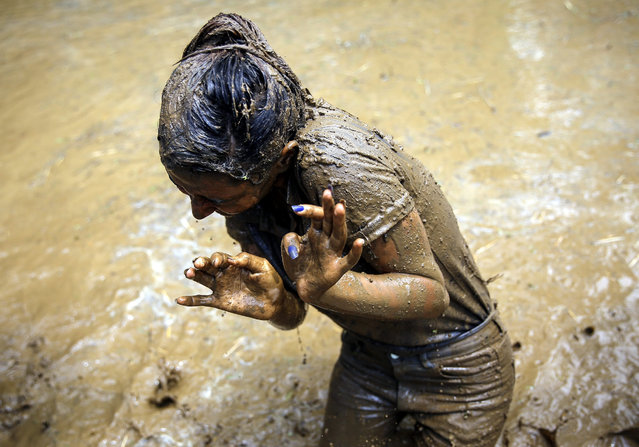
A reveller covered in tomato pulp participates in the annual “Tomatina” festival in the eastern town of Bunol, on August 28, 2019. The iconic fiesta, which is billed at “the world's biggest food fight” has become a major draw for foreigners, in particular from Britain, Japan and the United States. (Photo by Jaime Reina/AFP Photo)

A reveller covered in tomato pulp participates in the annual “Tomatina” festival in the eastern town of Bunol, on August 28, 2019. The iconic fiesta, which is billed at “the world's biggest food fight” has become a major draw for foreigners, in particular from Britain, Japan and the United States. (Photo by Jaime Reina/AFP Photo)
Details
30 Aug 2019 00:01:00
“Secrets of the Whales”. Skerry’s photographs celebrate the lives and culture of whales, illuminating recent research and their diverse behaviours. His latest work focuses on four key species: sperm whales, humpbacks, orca and beluga whales. Humpback whales bubble-net feeding off the coast of Alaska. They work cooperatively to feed on herring by blowing a perfect ring of bubbles underwater to form a net encircling the fish. The whales then swim up through the centre of the bubble net with their mouths open. (Photo by Brian Skerry/National Geographic Photo/Visa pour l'Image)

“Secrets of the Whales”. Skerry’s photographs celebrate the lives and culture of whales, illuminating recent research and their diverse behaviours. His latest work focuses on four key species: sperm whales, humpbacks, orca and beluga whales. Humpback whales bubble-net feeding off the coast of Alaska. They work cooperatively to feed on herring by blowing a perfect ring of bubbles underwater to form a net encircling the fish. The whales then swim up through the centre of the bubble net with their mouths open. (Photo by Brian Skerry/National Geographic Photo/Visa pour l'Image)
Details
04 Sep 2021 09:02:00


Ukrainian folk song “Распрягайте, Хлопцы, Коней” (Vlad Burk Remix Dance Video)
Details
10 Apr 2019 00:03:00
Elephant

Elephant Festival is a festival celebrated in Jaipur city in Rajasthan state in India. It is held on the day of Holi festival, usually in the month of March.The festival features Elephant polo and Elephant Dance. The Elephant Festival begins with a beautiful procession of bedecked elephants, camels, horses and folk dancers. The owners proudly embellish their elephants with vibrant colors, jhools (saddle cloth) and heavy jewellery. It is quite a treat to see female elephants wearing anklets, which tinkle as they walk. One can see people sprinkling 'gulaal' (colored powder) perched on top of the elephant. The most beautifully decorated elephant is awarded. Elephant polo, Elephant race, the tug-of-war between Elephant and 19 men and women are the featured events of the festival.
Details
30 Apr 2015 16:55:00
A young woman (C) clad in samurai costume leads other local poeple as she rides her horse during a parade at the annual Soma Nomaoi festival in Minamisoma, Fukushima Prefecture, on July 28, 2012.  The traditional full-scale festival kicked off for the first time after the accident of the Fukushima Dai-ichi Nuclear Power Plant following the massive earthquake and the tsunami on March 11, 2011. (Photo by Toru Yamanaka/AFP Photo)

Soma-Nomaoi is a festival that recreates a battle scene from more than 1,000 years ago. It is annually held for 4 days from July 22 to 25 in Haramachi City, Fukushima Prefecture, in the eastern part of Japan. In this historical event, 600 mounted samurai in traditional Japanese armor, with long swords at their side and ancestral flagstaffs streaming from their backs, ride across open fields. Soma-Nomaoi has been designated an Important Intangible Folk Cultural Property.

Photo: A young woman (C) clad in samurai costume leads other local poeple as she rides her horse during a parade at the annual Soma Nomaoi festival in Minamisoma, Fukushima Prefecture, on July 28, 2012. The traditional full-scale festival kicked off for the first time after the accident of the Fukushima Dai-ichi Nuclear Power Plant following the massive earthquake and the tsunami on March 11, 2011. (Photo by Toru Yamanaka/AFP Photo)
Details
02 Aug 2012 12:59:00


“Itasha (痛車), literally “painmobile”, is a Japanese term for an otaku fad of individuals decorating the bodies of their cars with fictional characters of anime, manga, or video games (especially bishōjo game or eroge). These characters are predominately “cute” female. The decorations usually involve paint schemes and stickers. Automobiles are called Itasha, while similar motorcycles and bicycles are called itansha (痛単車) and itachari (痛チャリ), respectively”. – Wikipedia


Photo: A visitor takes pictures of an anime-decorated «Itasha» car displayed during the “Moe Fes in Washimiya” at Washimiya Town Hall on July 18, 2009 in Washimiya, Saitama, Japan. Itasha, a word derived from “itai” (painful) and “sha” (car), are vehicles decorated with mostly female characters from Japanese manga, anime and video games. (Photo by Kiyoshi Ota/Getty Images)
Details
02 May 2011 08:38:00