Loading...
Done
A woman dressed in a traditional Ukrainian embroidered shirt holds her cat as she take part in an embroidered shirt parade in central Kiev, Ukraine, May 27, 2017. (Photo by Gleb Garanich/Reuters)

A woman dressed in a traditional Ukrainian embroidered shirt holds her cat as she take part in an embroidered shirt parade in central Kiev, Ukraine, May 27, 2017. (Photo by Gleb Garanich/Reuters)
Details
28 May 2017 07:35:00
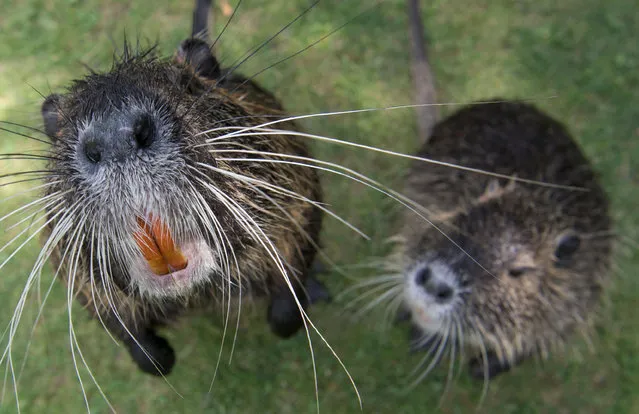
Nutrias venture near the camera at the river Nidda in Frankfurt am Main, Germany, 15 June 2017. The rabbit sized animals are often confused with biebers by amateurs. (Photo by Boris Roessler/DPA)

Nutrias venture near the camera at the river Nidda in Frankfurt am Main, Germany, 15 June 2017. The rabbit sized animals are often confused with biebers by amateurs. (Photo by Boris Roessler/DPA)
Details
18 Jun 2017 03:24:00
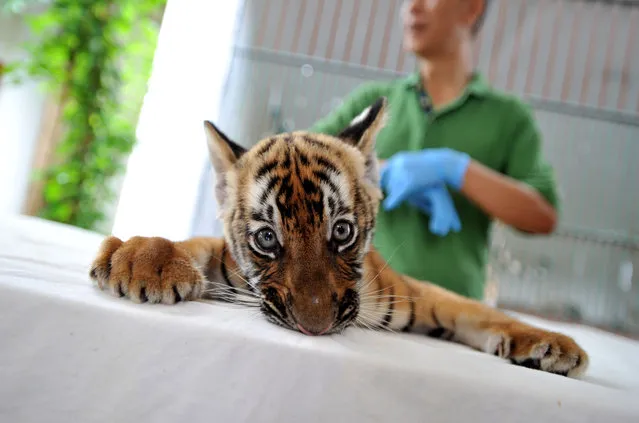
A South China Tiger cub meets public at Guangzhou Zoo on June 22, 2017 in Guangzhou, Guangdong Province of China. Guangzhou Zoo boasts of the successful breeding of South China Tiger cub after 15 years. (Photo by VCG/VCG via Getty Images)

A South China Tiger cub meets public at Guangzhou Zoo on June 22, 2017 in Guangzhou, Guangdong Province of China. Guangzhou Zoo boasts of the successful breeding of South China Tiger cub after 15 years. (Photo by VCG/VCG via Getty Images)
Details
25 Jun 2017 06:57:00
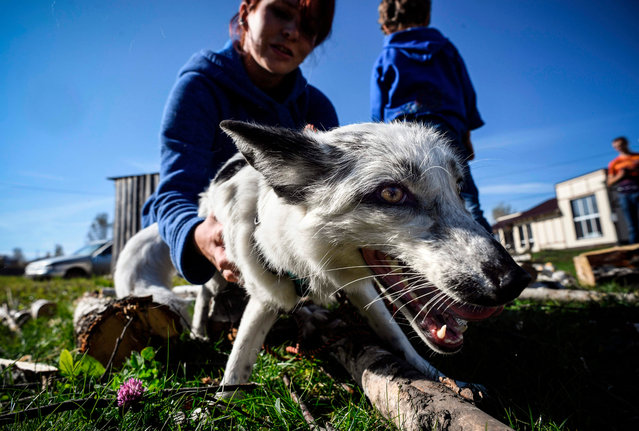
Tatyana Abramova, 33, plays with her home fox Plombir at her countryside house outside Siberian city of Novosibirsk on September 12, 2020. The official start of the Soviet experiment to better understand the domestication of animals by humans began in 1959, and was initiated by geneticists Dmitri Beliaiev and Lioudmila Trout on a farm in Akademgorodok, the scientific center of excellence in Siberia. Their primary objective was to domesticate foxes, to understand how the ancestor of wolves, another canine, evolved into a loyal and loving dog. And understand what this domestication tells us about the genetic evolution of species. (Photo by Alexander Nemenov/AFP Photo)


Tatyana Abramova, 33, plays with her home fox Plombir at her countryside house outside Siberian city of Novosibirsk on September 12, 2020. The official start of the Soviet experiment to better understand the domestication of animals by humans began in 1959, and was initiated by geneticists Dmitri Beliaiev and Lioudmila Trout on a farm in Akademgorodok, the scientific center of excellence in Siberia. Their primary objective was to domesticate foxes, to understand how the ancestor of wolves, another canine, evolved into a loyal and loving dog. And understand what this domestication tells us about the genetic evolution of species. (Photo by Alexander Nemenov/AFP Photo)
Details
25 Oct 2020 00:05:00
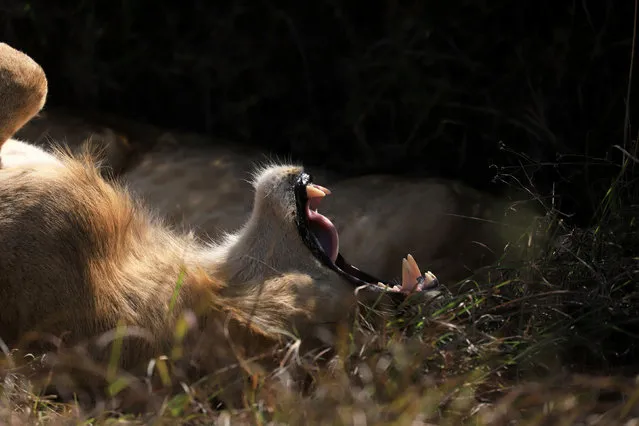
A lion rests in the Nairobi National Park, Kenya on January 6, 2021. (Photo by Tiksa Negeri/Reuters)

A lion rests in the Nairobi National Park, Kenya on January 6, 2021. (Photo by Tiksa Negeri/Reuters)
Details
18 Jan 2021 00:05:00
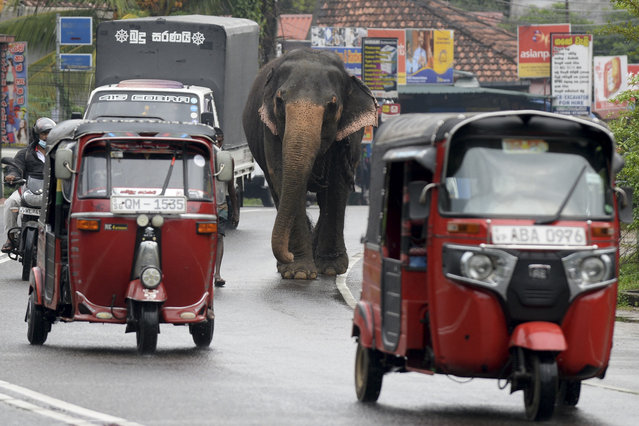
A mahout walks next to his elephant through a busy street in Horana, a suburb of Sri Lanka's capital Colombo on March 23, 2021. (Photo by Lakruwan Wanniarachchi/AFP Photo)

A mahout walks next to his elephant through a busy street in Horana, a suburb of Sri Lanka's capital Colombo on March 23, 2021. (Photo by Lakruwan Wanniarachchi/AFP Photo)
Details
04 Apr 2021 08:42:00
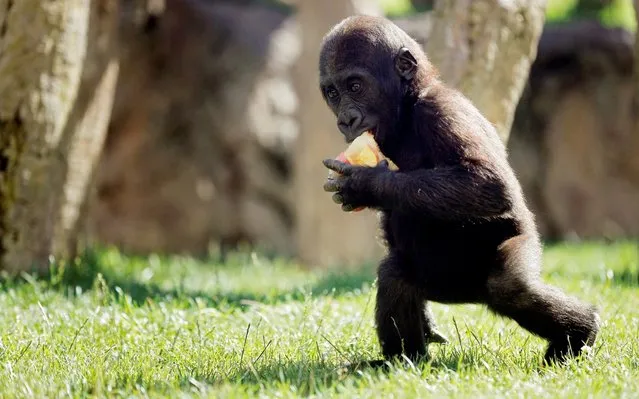
A gorilla cube named Pepe eats frozen fruit to fight high temperatures at the Bioparc zoo in Valencia, eastern Spain, 28 June 2019. Spanish peninsula is suffering a heat wave with temperatures reaching up to 45 degrees. (Photo by Kai Foersterling/EPA/EFE/Rex Features/Shutterstock)

A gorilla cube named Pepe eats frozen fruit to fight high temperatures at the Bioparc zoo in Valencia, eastern Spain, 28 June 2019. Spanish peninsula is suffering a heat wave with temperatures reaching up to 45 degrees. (Photo by Kai Foersterling/EPA/EFE/Rex Features/Shutterstock)
Details
30 Jun 2019 00:03:00
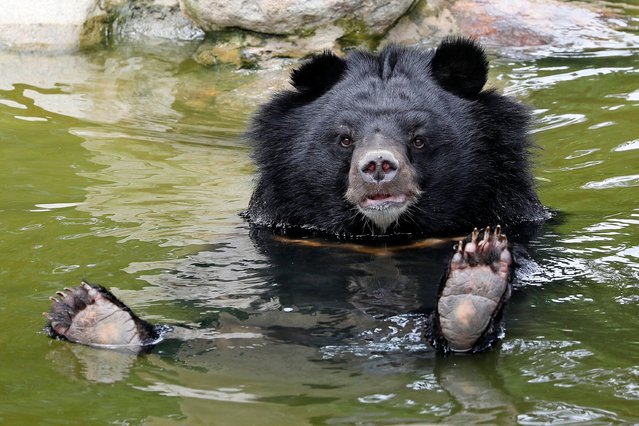
A moon bear rests in a pool inside an enclosure at the Vietnam bear rescue centre, in Tam Dao national park, Vinh Phuc, Vietnam, 09 July 2019. The center is operated by international organization Animals Asia. There are currently 184 bears living at the the Vietnam Bear Rescue Centre. It is estimated that there are less than a few hundred bears left in the wild in Vietnam. According to the latest data from the Ministry of Agriculture and Rural development, around 600 bears are still being kept on farms. In Vietnam, Animals Asia has rescued a total of 209 sun bears and moon bears. (Photo by Minh Hoang/EPA/EFE/Rex Features/Shutterstock)

A moon bear rests in a pool inside an enclosure at the Vietnam bear rescue centre, in Tam Dao national park, Vinh Phuc, Vietnam, 09 July 2019. The center is operated by international organization Animals Asia. There are currently 184 bears living at the the Vietnam Bear Rescue Centre. It is estimated that there are less than a few hundred bears left in the wild in Vietnam. According to the latest data from the Ministry of Agriculture and Rural development, around 600 bears are still being kept on farms. In Vietnam, Animals Asia has rescued a total of 209 sun bears and moon bears. (Photo by Minh Hoang/EPA/EFE/Rex Features/Shutterstock)
Details
14 Jul 2019 00:05:00