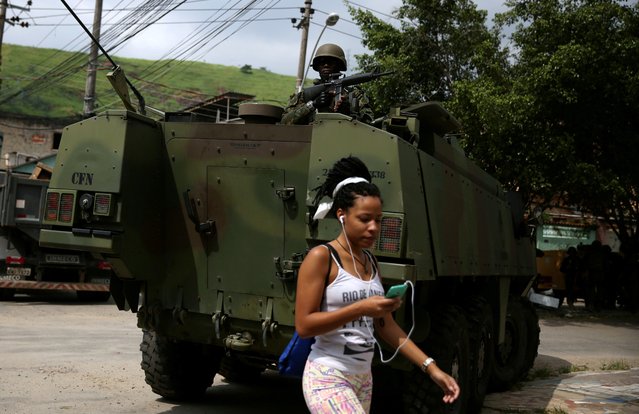
An armed forces members patrol during an operation against drug dealers in Vila Kennedy slum in Rio de Janeiro, March 7, 2018. (Photo by Pilar Olivares/Reuters)
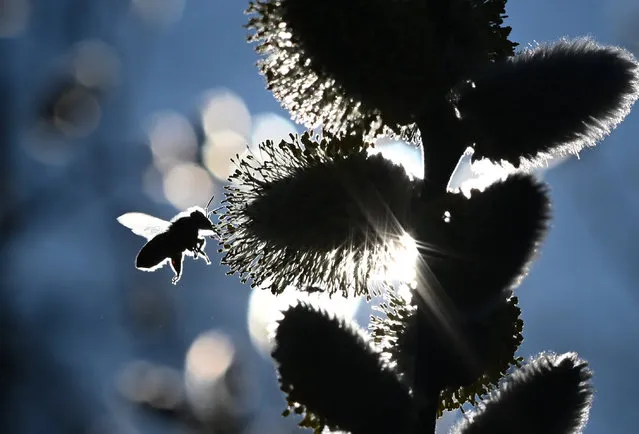
A bee approaching the flowers of a willow in Otzberg, Germany on February 28, 2021. Willow catkins are a protected species and one of the first sources of food for insects in early spring. (Photo by Arne Dedert/DPA)
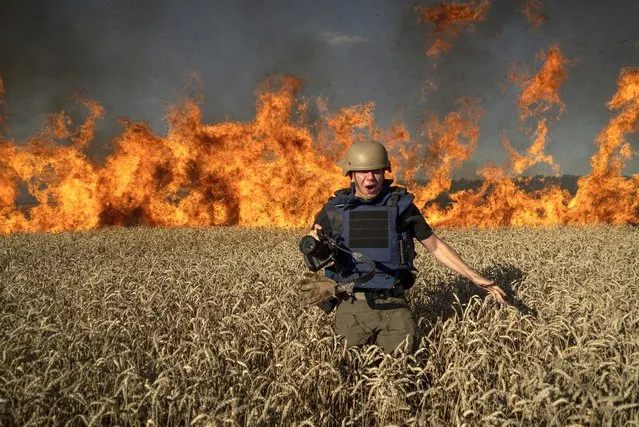
Photojournalist Evgeniy Maloletka runs from a blaze in a burning wheat field while on assignment after Russian shelling, a few kilometers from the Ukrainian-Russian border in the Kharkiv region, Ukraine, Friday, July 29, 2022. (Photo by Mstyslav Chernov/AP Photo)
Youths cover their faces with plastic bags while pushing a handcart during rainfall in Peshawar, Pakistan, Sunday, July 12, 2020. (Photo by Muhammad Sajjad/AP Photo)
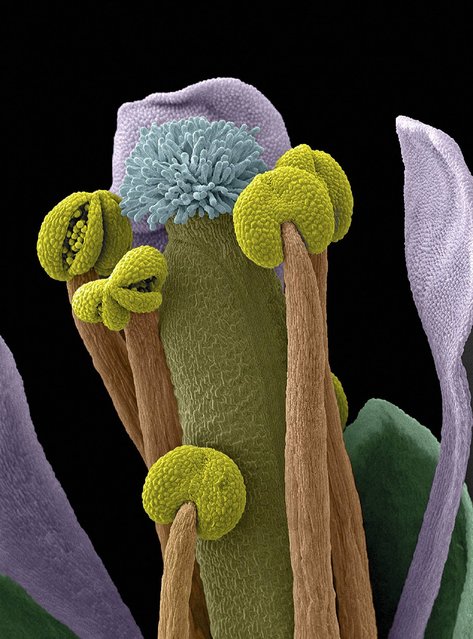
Beautiful, strange and occasionally alarming pictures from the shortlist for this year’s Wellcome image awards – which celebrate the very best in science photography and imaging – from an x-ray of a bat to a micrograph of a kidney stone. The exhibition opens on 12 March at three science centres and the Museum of Science and Industry in Manchester. Photo: Scanning electron micrograph (SEM) of an Arabidopsis thaliana flower, also commonly known as thale cress. Some of the anthers are open, revealing pollen grains ready for dispersal. Arabidopsis was the first plant to have its entire genome sequenced and is widely used as a model organism in molecular and plant biology. Horizontal width of image is 1200 microns. Magnification 100x. (Photo by Stefan Eberhard/Wellcome Images)
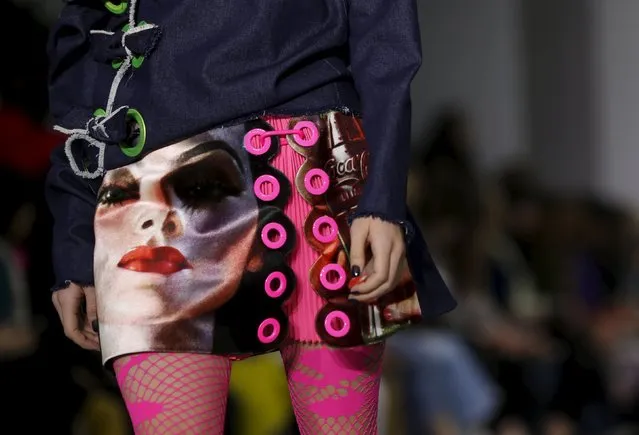
A model presents a creation from the Fyodor Golan catwalk show at London Fashion Week Autumn/Winter 16 in London, Britain February 19, 2016. (Photo by Neil Hall/Reuters)
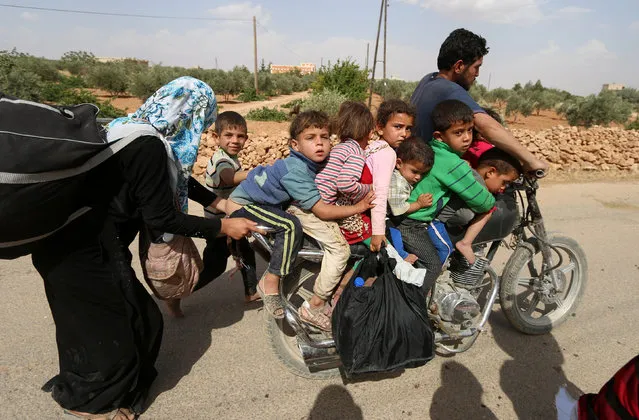
Civilians, who fled the violence in Manbij city, arrive to the southeastern rural area of Manbij, in Aleppo Governorate, Syria June 19, 2016. (Photo by Rodi Said/Reuters)