Loading...
Done
Members of the U.S. Army 173rd Airborne Brigade stand at attention as a Ukrainian folk dance group performs at the opening ceremony of the “Rapid Trident” NATO military exercises on September 15, 2014 near Yavorov, Ukraine. (Photo by Sean Gallup/Getty Images)

Members of the U.S. Army 173rd Airborne Brigade stand at attention as a Ukrainian folk dance group performs at the opening ceremony of the “Rapid Trident” NATO military exercises on September 15, 2014 near Yavorov, Ukraine. The two-week exercises include participating units from a variety of NATO and NATO-associate countries as well as Ukrainian troops. Meanwhile fighting between pro-Russian separatists and Ukrainian armed foces has flared again in eastern Ukraine in a battle for the control of Donetsk airport despite the tenuous ceasefire. (Photo by Sean Gallup/Getty Images)
Details
17 Sep 2014 12:34:00
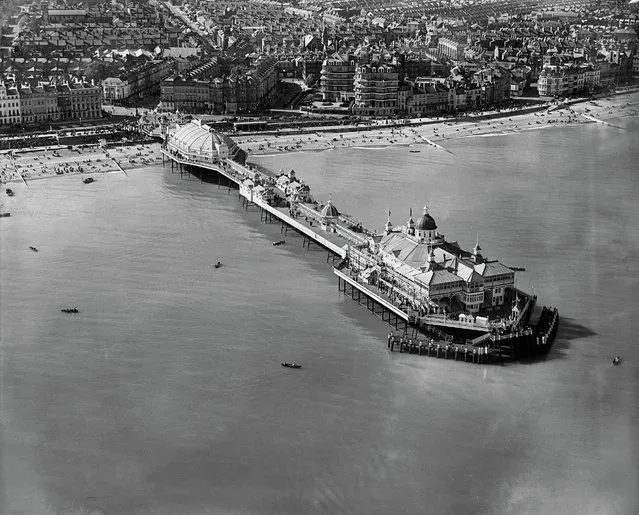
While the lido was described as bringing “modernism to the masses” on the British coast it was just the latest example of a trend that had been developing since Victorian times – transforming seaside towns into resorts for leisure and entertainment. In the latter half of the nineteenth century, the fashion was for local authorities to build great piers stretching from the promenade out into the sea

While the lido was described as bringing “modernism to the masses” on the British coast it was just the latest example of a trend that had been developing since Victorian times – transforming seaside towns into resorts for leisure and entertainment. In the latter half of the nineteenth century, the fashion was for local authorities to build great piers stretching from the promenade out into the sea. The Eastbourne Pier, pictured here in May 1931, was erected between 1866 and 1870 to an ingenious design by Eugenius Birch, which saw the structure sitting on special cups allowing the supporting struts to “move” in bad weather. Arranged on the pier's 1,000-foot length were kiosks, a theatre, a ballroom and a camera obscura. 1931. (Photo by Aerofilms Collection via “A History of Britain From Above”)
Details
25 Feb 2014 12:59:00
Galapagos – Rocking the Cradle: Four major ocean currents converge along the Galapagos archipelago, creating the conditions for an extraordinary diversity of animal life, April 25, 2016. The islands are home to at least 7,000 flora and fauna species, of which 97 percent of the reptiles, 80 percent of the land birds, 50 percent of the insects and 30 percent of the plants are endemic. The local ecosystem is highly sensitive to the changes in temperature, rainfall and ocean currents that characterize the climatic events known as El Niño and La Niña. These changes cause marked fluctuations in weather and food availability. Many scientists expect the frequency of El Niño and La Niña to increase as a result of climate change, making the Galapagos a possible early-warning location for its effects. (Photo by Thomas P. Peschak for National Geographic/World Press Photo)

Galapagos – Rocking the Cradle: Four major ocean currents converge along the Galapagos archipelago, creating the conditions for an extraordinary diversity of animal life, April 25, 2016. The islands are home to at least 7,000 flora and fauna species, of which 97 percent of the reptiles, 80 percent of the land birds, 50 percent of the insects and 30 percent of the plants are endemic. (Photo by Thomas P. Peschak for National Geographic/World Press Photo)
Details
16 Apr 2018 00:01:00
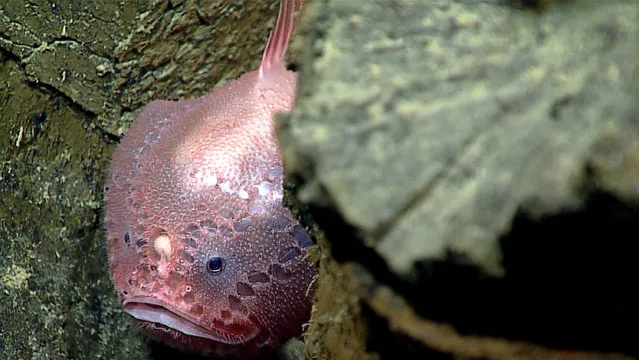
This April 30, 2016 image made available by NOAA shows a deep sea anglerfish living between pillow basalt rock formations, during a deepwater exploration of the Marianas Trench Marine National Monument area in the Pacific Ocean near Guam and Saipan. The ambush predator waits for prey to be attracted by its lure, located between its eyes, and gulps it with its large mouth. (Photo by NOAA Office of Ocean Exploration and Research via AP Photo)

This April 30, 2016 image made available by NOAA shows a deep sea anglerfish living between pillow basalt rock formations, during a deepwater exploration of the Marianas Trench Marine National Monument area in the Pacific Ocean near Guam and Saipan. The ambush predator waits for prey to be attracted by its lure, located between its eyes, and gulps it with its large mouth. (Photo by NOAA Office of Ocean Exploration and Research via AP Photo)
Details
21 Oct 2016 12:30:00
Midas, a four-month-old kitten born with four ears, is pictured at her home in Ankara, Turkey on November 19, 2021. (Photo by Cagla Gurdogan/Reuters)

Midas, a four-month-old kitten born with four ears, is pictured at her home in Ankara, Turkey on November 19, 2021. (Photo by Cagla Gurdogan/Reuters)
Details
12 Dec 2021 05:34:00
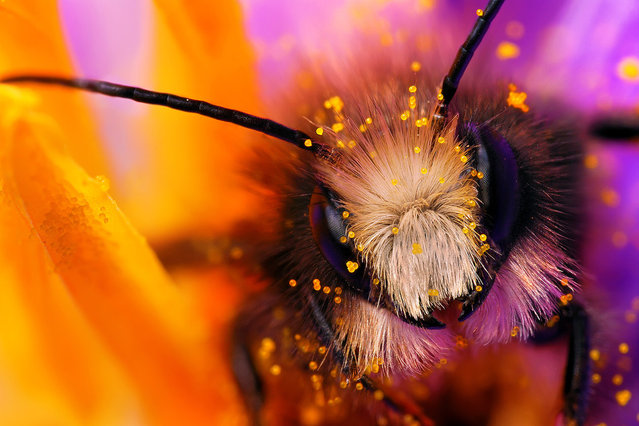
Bee. (Photo by Boris Godfroid)

Belgian Photographer Boris Godfroid, a former biology student who recently graduated from film school, started shooting macro photography in 2008. Photo: Bee. (Photo by Boris Godfroid)
Details
02 Aug 2013 07:25:00
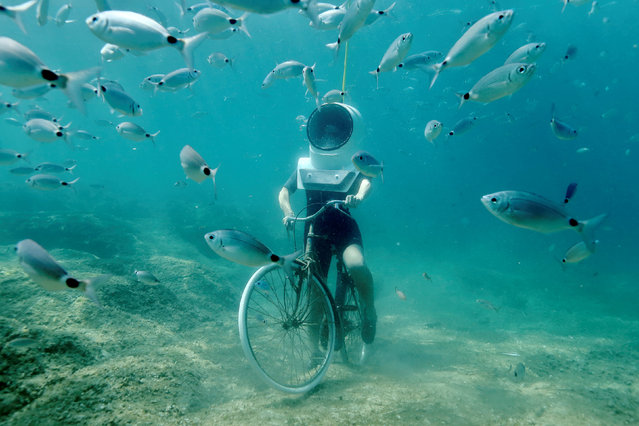
A woman dives and pretends to ride a bike in Underwater Park in Pula, Croatia, August 1, 2017. (Photo by Antonio Bronic/Reuters)

A woman dives and pretends to ride a bike in Underwater Park in Pula, Croatia, August 1, 2017. (Photo by Antonio Bronic/Reuters)
Details
03 Aug 2017 08:54:00
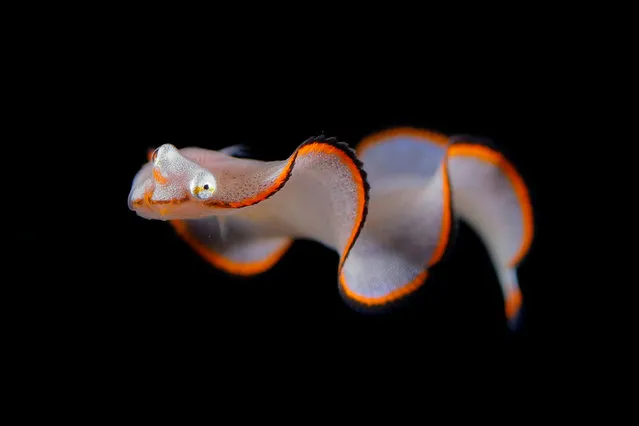
Batesian mimicry by a Soleichthys fish larva. (Photo by Ryo Minemizu/The Guardian)

Ryo Minemizu, one of Japan’s emerging stars in the field of marine life photography and the 2017 winner of the Nikkei National Geographic photography prize, captures the beauty and complexity of plankton that drift in our planet’s oceans and other bodies of water in meticulous detail. Here: Batesian mimicry by a Soleichthys fish larva. (Photo by Ryo Minemizu/The Guardian)
Details
21 Aug 2018 00:05:00