Loading...
Done
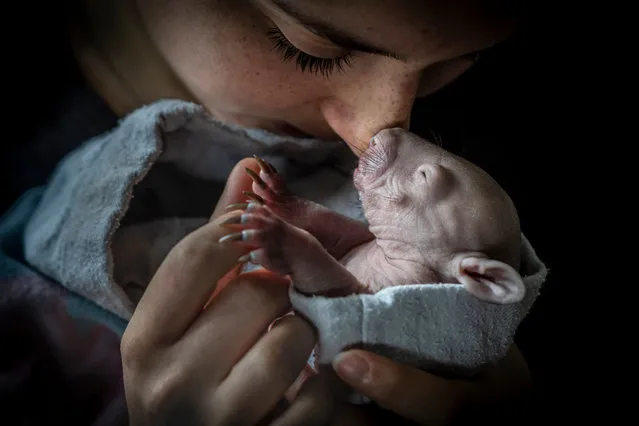
Nose to Nose; Human/Nature winner. “Doug Gimesy was documenting work at the Joey and Bat Sanctuary near Melbourne when he met a wombat (Vombatus ursinus) whose mother had been killed by a car. Gimesy watched as a young veterinary student bottle-fed the orphaned joey, then touched her nose to the joey’s in a tender moment of interspecies bonding”. (Photo by Doug Gimesy/BigPicture)

Nose to Nose; Human/Nature winner. “Doug Gimesy was documenting work at the Joey and Bat Sanctuary near Melbourne when he met a wombat (Vombatus ursinus) whose mother had been killed by a car. Gimesy watched as a young veterinary student bottle-fed the orphaned joey, then touched her nose to the joey’s in a tender moment of interspecies bonding”. (Photo by Doug Gimesy/BigPicture)
Details
25 Jun 2023 05:33:00
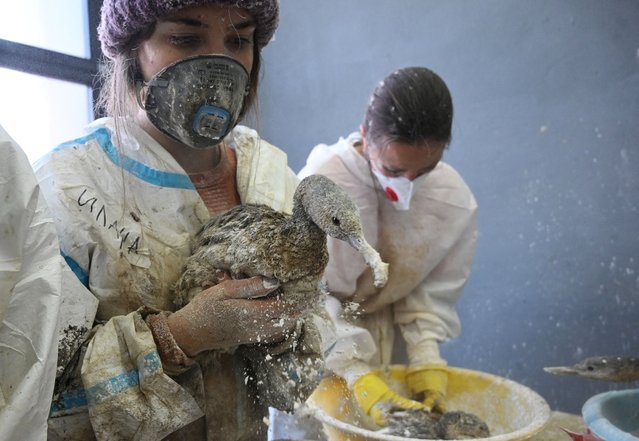
Volunteers use flour to clean birds following an oil spill caused by an incident involving two tankers damaged in a storm in the Kerch Strait, in the village of Vityazevo near the Black Sea resort of Anapa, Russia on December 20, 2024. (Photo by Sergey Pivovarov/Reuters)

Volunteers use flour to clean birds following an oil spill caused by an incident involving two tankers damaged in a storm in the Kerch Strait, in the village of Vityazevo near the Black Sea resort of Anapa, Russia on December 20, 2024. (Photo by Sergey Pivovarov/Reuters)
Details
24 Dec 2024 04:11:00
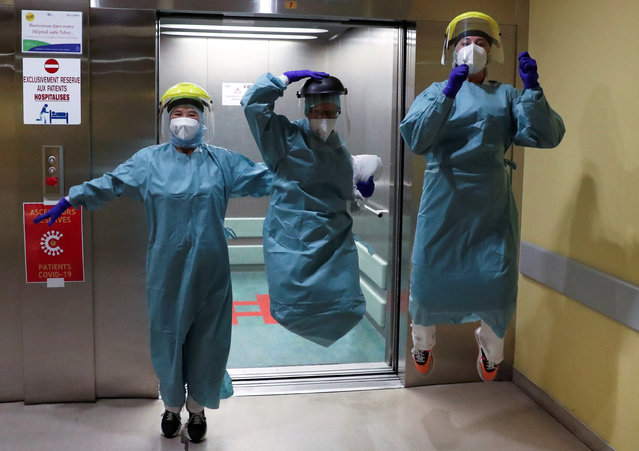
Medical personnel jump in the COVID-19 unit at the CHR Centre Hospitalier Regional de la Citadelle Hospital, during the coronavirus disease (COVID-19) outbreak, in Liege, Belgium, April 22, 2020. (Photo by Yves Herman/Reuters)

Medical personnel jump in the COVID-19 unit at the CHR Centre Hospitalier Regional de la Citadelle Hospital, during the coronavirus disease (COVID-19) outbreak, in Liege, Belgium, April 22, 2020. (Photo by Yves Herman/Reuters)
Details
24 Apr 2020 00:07:00
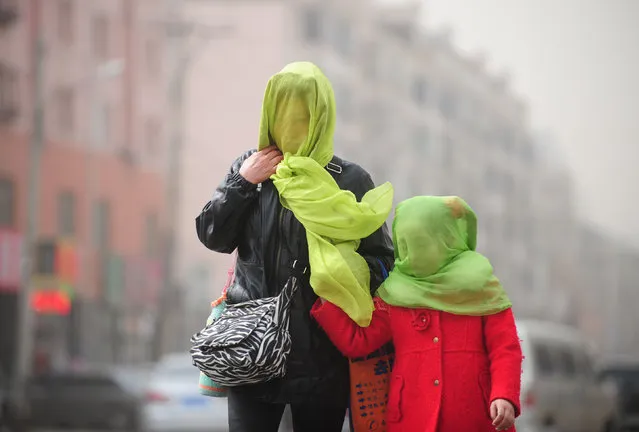
People walk during a polluted day in Shenyang, Liaoning province, March 31, 2016. (Photo by Reuters/Stringer)

People walk during a polluted day in Shenyang, Liaoning province, March 31, 2016. (Photo by Reuters/Stringer)
Details
18 Apr 2016 10:12:00
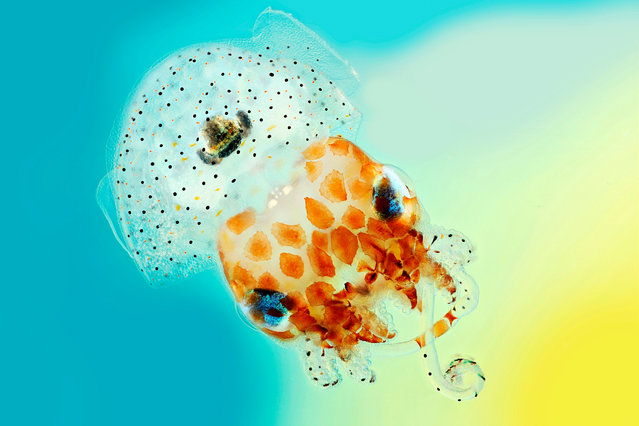
With its huge eyes, comical name and diminutive size, Mark R. Smith’s image of a baby Hawaiian bobtail squid can’t help but raise a smile. A curiously endearing creature, the cephalopod is just 1.5cm across, its mantle cavity bearing more than a passing resemblance to a rather natty shower cap. But it is also a beautiful example of symbiosis – nature’s version of “I’ll scratch your back if you scratch mine” – for on the underside of the squid is a light organ which houses bioluminescent bacteria. The squid offers the bacteria protection and food, while the bacteria emit a glow – a handy trait that the squid uses to offset its silhouette, helping it to evade predators in the depths below. Mark R. Smith’s entry combines several images of a Hawaiian bobtail squid with different focus lengths to create a final picture with greater depth of field than normal. (Photo by Mark R. Smith/Wellcome Images/Macroscopic Solutions)

With its huge eyes, comical name and diminutive size, Mark R. Smith’s image of a baby Hawaiian bobtail squid can’t help but raise a smile. A curiously endearing creature, the cephalopod is just 1.5cm across, its mantle cavity bearing more than a passing resemblance to a rather natty shower cap. But it is also a beautiful example of symbiosis – nature’s version of “I’ll scratch your back if you scratch mine” – for on the underside of the squid is a light organ which houses bioluminescent bacteria. The squid offers the bacteria protection and food, while the bacteria emit a glow – a handy trait that the squid uses to offset its silhouette, helping it to evade predators in the depths below. Mark R. Smith’s entry combines several images of a Hawaiian bobtail squid with different focus lengths to create a final picture with greater depth of field than normal. (Photo by Mark R. Smith/Wellcome Images/Macroscopic Solutions)
Details
08 Mar 2017 00:05:00
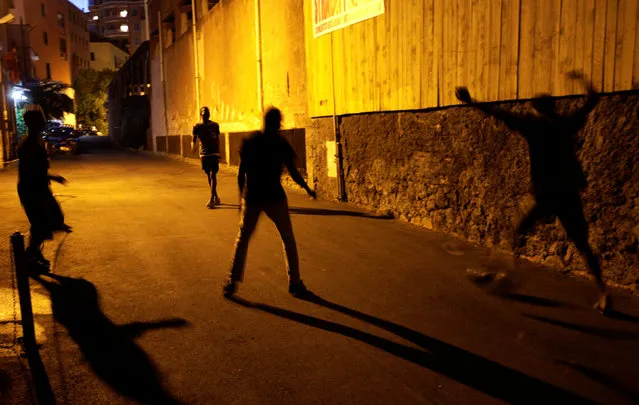
Migrants play soccer at makeshift camp in Via Cupa (Gloomy Street) in downtown Rome, Italy, August 2, 2016. Italy is taking in thousands of boat migrants every week for a third year in a row, and friction is common between them and those who live along the path many take on their journey towards northern Europe. Set up by volunteers, the Baobab centre, by Rome's Tiburtina train station, was shut down by police in December in the wake of the Paris attacks and because the European Union wants Italy to stop migrants from moving on, not help them to do so. B(Photo by Max Rossi/Reuters)

Migrants play soccer at makeshift camp in Via Cupa (Gloomy Street) in downtown Rome, Italy, August 2, 2016. Italy is taking in thousands of boat migrants every week for a third year in a row, and friction is common between them and those who live along the path many take on their journey towards northern Europe. (Photo by Max Rossi/Reuters)
Details
11 Aug 2016 14:31:00
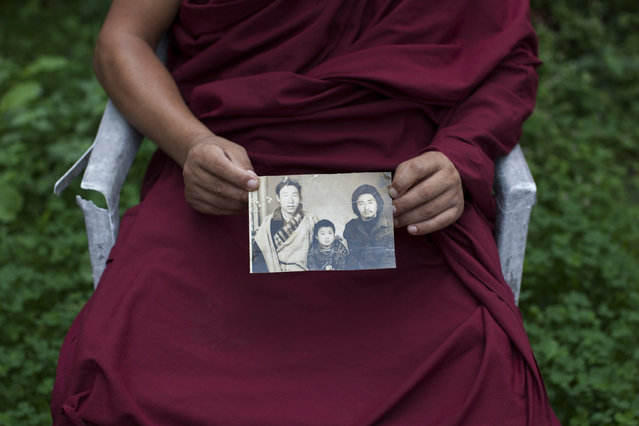
In this Saturday, September 27, 2014 photo, Tibetan monk Dorjee, 38, displays a photograph of his father, left, and himself, center, taken in Tibet, in Dharamsala, India. Dorjee said he held back his tears when he spoke with his parents on the phone after a separation period of 27 years. He exchanged a few words with his father but said his mother fainted on hearing his voice. (Photo by Tsering Topgyal/AP Photo)

“When I was 8 years old, my parents paid a smuggler to take me across the Himalayas, a weekslong walk over the mountains from Tibet to India. It was a trek that tens of thousands of other Tibetans have taken since the Dalai Lama fled a failed 1959 uprising against Chinese rule. My parents must have had their reasons to send me here; they must have had the best of intentions. But 18 years later, I still don't know why they did it. They are not political people. They are small farmers who raise barley and a few yak in a rural area not far from Lhasa, the Tibetan capital. I have not seen them since I left...”. – Tsering Topgyal via The Associated Press. (Photo by Tsering Topgyal/AP Photo)
Details
05 Nov 2014 12:27:00
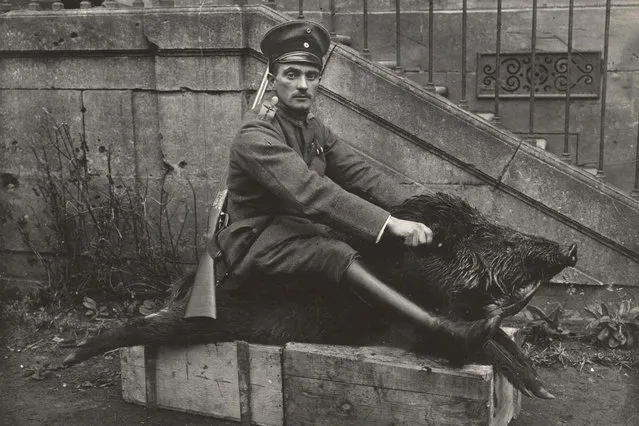
A German Air Force Officer sits astride a dead boar outside a house where he is stationed near the Western Front, in this 1918 handout picture. This picture is part of a previously unpublished set of World War One (WWI) images from a private collection. The pictures offer an unusual view of varied and contrasting aspects of the conflict, from high tech artillery to mobile pigeon lofts, and from officers partying in their headquarters to the grim reality of life and death in the trenches. The year 2014 marks the centenary of the start of the war. (Photo by Reuters/Archive of Modern Conflict London)

A German Air Force Officer sits astride a dead boar outside a house where he is stationed near the Western Front, in this 1918 handout picture. This picture is part of a previously unpublished set of World War One (WWI) images from a private collection. The pictures offer an unusual view of varied and contrasting aspects of the conflict, from high tech artillery to mobile pigeon lofts, and from officers partying in their headquarters to the grim reality of life and death in the trenches. The year 2014 marks the centenary of the start of the war. (Photo by Reuters/Archive of Modern Conflict London)
Details
26 Jun 2014 12:13:00