Loading...
Done
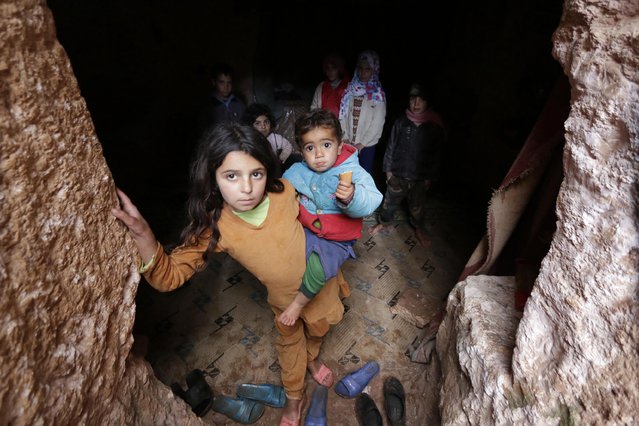
Mariam, a 9-year-old girl, carries her brother as she stands with other children at an underground ancient cemetery in Jabal al-Zawiya in the southern countryside of Idlib November 26, 2014. (Photo by Khalil Ashawi/Reuters)

Mariam, a 9-year-old girl, carries her brother as she stands with other children at an underground ancient cemetery in Jabal al-Zawiya in the southern countryside of Idlib November 26, 2014. Residents are using ancient caves and cemeteries as underground shelters to hide in during shelling from forces loyal to President Bashar al-Assad. Picture taken November 26, 2014. (Photo by Khalil Ashawi/Reuters)
Details
28 Nov 2014 11:51:00
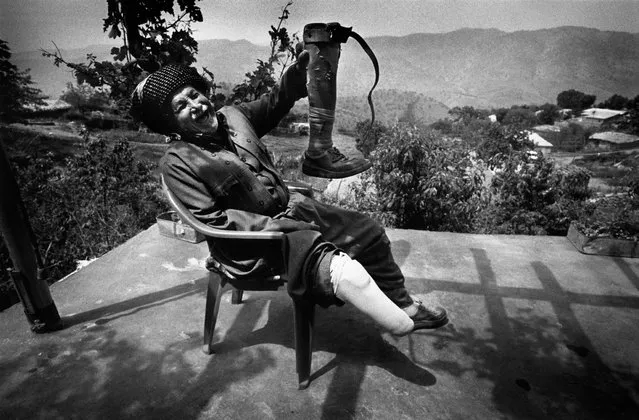
Ismail Mustafa, seen in 2007. “I was collecting mushrooms on the hill near here. I didn’t see the mine. There was a huge explosion. When I woke up I saw that both my legs were gone; I thought my life was over. My brother and another guy were with me. They made a stretcher from sticks and tied it together with clothing. It took two hours to get off the mountain. ‘My daughter has also been injured. She found a shell and brought it into the house and put it on the fire. She didn’t know what she was doing at the time – she was only three. She is blind and has lost an arm”. (Photo by Sean Sutton for the Mines Advisory Group/The Guardian)

Ismail Mustafa, seen in 2007. “I was collecting mushrooms on the hill near here. I didn’t see the mine. There was a huge explosion. When I woke up I saw that both my legs were gone; I thought my life was over. My brother and another guy were with me. They made a stretcher from sticks and tied it together with clothing. It took two hours to get off the mountain. ‘My daughter has also been injured. She found a shell and brought it into the house and put it on the fire. She didn’t know what she was doing at the time – she was only three. She is blind and has lost an arm”. (Photo by Sean Sutton for the Mines Advisory Group/The Guardian)
Details
08 Sep 2017 09:33:00
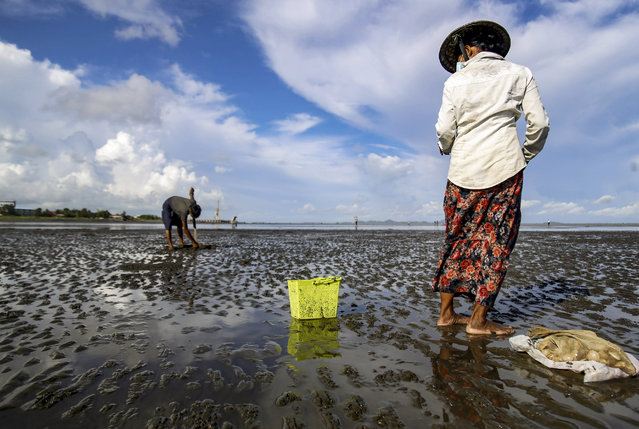
People search for shells on a beach in Sittwe, Rakhine State, Myanmar, 17 September 2020. International Coastal Cleanup Day is observed annually on the third Saturday of September and will occur on 19 September this year. The day was established to encourage global efforts to clean up garbage on beaches and coastal areas and raise awareness on protecting the world's oceans and waterways. According to a report released by the US-based nonprofit environmental advocacy group Ocean Conservancy on 08 September 2020, plastic food packaging topped the list of most common items found in beach trash. Close to five million food wrappers were collected in a single day during the International Coastal Cleanup Day in 2019. An approximate 11 million metric tons of plastic enters the ocean every year according to a 2016 analysis, affecting more than 800 marine species and causing contamination to human food chains and drinking water. (Photo by Nyunt Win/EPA/EFE/Rex Features/Shutterstock)

People search for shells on a beach in Sittwe, Rakhine State, Myanmar, 17 September 2020. International Coastal Cleanup Day is observed annually on the third Saturday of September and will occur on 19 September this year. (Photo by Nyunt Win/EPA/EFE/Rex Features/Shutterstock)
Details
24 Oct 2020 00:05:00
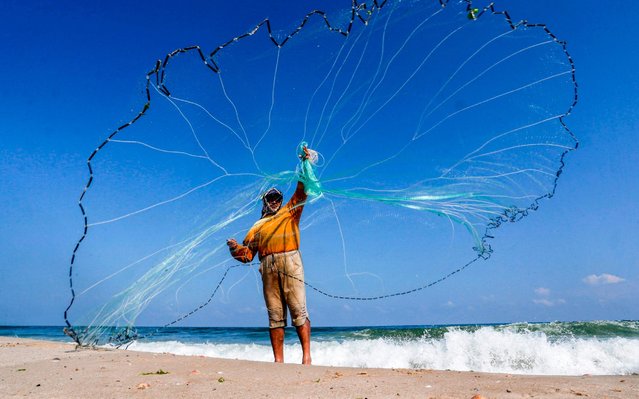
A Palestinian fisherman casts his net as he stands along the beach in Khan Yunis in the southern Gaza Strip on June 14, 2019. The Israeli government said late on June 12 that the fishing zone off the coast of Gaza had been closed, in retaliation for the launch of incendiary balloons from the Palestinian enclave. The move came after COGAT said on Tuesday it had reduced the extent of the fishing zone to six nautical miles offshore from 10 nautical miles, having downscaled it from 15 nautical miles a week ago. (Photo by Said Khatib/AFP Photo)

A Palestinian fisherman casts his net as he stands along the beach in Khan Yunis in the southern Gaza Strip on June 14, 2019. The Israeli government said late on June 12 that the fishing zone off the coast of Gaza had been closed, in retaliation for the launch of incendiary balloons from the Palestinian enclave. The move came after COGAT said on Tuesday it had reduced the extent of the fishing zone to six nautical miles offshore from 10 nautical miles, having downscaled it from 15 nautical miles a week ago. (Photo by Said Khatib/AFP Photo)
Details
12 Jul 2019 00:01:00
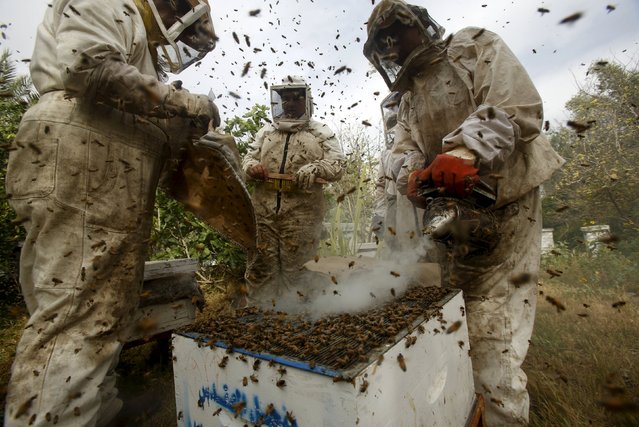
A Palestinian beekeeper uses smoke to calm bees in the process of collecting honey at a farm in Rafah, in the southern Gaza Strip April 11, 2016. (Photo by Suhaib Salem/Reuters)

A Palestinian beekeeper uses smoke to calm bees in the process of collecting honey at a farm in Rafah, in the southern Gaza Strip April 11, 2016. Rateb Samour sees 250 patients a day, whose complaints range from hair loss to cerebral palsy and cancer. He is not a doctor and has never worked in a hospital. Samour inherited the skill of bee-sting therapy from his father. From 2003 the agricultural engineer dedicated all his time to study and develop the alternative-medicine treatment of apitherapy, which uses bee-related products from honey, propolis – or bee glue used to build hives – to venom. (Photo by Suhaib Salem/Reuters)
Details
13 Apr 2016 09:14:00
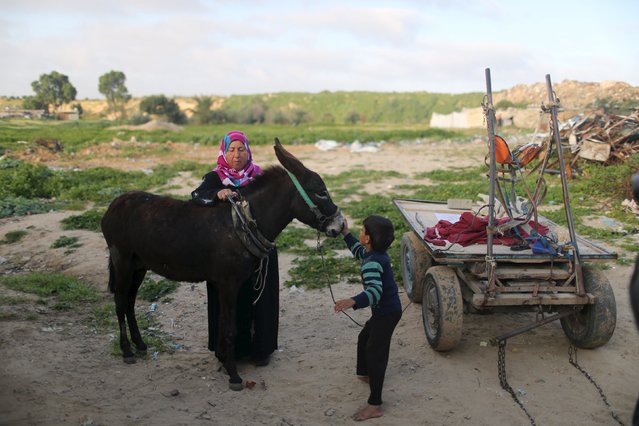
Palestinian woman Jihan Abu Muhsen prepares her donkey with her son Kareem before going work collecting bricks for sale from sites of demolished buildings, at her dwelling in Khan Younis in the southern Gaza Strip March 8, 2016. Abu Muhsen gathers bricks from the sites of demolished buildings and sells them to recycling factories. She earns around 20 shekels ($5) a day and her 10-year-old son Mohammad helps her when he is not at school. (Photo by Ibraheem Abu Mustafa/Reuters)

Palestinian woman Jihan Abu Muhsen prepares her donkey with her son Kareem before going work collecting bricks for sale from sites of demolished buildings, at her dwelling in Khan Younis in the southern Gaza Strip March 8, 2016. Abu Muhsen gathers bricks from the sites of demolished buildings and sells them to recycling factories. She earns around 20 shekels ($5) a day and her 10-year-old son Mohammad helps her when he is not at school. (Photo by Ibraheem Abu Mustafa/Reuters)
Details
19 Apr 2016 13:32:00
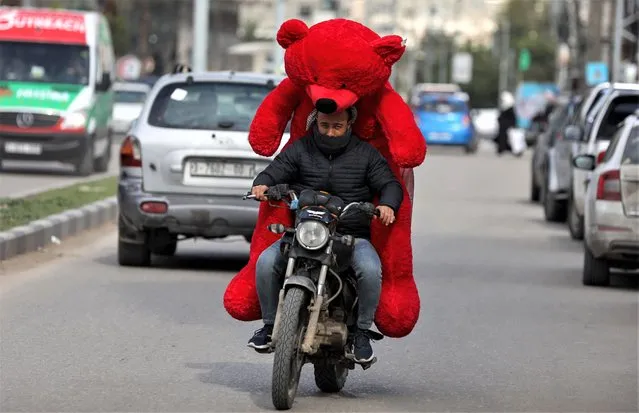
A Palestinian man holds a giant teddy bear as he rides a motorcycle on Valentine's day in Gaza city, on February 14, 2023. Valentine's Day is increasingly popular in the region as people have taken up the custom of giving flowers, cards, chocolates and gifts to sweethearts to celebrate the occasion. (Photo by Majdi Fathi/NurPhoto via Getty Images)

A Palestinian man holds a giant teddy bear as he rides a motorcycle on Valentine's day in Gaza city, on February 14, 2023. Valentine's Day is increasingly popular in the region as people have taken up the custom of giving flowers, cards, chocolates and gifts to sweethearts to celebrate the occasion. (Photo by Majdi Fathi/NurPhoto via Getty Images)
Details
04 Mar 2023 04:17:00
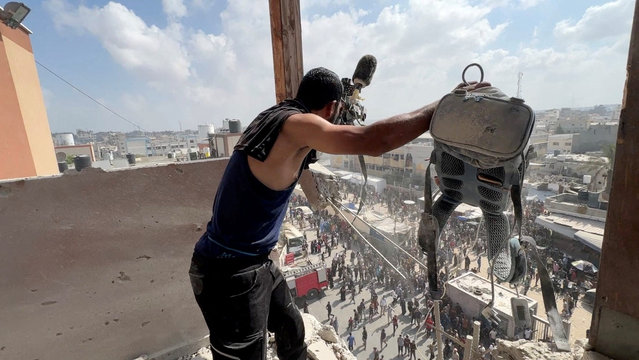
A man reacts as he holds the equipment used by Palestinian cameraman Hussam al-Masri, who was a contractor for Reuters, at the site where he was killed along with other journalists and people in Israeli strikes on Nasser hospital, in Khan Younis in the southern Gaza Strip, in this still image taken from a video shot by Reuters contractor Hatem Khaled, who was wounded shortly afterwards in another strike while he was filming the site on August 25, 2025. (Photo by Hatem Khaled/Reuters)

A man reacts as he holds the equipment used by Palestinian cameraman Hussam al-Masri, who was a contractor for Reuters, at the site where he was killed along with other journalists and people in Israeli strikes on Nasser hospital, in Khan Younis in the southern Gaza Strip, in this still image taken from a video shot by Reuters contractor Hatem Khaled, who was wounded shortly afterwards in another strike while he was filming the site on August 25, 2025. (Photo by Hatem Khaled/Reuters)
Details
19 Sep 2025 02:56:00