Loading...
Done
The once majestic building lies in ruins, with crumbling walls and chilling debris, including body bags and embalming fluids scattered throughout. Formerly an opera house, the building was transformed into a funeral home in 1946. The chilling snaps were taken by photographer Johnny Joo at the deserted House of Wills Funeral Home in Cleveland. Here: The balcony in the abandoned opera hall. (Photo by Johnny Joo/Caters News)

The once majestic building lies in ruins, with crumbling walls and chilling debris, including body bags and embalming fluids scattered throughout. Formerly an opera house, the building was transformed into a funeral home in 1946. The chilling snaps were taken by photographer Johnny Joo at the deserted House of Wills Funeral Home in Cleveland. Here: The balcony in the abandoned opera hall. (Photo by Johnny Joo/Caters News)
Details
03 Jul 2016 10:22:00
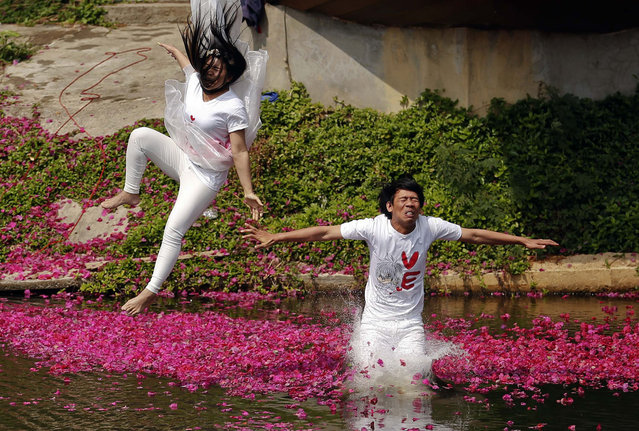
Groom Praem Pam Srichamnan and his bride Suriya Utai jump into a pond during a wedding ceremony ahead of Valentine's Day in Prachin Buri province, east of Bangkok February 13, 2014. Three Thai couples took part in the wedding ceremony arranged by a resort aimed to strengthen the relationships of the couples by doing fun activities. (Photo by Damir Sagolj/Reuters)

Groom Praem Pam Srichamnan and his bride Suriya Utai jump into a pond during a wedding ceremony ahead of Valentine's Day in Prachin Buri province, east of Bangkok February 13, 2014. Three Thai couples took part in the wedding ceremony arranged by a resort aimed to strengthen the relationships of the couples by doing fun activities. (Photo by Damir Sagolj/Reuters)
Details
15 Feb 2014 12:17:00
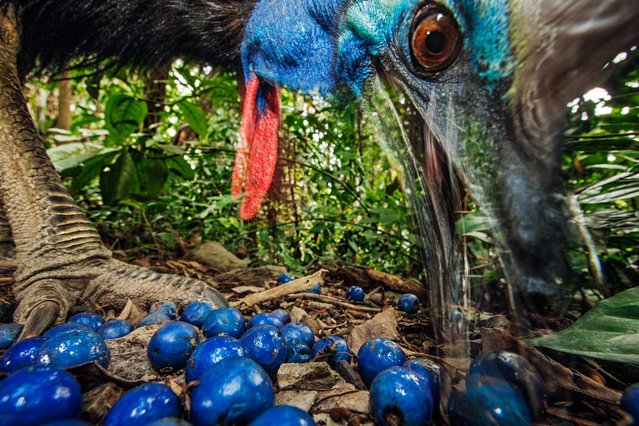
“Cassowaries are large, flightless birds related to emus and (more distantly) to ostriches, rheas, and kiwis”, writes Olivia Judson in the September issue of National Geographic magazine. (Photo by Christian Ziegler/National Geographic)

“Cassowaries are large, flightless birds related to emus and (more distantly) to ostriches, rheas, and kiwis”, writes Olivia Judson in the September issue of National Geographic magazine. How large? People-size: Adult males stand well over five foot five and top 110 pounds. Females are even taller, and can weigh more than 160 pounds. Dangerous when roused, they’re shy and peaceable when left alone. But even birds this big and tough are prey to habitat loss. The dense New Guinea and Australia rain forests where they live have dwindled. Today cassowaries might number 1,500 to 2,000. And because they help shape those same forests – by moving seeds from one place to another – “if they vanish”, Judson writes, “the structure of the forest would gradually change” too. (Photo by Christian Ziegler/National Geographic)
Details
06 Jan 2014 12:21:00
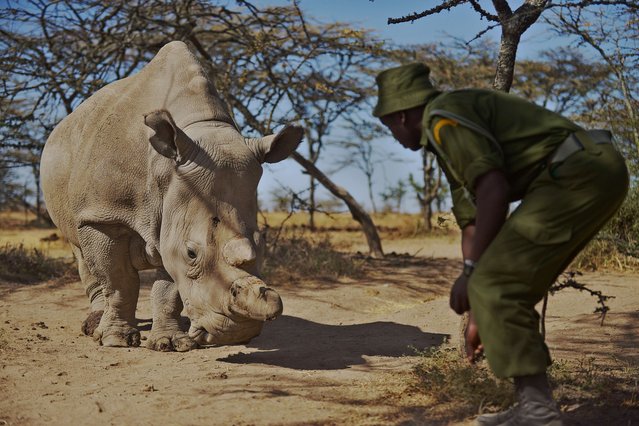
A park ranger stands next to a nothern white female rhinoceros named Najin at Ol Pejeta Conservancy, some 290 kms north of the Kenyan capital, Nairobi, on January 27, 2015. Najin is one of only five members of the sub-species left on the planet, three of which reside at Ol Pejeta Conservancy. (Photo by Tony Karumba/AFP Photo)

A park ranger stands next to a nothern white female rhinoceros named Najin at Ol Pejeta Conservancy, some 290 kms north of the Kenyan capital, Nairobi, on January 27, 2015. Najin is one of only five members of the sub-species left on the planet, three of which reside at Ol Pejeta Conservancy. Conservationists and scientists met in Kenya this week to come up with a last ditch plan to save the northern white rhinoceros from extinction. (Photo by Tony Karumba/AFP Photo)
Details
31 Jan 2015 14:07:00
A picture made available on 17 September 2014 shows extreme athletes resting in hammocks on webbings stretched between rocks during the International Highline Meeting in Monte Piana, near Misurina, in the northern Italian Alps, Italy, 08 September 2014. (Photo by Balazs Mohai/EPA)

A picture made available on 17 September 2014 shows extreme athletes resting in hammocks on webbings stretched between rocks during the International Highline Meeting in Monte Piana, near Misurina, in the northern Italian Alps, Italy, 08 September 2014. (Photo by Balazs Mohai/EPA)
Details
20 Sep 2014 10:37:00
The “Escape Velocity” moving sculpture by artist group Poetic Kinetics looms over Coachella festivalgoers on the Empire Polo Field, on the first day of the 2014 Coachella Music and Arts Festival in Indio, California, on April 11, 2014. (Photo by Chris Pizzello/Invision)

The “Escape Velocity” moving sculpture by artist group Poetic Kinetics looms over Coachella festivalgoers on the Empire Polo Field, on the first day of the 2014 Coachella Music and Arts Festival in Indio, California, on April 11, 2014. (Photo by Chris Pizzello/Invision)
Details
12 Apr 2014 12:55:00
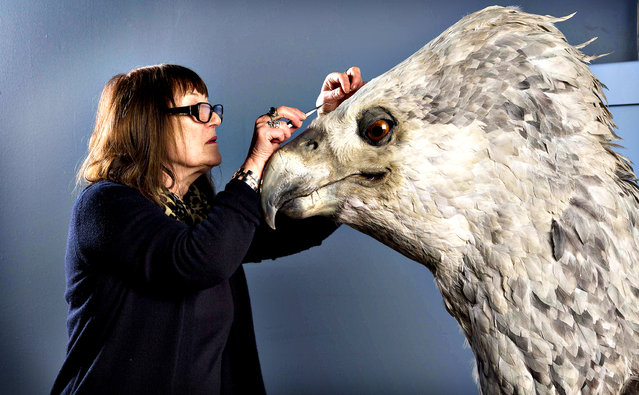
Undated handout photo of Buckbeak, a Hippogriff that lived with Rubeus Hagrid in the Harry Potter series, has his feathers preened and replenished by featherologist Val Jones, as he will feature in the the Feathers and Flight event at Warner Bros. Studio Tour London. (Photo credit should read: Tim Anderson/PA Wire)

Undated handout photo of Buckbeak, a Hippogriff that lived with Rubeus Hagrid in the Harry Potter series, has his feathers preened and replenished by featherologist Val Jones, as he will feature in the the Feathers and Flight event at Warner Bros. Studio Tour London. This is the first make-over Buckbeak has received since the hugely popular Harry Potter film series was made. His intricate coat is created from thousands of individually airbrushed chicken and goose feathers that Val will carefully clean and replenish in time for the start of Feathers and Flight. Val will lead an expert team to demonstrate the techniques that made winged wonders such as Buckbeak and Fawkes the Phoenix a reality on screen. (Photo by Tim Anderson/PA Wire)
Details
22 Mar 2014 13:56:00
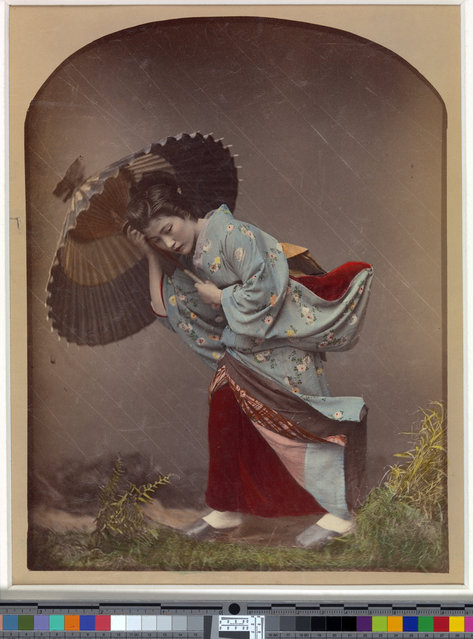
“Woman with Umbrella in Rain” by Raimund von Stillfried. Artist: Kusakabe Kimbei (Japanese, 1841–1934), 1870s. (Photo courtesy of The Metropolitan Museum of Art)

“Woman with Umbrella in Rain” by Raimund von Stillfried. Artist: Kusakabe Kimbei (Japanese, 1841–1934), 1870s. Commercial photography studios in Meiji-era Japan were renowned for the subtlety and refinement of their coloring techniques. This hand-tinted image of a young woman caught in a heavy rainstorm achieved its naturalistic effect by knitting together multiple strands of artifice: the greenery in the foreground was a studio prop; the flaps of the kimono were suspended by thin wires to create the impression of a strong wind; and long, diagonal marks were made on the negative to suggest streaks of rain. (Photo courtesy of The Metropolitan Museum of Art)
Details
12 May 2013 10:13:00