Loading...
Done
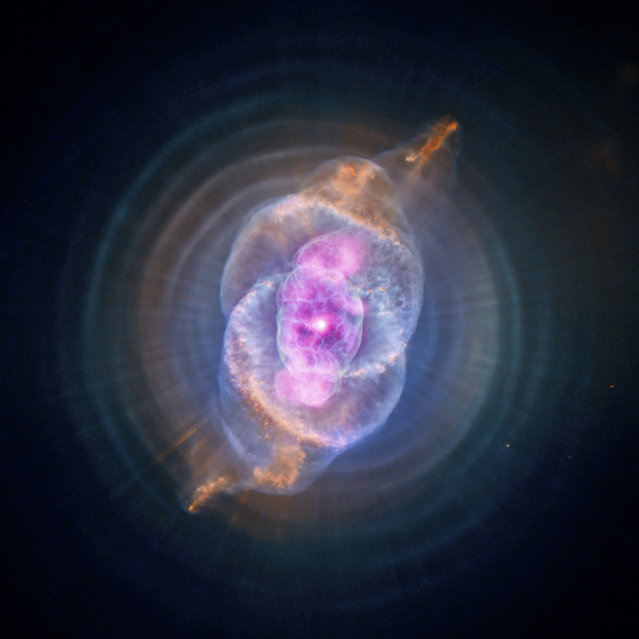
This image is NGC 6543 known as the Cat's Eye Nebula as it appears to the Chandra X-Ray Observatory and Hubble Telescope. A planetary nebula is a phase of stellar evolution that the sun should experience several billion years from now, when it expands to become a red giant and then sheds most of its outer layers, leaving behind a hot core that contracts to form a dense white dwarf star. This image was released October 10, 2012. (Photo by J. Kastner/NASA/CXC/RIT)

This image is NGC 6543 known as the Cat's Eye Nebula as it appears to the Chandra X-Ray Observatory and Hubble Telescope. A planetary nebula is a phase of stellar evolution that the sun should experience several billion years from now, when it expands to become a red giant and then sheds most of its outer layers, leaving behind a hot core that contracts to form a dense white dwarf star. This image was released October 10, 2012. (Photo by J. Kastner/NASA/CXC/RIT)
Details
15 Apr 2013 10:09:00
A member of the musuem team attends to a Aston Martin DB5 used in the James Bond film Goldfinger and being displayed at the Bond In Motion exhibition

A member of the musuem team attends to a Aston Martin DB5 used in the James Bond film Goldfinger and being displayed at the Bond In Motion exhibition at National Motor Museum on January 17, 2012 in Beaulieu, England. (Photo by Matt Cardy/Getty Images)
Details
18 Jan 2012 08:29:00
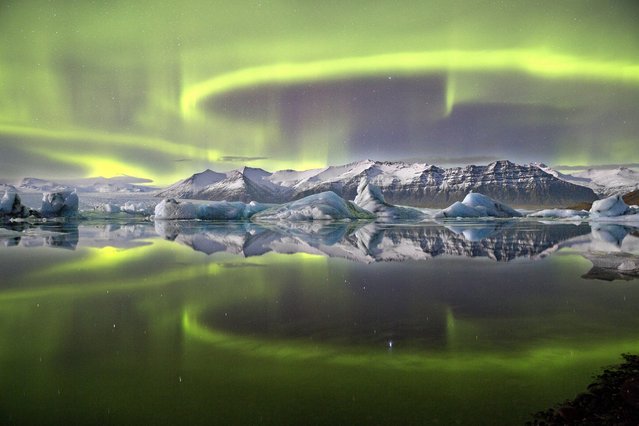
“Aurora over a glacier lagoon”. A vivid green overheaded aurrora pictured in Iceland's Vatnajokull National Park reflected almost symetrically in Jokulsrlon Glacier lagoon. A complete lack of wind and currrent combin in this sheltred lagoon scene to crete an arresting mirror effect giving the image a sensation of utter stillness. Despite theis there is motion on a suprising scale, as the loops and arcs of the aurora are shaped by the shifting forces of the Earth's magnetic field. (Photo by  James Woodend/The Astronomy Photographer of the Year 2014 Contest)

“Aurora over a glacier lagoon”. A vivid green overheaded aurrora pictured in Iceland's Vatnajokull National Park reflected almost symetrically in Jokulsrlon Glacier lagoon. A complete lack of wind and currrent combin in this sheltred lagoon scene to crete an arresting mirror effect giving the image a sensation of utter stillness. Despite theis there is motion on a suprising scale, as the loops and arcs of the aurora are shaped by the shifting forces of the Earth's magnetic field. James Woodend of Great Britain won the grand prize with the image, beating out more than 2,500 other entries. The Astronomy Photographer of the Year 2014 contest is judged by the Royal Observatory Greenwich and BBC Sky at Night magazine. (Photo by James Woodend/The Astronomy Photographer of the Year 2014 Contest)
Details
26 Sep 2014 13:39:00
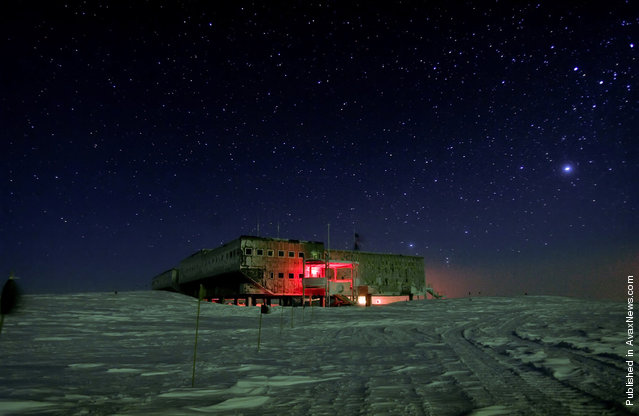
Amundsen-Scott South Pole Station experiences months of darkness. The sun dips below the horizon on March 21, after which follows several weeks of twilight before complete darkness results

Amundsen-Scott South Pole Station experiences months of darkness. The sun dips below the horizon on March 21, after which follows several weeks of twilight before complete darkness results. Photo taken on June 25, 2009. (National Science Foundation/Jeremy Johnson)
Details
08 Apr 2012 13:07:00


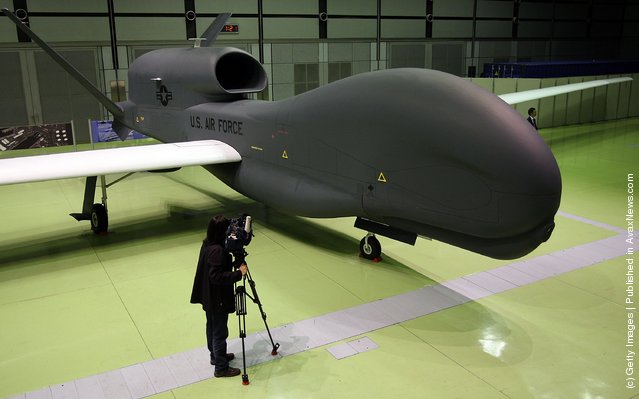
“The Northrop Grumman (formerly Ryan Aeronautical) RQ-4 Global Hawk (known as Tier II+ during development) is an unmanned aerial vehicle (UAV) used by the United States Air Force and Navy as a surveillance aircraft”. – Wikipedia

Photo: A full-scale model of The RQ-4 Global Hawk unmanned plane is displayed during a presentation at PiO Exhibition Center on March 24, 2010 in Tokyo, Japan. (Photo by Koichi Kamoshida/Getty Images)
Details
23 Jul 2011 12:31:00
A ghost glass frog in the Chocó rainforest, Ecuador in November 2020. The marbled swirling “hypnotising” eyes are thought to be helpful in attracting a mate. (Photo by David Weiller/WENN)

A ghost glass frog in the Chocó rainforest, Ecuador in November 2020. The marbled swirling “hypnotising” eyes are thought to be helpful in attracting a mate. (Photo by David Weiller/WENN)
Details
19 May 2022 04:36:00
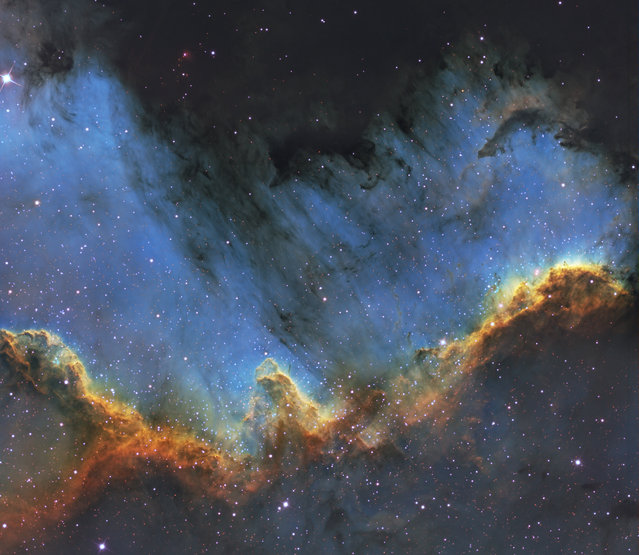
The Cygnus Wall is in the southern  area of NGC7000 also known as the North America Nebula. It is approximately 1800 light years from Earth, and is in the constellation Cygnus. The Wall is an energized shock front and contains the most concentrated star formations in the nebula. The size of the North America Nebula is about 4 full moons. (Bill Snyder)

Amateur astronomer Bill Snyder has been involved with astrophotography since 2007. Photo: The Cygnus Wall is in the southern area of NGC7000 also known as the North America Nebula. It is approximately 1800 light years from Earth, and is in the constellation Cygnus. The Wall is an energized shock front and contains the most concentrated star formations in the nebula. The size of the North America Nebula is about 4 full moons. (Photo and caption by Bill Snyder)
Details
30 Oct 2013 09:15:00
Folk dancers in Ahmedabad, western India, rehearsing on September 14, 2025 for the Hindu festival of Navaratri, which begins next week. (Photo by Sam Panthaky/Getty Images)

Folk dancers in Ahmedabad, western India, rehearsing on September 14, 2025 for the Hindu festival of Navaratri, which begins next week. (Photo by Sam Panthaky/Getty Images)
Details
29 Sep 2025 03:48:00