Loading...
Done
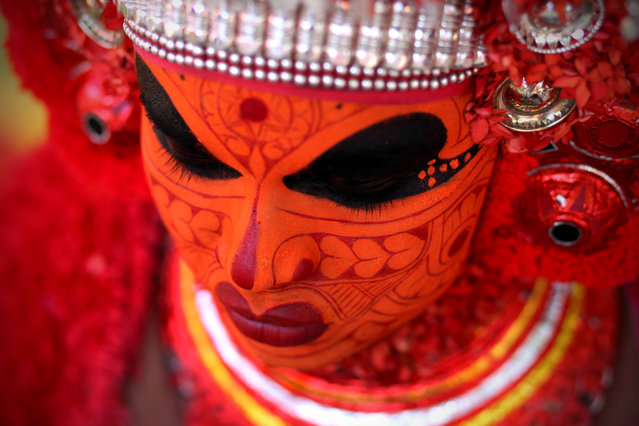
“Theyyam”. Preparation for the Theyyam performance in the surroundings of Kasaragod city. Theyyam is a popular ritual dance form of North Kerala, particularly in Kannur and Kasargod districts. The Theyyam represents a mythological, divine or heroic character. Make up of Theyyams is done by specialist. There are different types of face painting for which primarily and secondary colours are used. Photo location:  Kasaragod, India. (Photo and caption by Rafal Ziejewski/National Geographic Photo Contest)

“Theyyam”. Preparation for the Theyyam performance in the surroundings of Kasaragod city. Theyyam is a popular ritual dance form of North Kerala, particularly in Kannur and Kasargod districts. The Theyyam represents a mythological, divine or heroic character. Make up of Theyyams is done by specialist. There are different types of face painting for which primarily and secondary colours are used. Therefore it is essential that the makeup man should have perfect knowledge of primary and secondary colour combinations. Sometimes, it takes several hours to paint each face. Photo location: Kasaragod, India. (Photo and caption by Rafal Ziejewski/National Geographic Photo Contest)
Details
02 Jul 2014 10:42:00
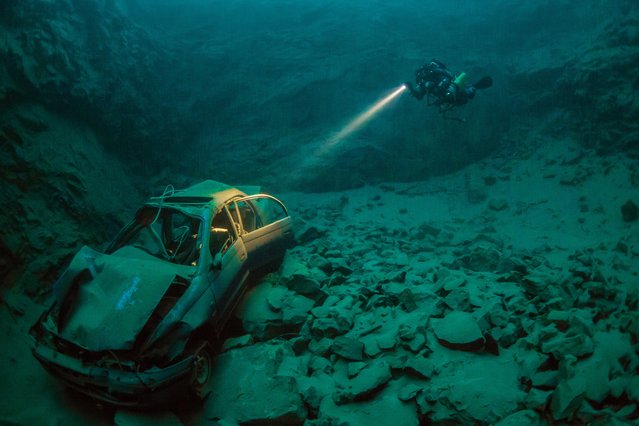
Wide-angle category winner. Part of the Illusion by Marcus Blatchford (UK). Location: National Dive & Activity Centre, Chepstow, Wales. “This is the deepest inland dive centre in the UK. The dive plan was to explore the deep end, but this time I dived ‘unplugged’ (without my strobes). With the exception of this change to my camera technique, there were no planned shots I wanted to achieve – just a fun dive with ad-hoc photos along the way. Shortly after this photo was captured, in 6C water and two hours of decompression ahead of us, we turned and started the long ascent back to the surface”. (Photo by Marcus Blatchford/Underwater Photographer of the Year 2016)

Wide-angle category winner. Part of the Illusion by Marcus Blatchford (UK). Location: National Dive & Activity Centre, Chepstow, Wales. “This is the deepest inland dive centre in the UK. The dive plan was to explore the deep end, but this time I dived ‘unplugged’ (without my strobes). With the exception of this change to my camera technique, there were no planned shots I wanted to achieve – just a fun dive with ad-hoc photos along the way. Shortly after this photo was captured, in 6C water and two hours of decompression ahead of us, we turned and started the long ascent back to the surface”. (Photo by Marcus Blatchford/Underwater Photographer of the Year 2016)
Details
18 Feb 2016 13:44:00
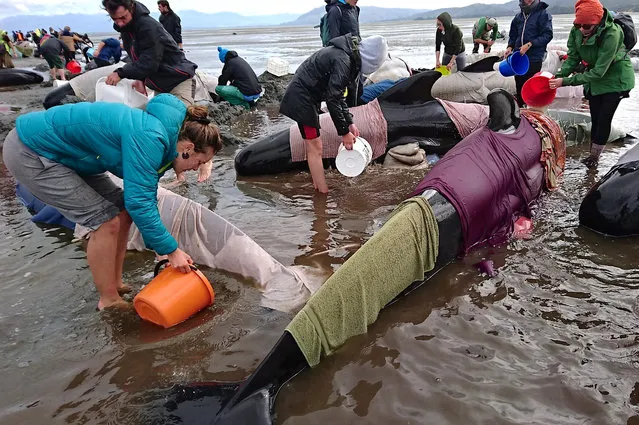
Volunteers try to keep alive some of the hundreds of stranded pilot whales after one of the country's largest recorded mass whale strandings, in Golden Bay, at the top of New Zealand's south island, February 10, 2017. (Photo by Ross Wearing/Reuters)

Volunteers try to keep alive some of the hundreds of stranded pilot whales after one of the country's largest recorded mass whale strandings, in Golden Bay, at the top of New Zealand's south island, February 10, 2017. Volunteers in New Zealand managed to refloat about 100 surviving pilot whales on Saturday, February 11, 2017 and are hoping they will swim back out to sea after more than 400 of the creatures swam aground at a remote beach. (Photo by Ross Wearing/Reuters)
Details
12 Feb 2017 00:06:00
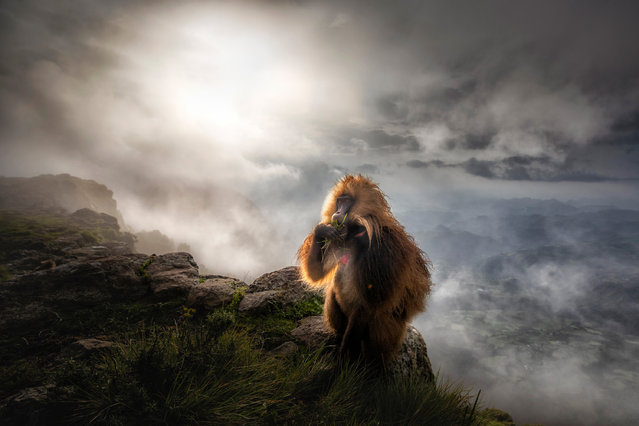
Highly commended, mammals: Gelada after the storm – Marco Gaiotti (Italy). “Gelada baboons are the only monkey species in the world that feed on grasses. They are native to the tableland of Ethiopia. Every morning large family groups wander from their sleeping places in the steep rock face, up to 1,000 metres high, to the feeding grounds at the tablelands. This image clearly depicts their feeding strategy: they pull out bunches of grass, sort the stalks and then lift them to their mouth. This shot was taken towards the end of the rainy season after a heavy storm”. (Photo by Marco Gaiotti/2019 GDT European Wildlife Photographer of the Year)

Highly commended, mammals: Gelada after the storm – Marco Gaiotti (Italy). “Gelada baboons are the only monkey species in the world that feed on grasses. They are native to the tableland of Ethiopia. Every morning large family groups wander from their sleeping places in the steep rock face, up to 1,000 metres high, to the feeding grounds at the tablelands. This image clearly depicts their feeding strategy: they pull out bunches of grass, sort the stalks and then lift them to their mouth. This shot was taken towards the end of the rainy season after a heavy storm”. (Photo by Marco Gaiotti/2019 GDT European Wildlife Photographer of the Year)
Details
31 Oct 2019 00:03:00
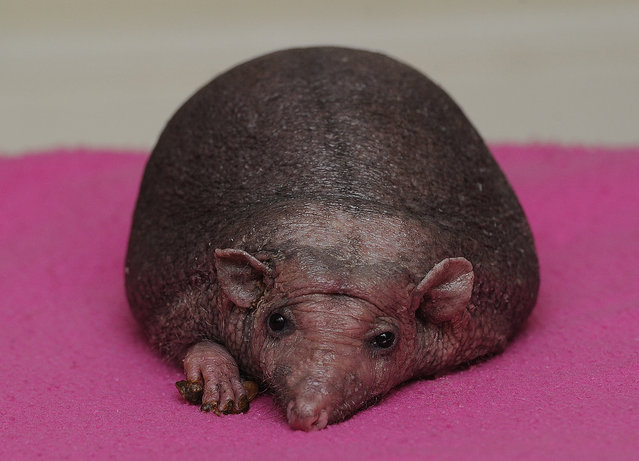
Meet the world's smoothest cuddliest hedgehog. Names after brave hero, but Nelson is completely bald so when curled up he looks like an egg. Doesn't have a single prickle or strand of hair. Thought to be suffering a stress related alopecia following a trauma in the wild. Volunteers have been massaging him for half an hour a day for the last year to encourage spikes to grow. Now given up but he still gets daily massages because he enjoys them so much and to keep his cuddle skin soft and smooth. Unlike his namesake Nelson could not defend himself so will live out his days at the Foxy Lodge Wildlife Rescue in Hemsby, England. (Photo by Jeremy Durkin)

Meet the world's smoothest cuddliest hedgehog. Names after brave hero, but Nelson is completely bald so when curled up he looks like an egg. Doesn't have a single prickle or strand of hair. Thought to be suffering a stress related alopecia following a trauma in the wild. Volunteers have been massaging him for half an hour a day for the last year to encourage spikes to grow. Now given up but he still gets daily massages because he enjoys them so much and to keep his cuddle skin soft and smooth. Unlike his namesake Nelson could not defend himself so will live out his days at the Foxy Lodge Wildlife Rescue in Hemsby, England. (Photo by Jeremy Durkin)
Details
23 Oct 2016 11:33:00
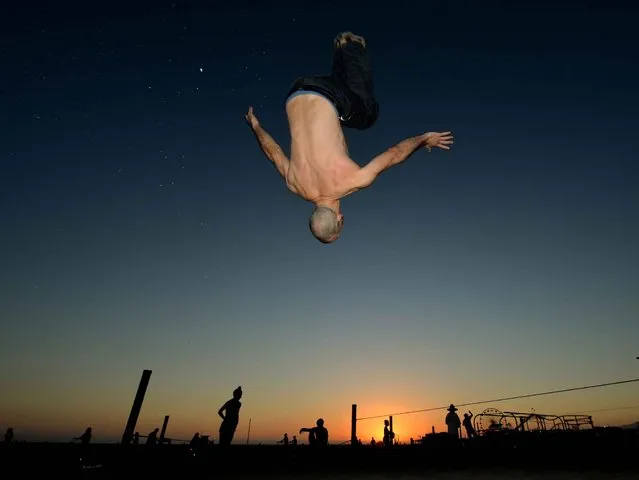
Dhruva Aliman does a back somersault as he dismounts from a slackline on the beach at Santa Monica, California on October 19, 2014. Slackline is a balance sport where a line of webbing is adjusted at different levels of tension between two anchor points and participants (called slackers) perform tricks and stunts including somersaults. (Photo by Mark Ralston/AFP Photo)

Dhruva Aliman does a back somersault as he dismounts from a slackline on the beach at Santa Monica, California on October 19, 2014. Slackline is a balance sport where a line of webbing is adjusted at different levels of tension between two anchor points and participants (called slackers) perform tricks and stunts including somersaults. (Photo by Mark Ralston/AFP Photo)
Details
25 Oct 2014 13:49:00
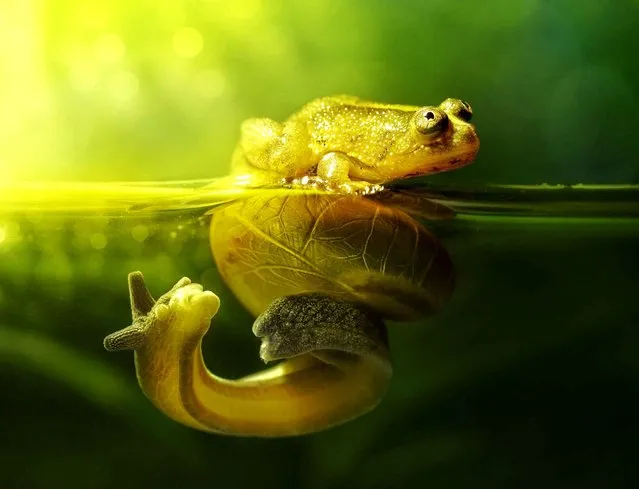
A frog sits on a leaf and instead of seeing a reflection of itself in the water below, it sees a snail, attached to the bottom of the leaf, in a fish tank in Vietnam. (Photo by Duong Quoc Dinh/Solent Ne/SIPA Press)

A frog sits on a leaf and instead of seeing a reflection of itself in the water below, it sees a snail, attached to the bottom of the leaf, in a fish tank in Vietnam. (Photo by Duong Quoc Dinh/Solent Ne/SIPA Press)
Details
26 Jan 2014 13:05:00
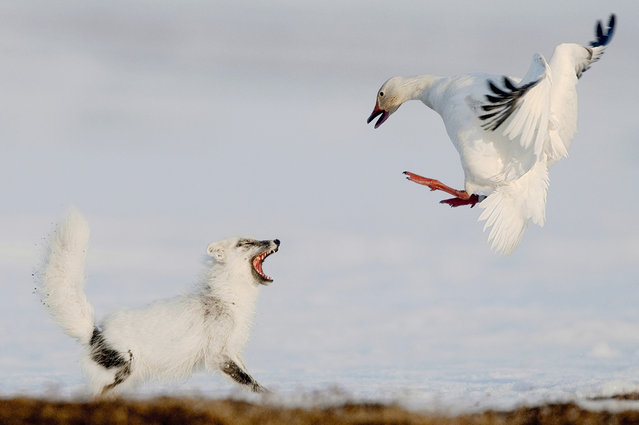
Commended. In late May, about a quarter of a million snow geese arrive from North America to nest on Wrangel Island, in northeastern Russia. They form the world's largest breeding colony of snow geese. Photographer Sergey Gorshkov spent two months on the remote island photographing the unfolding dramas. (Photo by Sergey Gorshkov/Veolia Environnement Wildlife Photographer)

Commended. In late May, about a quarter of a million snow geese arrive from North America to nest on Wrangel Island, in northeastern Russia. They form the world's largest breeding colony of snow geese. Photographer Sergey Gorshkov spent two months on the remote island photographing the unfolding dramas. Arctic foxes take advantage of the abundance of eggs, caching surplus eggs for leaner times. But a goose (here the gander) is easily a match for a fox, which must rely on speed and guile to steal eggs. “The battles were fairly equal”, notes Sergey, “and I only saw a fox succeed in grabbing an egg on a couple of occasions, despite many attempts”. Surprisingly, “the geese lacked any sense of community spirit”, he adds, “and never reacted when a fox harassed a neighboring pair nesting close by”. (Photo by Sergey Gorshkov/Veolia Environnement Wildlife Photographer)
Details
16 Jun 2015 12:30:00