Loading...
Done
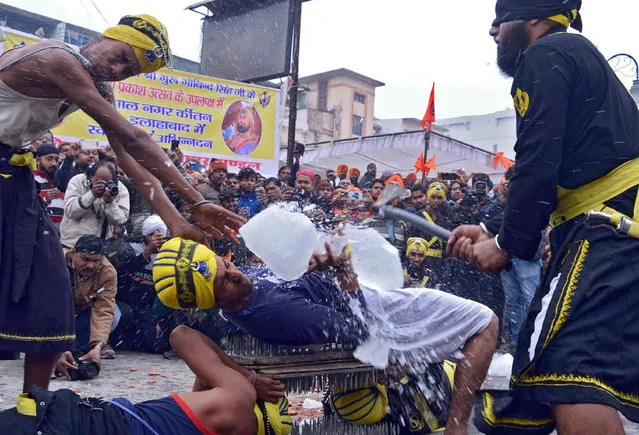
Sikh devotee take part in Nagar Keertan procession on the occasion of Guru Gobind Singh birth anniversary in Allahabad, India on December 29, 2016. (Photo by Prabhat Kumar Verma/Pacific Press via ZUMA Wire/Rex Features/Shutterstock)

Sikh devotee take part in Nagar Keertan procession on the occasion of Guru Gobind Singh birth anniversary in Allahabad, India on December 29, 2016. Guru Gobind Singh, born Gobind Rai (1666 – 1708), was the 10th Sikh Guru, a spiritual master, warrior, poet and philosopher. When his father, Guru Tegh Bahadur, was beheaded for refusing to convert to Islam, Guru Gobind Singh was formally installed as the leader of the Sikhs at age nine, becoming the last of the living Sikh Gurus. (Photo by Prabhat Kumar Verma/Pacific Press via ZUMA Wire/Rex Features/Shutterstock)
Details
31 Dec 2016 10:27:00
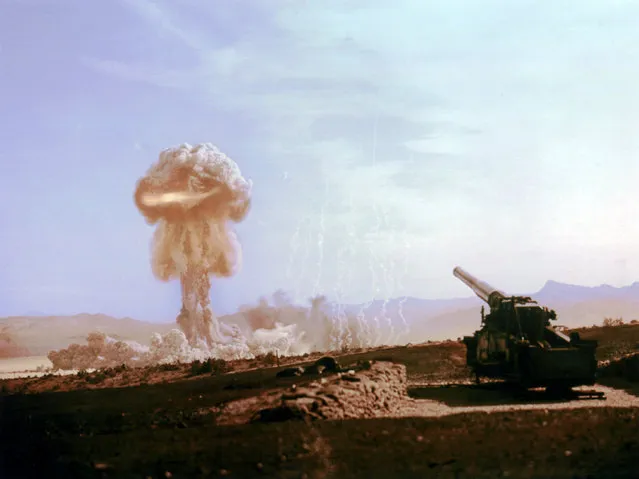
Atomic Annie at work during the Upshot-Knothole test series, 1953. (Photo by Los Alamos National Laboratory/US Army)

“A fter the former Soviet Union conducted its first nuclear test in August 1949, the US reevaluated its postwar defense policies. With the US monopoly on atomic weapons broken, military and political leaders chose to diversify the American stockpile by developing thermonuclear and tactical nuclear weapons. One of the more interesting concepts to come out of this period was atomic artillery, which was successfully tested at the Nevada Proving Grounds (now the Nevada Test Site) in May 1953”. – Alan Carr. Photo: Atomic Annie at work during the Upshot-Knothole test series, 1953. (Photo by Los Alamos National Laboratory/US Army)
Details
11 Mar 2013 11:43:00
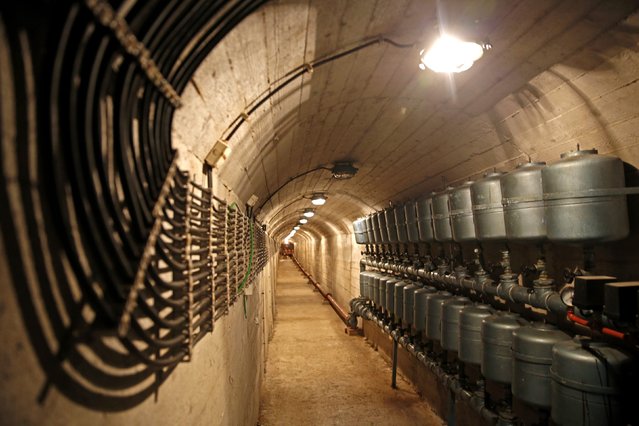
A tunnel with electric switches are seen in Josip Broz Tito's underground secret bunker (ARK) in Konjic, October 16, 2014. (Photo by Dado Ruvic/Reuters)

A tunnel with electric switches are seen in Josip Broz Tito's underground secret bunker (ARK) in Konjic, October 16, 2014. In the early 1950s, Josip Broz Tito, the late leader of the former Yugoslavia, ordered the building of the secret bunker, located 900 feet (270 m) underground and near the Bosnian town of Konjic, to safeguard the country's ruling class in case of a nuclear attack. Construction at the complex, which had a cost equivalent price tag of $4.6 billion, continued until 1979, the year before Tito died. (Photo by Dado Ruvic/Reuters)
Details
28 Nov 2014 12:14:00
A one month old Turquoise colored Green Veiled Chameleon perches on a finger in the Cardin's Chameleons boothat Repticon 2014 Sunday, August 3, 2014 in Jacksonville, Fla. The vendor specializes in captive bred and born Veiled Chameleons and this particular specimen cost $40.00. (Photo by Bob Self/AP Photo/The Florida Times-Union)

A one month old Turquoise colored Green Veiled Chameleon perches on a finger in the Cardin's Chameleons boothat Repticon 2014 Sunday, August 3, 2014 in Jacksonville, Fla. The vendor specializes in captive bred and born Veiled Chameleons and this particular specimen cost $40.00. The Repticon reptile and Exotic Animal show made its stop in Jacksonville over Saturday and Sunday offering a variety of cold blooded critters and related supplies for sale at the University Center on the University of North Florida campus. The show, which travels nationally stops in Jacksonville several times a year according to event vendor team leader Patty Healey. (Photo by Bob Self/AP Photo/The Florida Times-Union)
Details
09 Aug 2014 11:36:00


“Sektor gaza” (Russian: Сектор газа) was a Russian rock band formed on 5 December 1987 in the city of Voronezh, Russia. Despite only semi-officially existing (due to obscene lyrics), the group remains popular in Russia today. The group name was taken from an eponymous industrial district of Voronezh (itself named for high levels of environmental contamination). Their music style could be defined as Russian punk, integrated with elements of different musical genres such as rock, rap, and Russian folk. On 4 July 2000, group leader Yuri “Hoy” Klinskih complained of strong pains in his stomach and the left side of his chest. He suffered heart failure shortly thereafter. Klinskikh died in Voronezh (Russia)at the age of 35. He is buried in the Levoberezhniy Cemetery. The group ceased to exist.

About the music video: The First Chechen War, also known as the War in Chechnya, was a conflict between the Russian Federation and the Chechen Republic of Ichkeria, fought from December 1994 to August 1996. After the initial campaign of 1994 – 1995, culminating in the devastating Battle of Grozny, Russian federal forces attempted to seize control of the mountainous area of Chechnya but were set back by Chechen guerrilla warfare and raids on the flatlands in spite of Russia's overwhelming manpower, weaponry, and air support...

Details
24 May 2012 14:38:00
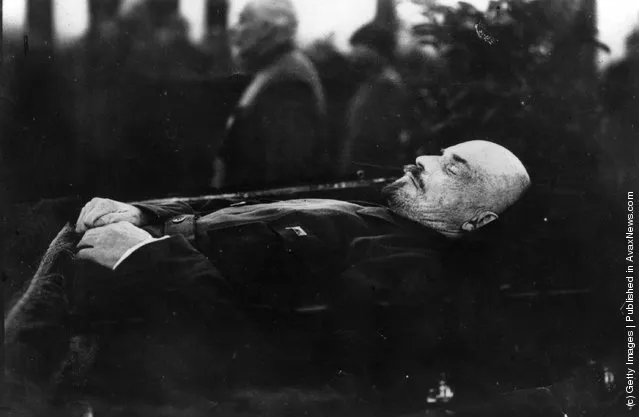
1924:  Vladimir Ilyich Lenin lying in state in the Kremlin

Photo: Vladimir Ilyich Lenin (1870 – 1924) lying in state in the Kremlin. (Photo by Hulton Archive/Getty Images). 1924

Important! For the same article in Russian language click here.

Something quite intriguing is happening within Russian-speaking internet during the last few – should you type a fully academic inquiry (at least, according to Russian academic requirements) in national search engines for "Lenin's mausoleum" – the first thing you get (even in top 10 searches) is website pages talking about black magic and occult. Website authors view this construction differently, but unconditionally agree on one thing: the mausoleum of the "leader of the world proletariat” – the essence of a magical artifact, a sort of “energy vampire”. It was built with a certain purpose: to drain the energy out of miserable Soviet citizens on one hand; and to poison the anthroposphere of one-sixth part of the earth with its vibes (the exact territory that was occupied by the former Soviet Union), depriving the Russian people of will to resist on the other hand. Complete nonsense? No doubt. Nevertheless, an intriguing one. Well, probably because some oddities do exist in mausoleum's history. These oddities are the thing we are going to discuss this time. First, let me refresh you memory on the subject.
Details
16 Oct 2011 11:27:00
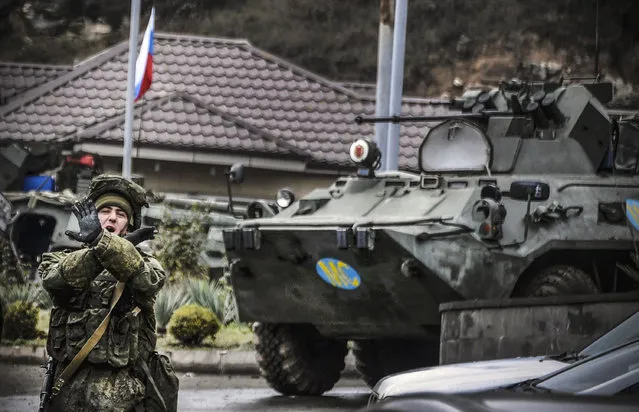
A Russian peacekeeper shouts “No pictures!” at a checkpoint outside the city of Stepanakert on November 13, 2020, during a ceasefire in the military conflict between Armenia and Azerbaijan over the breakaway region of Nagorno-Karabakh. Russian began deploying 2,000 peacekeepers to Nagorno-Karabakh on November 10 after Armenia and Azerbaijan agreed a peace deal to end weeks of fierce fighting over the disputed region. The Moscow-brokered agreement came after a string of Azerbaijani victories in its fight to retake the ethnic Armenian enclave. It sparked celebrations in Azerbaijan but fury in Armenia, where protesters took to the streets to denounce their leaders for losses in the territory, which broke from Azerbaijan's control during a war in the early 1990s. (Photo by Alexander Nemenov/AFP Photo)

A Russian peacekeeper shouts “No pictures!” at a checkpoint outside the city of Stepanakert on November 13, 2020, during a ceasefire in the military conflict between Armenia and Azerbaijan over the breakaway region of Nagorno-Karabakh. Russian began deploying 2,000 peacekeepers to Nagorno-Karabakh on November 10 after Armenia and Azerbaijan agreed a peace deal to end weeks of fierce fighting over the disputed region. (Photo by Alexander Nemenov/AFP Photo)
Details
15 Nov 2020 00:07:00
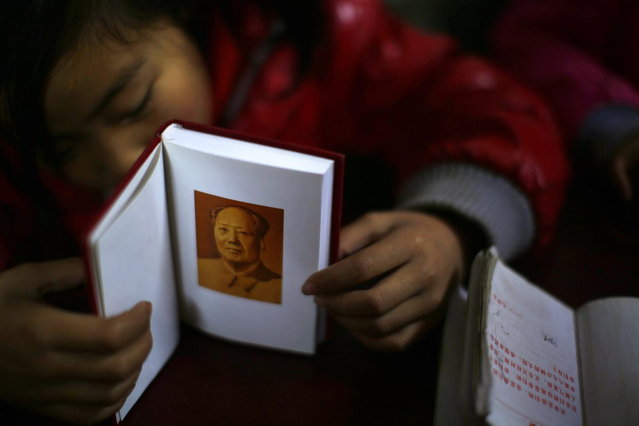
A student falls asleep as she holds a book containing a portrait of China's late chairman Mao Zedong during a lesson at the Democracy Elementary and Middle School in Sitong town, Henan province December 3, 2013. (Photo by Carlos Barria/Reuters)

A student falls asleep as she holds a book containing a portrait of China's late chairman Mao Zedong during a lesson at the Democracy Elementary and Middle School in Sitong town, Henan province December 3, 2013. In a remote part of central China, the day starts at the Democracy Elementary and Middle School with a pre-dawn jog, some revolutionary songs and then an activity long since forgotten at other schools: reciting quotations from Mao Zedong's famed “Little Red Book”. While the ruling Communist Party that Mao led continues to hold him in esteem as the leader of the Communist Revolution, his radical policies and teachings have been largely shelved since his death in 1976 in favour of a pro-market approach that has turned China from a backwater into the world's second biggest economy. The 120th anniversary of Mao's birth is on December 26, 2013. (Photo by Carlos Barria/Reuters)
Details
19 Dec 2013 09:40:00