Loading...
Done
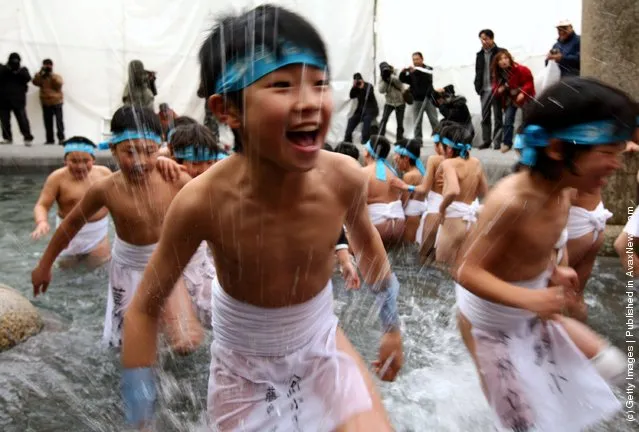
Japanese children wear loincloths as they splash about in freezing cold water during Saidaiji Naked Festival, at Saidaiji Temple

“A Hadaka Matsuri (“Naked Festival”) is a type of Japanese festival, or matsuri, in which participants wear a minimum amount of clothing; usually just a Japanese loincloth (called fundoshi), sometimes with a short happi coat, and rarely completely naked. Whatever the clothing, it is considered to be above vulgar, or everyday, undergarments, and on the level of holy Japanese shrine attire. Naked festivals are held in dozens of places throughout Japan every year, usually in the summer or winter. The most famous festival is held in Okayama, where the festival originated. Every year, over 9,000 men participate in this festival”. – Wikipedia

Photo: Japanese men wear loincloths as they splash about in freezing cold water during Saidaiji Naked Festival, at Saidaiji Temple on February 18, 2012 in Okayama, Japan. (Photo by Buddhika Weerasinghe/Getty Images)
Details
19 Feb 2012 12:18:00
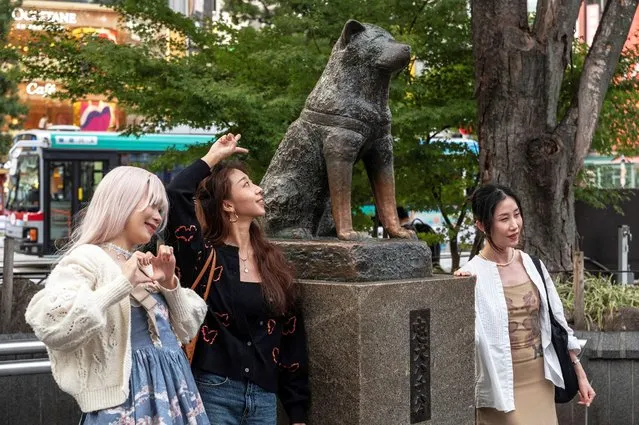
This photo taken on November 6, 2023 shows people posing for photos next to the statue of “Hachiko” in front of Shibuya station in central Tokyo, ahead of the 100th anniversary of the legendary dog's birth this month. A century since its birth, the tale of the loyal companion who had waited at the Shibuya train station for its master to come home – not knowing he had already died – continues to inspire the public, who have made the statue a singular landmark at a glitzy hub of Tokyo's street culture. (Photo by Richard A. Brooks/AFP Photo)

This photo taken on November 6, 2023 shows people posing for photos next to the statue of “Hachiko” in front of Shibuya station in central Tokyo, ahead of the 100th anniversary of the legendary dog's birth this month. A century since its birth, the tale of the loyal companion who had waited at the Shibuya train station for its master to come home – not knowing he had already died – continues to inspire the public, who have made the statue a singular landmark at a glitzy hub of Tokyo's street culture. (Photo by Richard A. Brooks/AFP Photo)
Details
27 Nov 2023 00:06:00
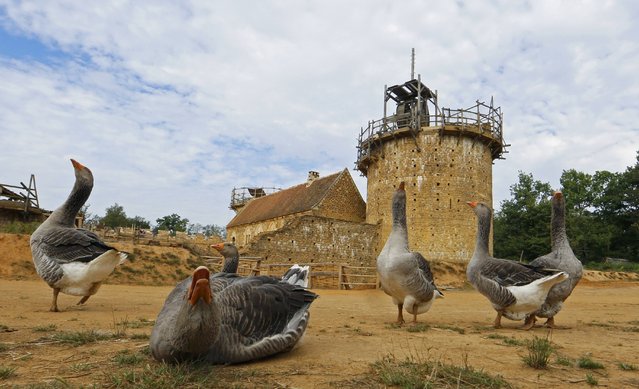
A view of the construction site of the Chateau de Guedelon near Treigny in the Burgundy region of France, September 13, 2016. Blacksmiths, stonemasons and quarry men are hard at work in a Burgundy forest building a 13th-century-style castle using the most basic tools and materials, replicating the methods used hundreds of years ago to better understand them. Forgoing all modern technology, workers use hammers to break stones and forge iron, operate wooden wheels to hoist their materials up to where they are needed, and rely on a quarry for stone, clay and sand as they build up a castle from scratch. Construction on Guedelon Castle in central France began in 1997 after an archaeological survey revealed a medieval fortress hidden inside the walls of nearby Chateau de Saint-Fargeau. Those behind the project hope to answer questions about medieval construction and provide lessons on sustainable building. (Photo by Jacky Naegelen/Reuters)

A view of the construction site of the Chateau de Guedelon near Treigny in the Burgundy region of France, September 13, 2016. Blacksmiths, stonemasons and quarry men are hard at work in a Burgundy forest building a 13th-century-style castle using the most basic tools and materials, replicating the methods used hundreds of years ago to better understand them. (Photo by Jacky Naegelen/Reuters)
Details
15 Sep 2016 09:43:00
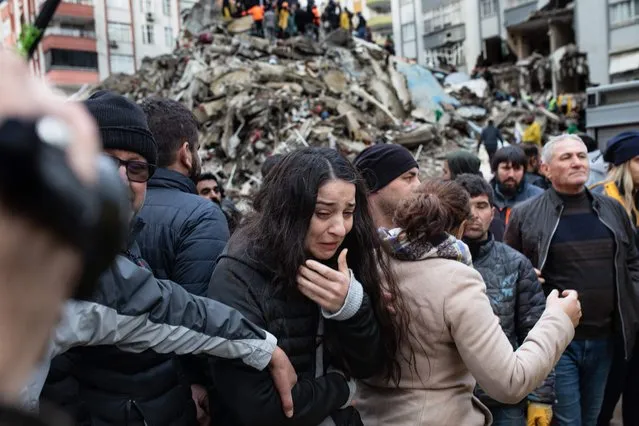
A woman reacts as rescuers search for survivors through the rubble of collapsed buildings in Adana, on February 6, 2023 after a 7,8 magnitude earthquake struck the country's south-east. The combined death toll has risen to over 1,900 for Turkey and Syria after the region's strongest quake in nearly a century. Turkey's emergency services said at least 1,121 people died in the earthquake, with another 783 confirmed fatalities in Syria. (Photo by Can Erok/AFP Photo)

A woman reacts as rescuers search for survivors through the rubble of collapsed buildings in Adana, on February 6, 2023 after a 7,8 magnitude earthquake struck the country's south-east. The combined death toll has risen to over 1,900 for Turkey and Syria after the region's strongest quake in nearly a century. Turkey's emergency services said at least 1,121 people died in the earthquake, with another 783 confirmed fatalities in Syria. (Photo by Can Erok/AFP Photo)
Details
08 Feb 2023 05:57:00
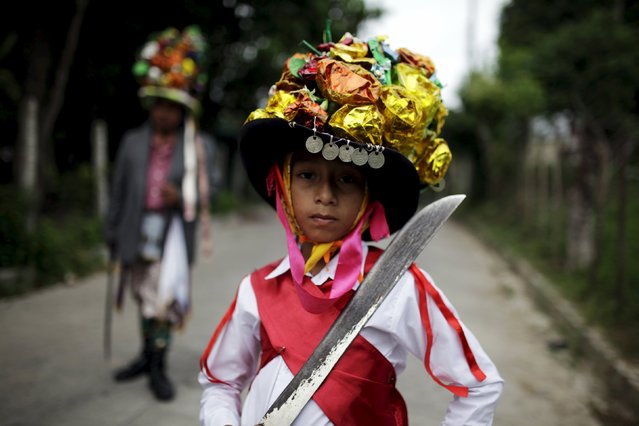
A participant in the traditional dance of Los Historiantes poses for a picture prior to performing in the festivity held in the honour of Saint James, in Santiago Nonualco July 22, 2015. The traditional dance was brought to Latin America by the Spanish, and participants each dramatise an episode of the battles between the Christians and the Moors that took place on the Iberian Peninsula about eight centuries ago, according to the dancers. (Photo by Jose Cabezas/Reuters)

A participant in the traditional dance of Los Historiantes poses for a picture prior to performing in the festivity held in the honour of Saint James, in Santiago Nonualco July 22, 2015. The traditional dance was brought to Latin America by the Spanish, and participants each dramatise an episode of the battles between the Christians and the Moors that took place on the Iberian Peninsula about eight centuries ago, according to the dancers. (Photo by Jose Cabezas/Reuters)
Details
24 Jul 2015 11:56:00
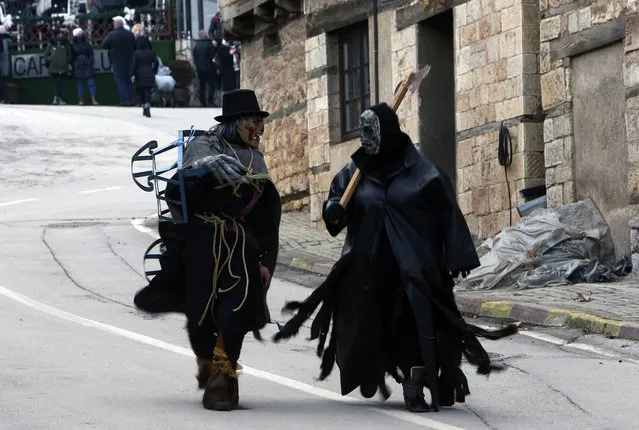
Costumed revelers walk through a street prior to the carnival parade in the village of Vevcani, in the southwestern part of North Macedonia, on Wednesday, January 13, 2021. The coronavirus pandemic has disrupted the usual carnival celebrations which have been taken place for centuries in the tiny North Macedonian town of Vevcani. A few hundred locals gathered at the small town square to celebrate the carnival, but police dispersed the gathering after a brief scuffle with a small group. No arrests or injuries were reported. (Photo by Boris Grdanoski/AP Photo)

Costumed revelers walk through a street prior to the carnival parade in the village of Vevcani, in the southwestern part of North Macedonia, on Wednesday, January 13, 2021. The coronavirus pandemic has disrupted the usual carnival celebrations which have been taken place for centuries in the tiny North Macedonian town of Vevcani. A few hundred locals gathered at the small town square to celebrate the carnival, but police dispersed the gathering after a brief scuffle with a small group. No arrests or injuries were reported. (Photo by Boris Grdanoski/AP Photo)
Details
15 Jan 2021 00:07:00
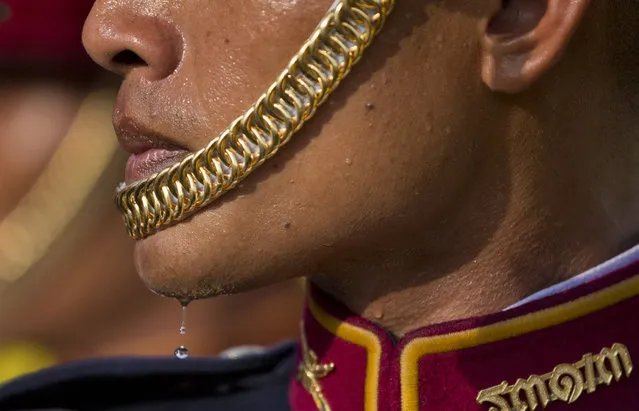
A solders in ceremonial attire sweats as he waits outside Suddhaisavarya Prasad Hall, in which Thailand's King Maha Vajiralongkorn scheduled to grant a public audience in Bangkok, Thailand, Monday, May 6, 2019. King Maha Vajiralongkorn was officially crowned amid the splendour of the country's Grand Palace, taking the central role in an elaborate centuries-old royal ceremony that was last held almost seven decades ago. (Photo by Gemunu Amarasinghe/AP Photo)

A solders in ceremonial attire sweats as he waits outside Suddhaisavarya Prasad Hall, in which Thailand's King Maha Vajiralongkorn scheduled to grant a public audience in Bangkok, Thailand, Monday, May 6, 2019. King Maha Vajiralongkorn was officially crowned amid the splendour of the country's Grand Palace, taking the central role in an elaborate centuries-old royal ceremony that was last held almost seven decades ago. (Photo by Gemunu Amarasinghe/AP Photo)
Details
14 May 2019 00:01:00
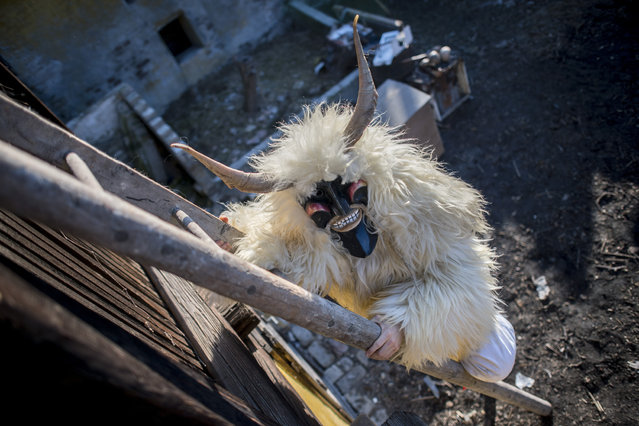
A man wears a busho mask and a costume made of sheep pelt while climbing up a ladder outside a barn in Mohacs, Hungary, 20 February 2020, on the first day of carnival. The traditional Busho carnival, which marks the end of winter, dates back to the 16th century. According to local legend, members of an ethnic South Slavic group living in Mohacs at the time dressed up in similar costumes and wore wooden masks to scare away Ottoman invaders, who mistook them for demons. (Photo by Tamas Soki/EPA/EFE)

A man wears a busho mask and a costume made of sheep pelt while climbing up a ladder outside a barn in Mohacs, Hungary, 20 February 2020, on the first day of carnival. The traditional Busho carnival, which marks the end of winter, dates back to the 16th century. According to local legend, members of an ethnic South Slavic group living in Mohacs at the time dressed up in similar costumes and wore wooden masks to scare away Ottoman invaders, who mistook them for demons. (Photo by Tamas Soki/EPA/EFE)
Details
23 Feb 2020 00:07:00