Loading...
Done
Highly commended birds : Crested guan by Tim Hunt (UK). ‘This photo shows a crested guan in the cloud forests of Costa Rica as it pauses while foraging on a lone branch. Due to the clouds that are so typical for this habitat, I could often only photograph the bird’s silhouette against a grey sky. (Photo by Tim Hunt/GDT European Wildlife Photographer of the Year 2015)

Highly commended birds : Crested guan by Tim Hunt (UK). ‘This photo shows a crested guan in the cloud forests of Costa Rica as it pauses while foraging on a lone branch. Due to the clouds that are so typical for this habitat, I could often only photograph the bird’s silhouette against a grey sky. But then, for a short moment only, the sun broke through the clouds, and I overexposed the image by over two stops in order to blow out the background and allow this beautifully marked bird to stand out’. (Photo by Tim Hunt/GDT European Wildlife Photographer of the Year 2015)
Details
24 Nov 2015 08:01:00
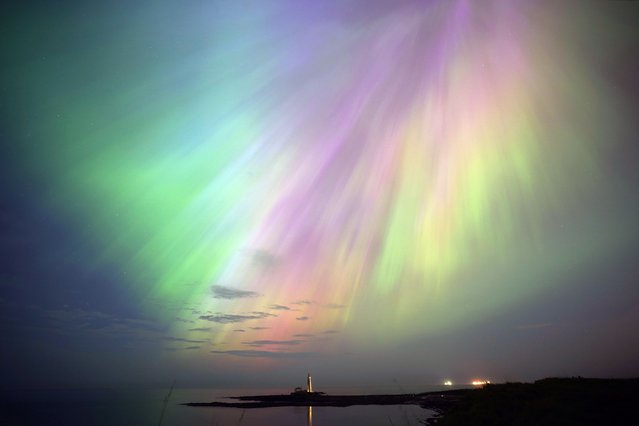
A man poses standing on a rock looking at the aurora borealis, or northern lights, illuminating the night sky at Embleton Bay in Northumberland, England, on February 27, 2014. The northern lights is a fantastical natural light display with fast moving light effects caused by particles charged by the sun colliding with particles in Earth's upper atmosphere. (Photo by Tom White/PA Wire)

A man poses standing on a rock looking at the aurora borealis, or northern lights, illuminating the night sky at Embleton Bay in Northumberland, England, on February 27, 2014. The northern lights is a fantastical natural light display with fast moving light effects caused by particles charged by the sun colliding with particles in Earth's upper atmosphere. (Photo by Tom White/PA Wire)
Details
02 Mar 2014 10:12:00
A meteor streaks over the sky during the Perseid meteor shower at the Maculje archaeological site near Novi Travnik August 12, 2014. According to NASA, the annual Perseid meteor shower reaches its peak on August 12 and 13 in Europe. The fireballs from the meteorites are fast and plentiful, although a nearly full moon (Supermoon) makes it difficult to view them this year, the agency adds. (Photo by Dado Ruvic/Reuters)

A meteor streaks over the sky during the Perseid meteor shower at the Maculje archaeological site near Novi Travnik August 12, 2014. According to NASA, the annual Perseid meteor shower reaches its peak on August 12 and 13 in Europe. The fireballs from the meteorites are fast and plentiful, although a nearly full moon (Supermoon) makes it difficult to view them this year, the agency adds. (Photo by Dado Ruvic/Reuters)
Details
14 Aug 2014 10:45:00
An empty camp is shown beneath a colourful sky in Siberia, December 2016. (Photo by Timothy Allen/Barcroft Productions)

A British photographer has captured life at the “edge of the world”. Timothy Allen, best known for his work on BBC's Human Planet, trekked through the freezing Siberian wilderness for 16 days as he joined part of an 800km migration of reindeer in the Yamal-Nenets region – a name that roughly translates to “edge of the world”. The stunning pictures feature the nomadic Nenets tribe, who drink blood to survive in -45°C temperatures. Timothy's epic journey, which will be revealed in an eight-minute documentary on Animal Planet USA, saw him travel across the bleak terrain of the frozen Ob River with the Nenets people in December last year. Here: An empty camp is shown beneath a colourful sky in Siberia, December 2016. (Photo by Timothy Allen/Barcroft Productions)
Details
19 Sep 2017 07:48:00
Storm erupts over Pacific Ocean as plane zooms past at 37,000 ft. The amazing picture shows a massive cloud erupting against a starry night sky as the off-duty airman Santiago Borja flew over the Pacific near Panama City. He had just moments to take the breathtaking snap as the Boeing 767 zoomed by at 37,000 ft on its way from North America to Ecuador. He also had take the picture perfectly in time with the flash of lightning to capture the storm in all its glory. (Photo by Santiago Borja/Solent News)

Storm erupts over Pacific Ocean as plane zooms past at 37,000 ft. The amazing picture shows a massive cloud erupting against a starry night sky as the off-duty airman Santiago Borja flew over the Pacific near Panama City. He had just moments to take the breathtaking snap as the Boeing 767 zoomed by at 37,000 ft on its way from North America to Ecuador. He also had take the picture perfectly in time with the flash of lightning to capture the storm in all its glory. (Photo by Santiago Borja/Solent News)
Details
08 Nov 2016 11:16:00
A colourful sky before sunrise on Whitley Bay beach on December 21, 2015, as December could be the mildest across a large part of England since records began more than 350 years ago, forecasters have said. (Photo by Owen Humphreys/PA Wire)

A colourful sky before sunrise on Whitley Bay beach on December 21, 2015, as December could be the mildest across a large part of England since records began more than 350 years ago, forecasters have said. (Photo by Owen Humphreys/PA Wire)
Details
10 Jan 2016 08:05:00
Tiny pieces of space rocks, called meteorites, are seen burning in the atmosphere over the night sky near Salgótarján, some 109km northeast of Budapest, Hungary, 21 April 2018 (issued 22 April 2018). (Photo by Peter Komka/EPA/EFE)

Tiny pieces of space rocks, called meteorites, are seen burning in the atmosphere over the night sky near Salgótarján, some 109km northeast of Budapest, Hungary, 21 April 2018 (issued 22 April 2018). (Photo by Peter Komka/EPA/EFE)
Details
24 Apr 2018 00:03:00
Fossil records indicate that this early lizard, Megalina prisca, was a whopping seven metres in length. (Photo by Sky TV/The Guardian)

Fossil records indicate that this early lizard, Megalania (Megalania prisca or Varanus priscus), was a whopping seven metres in length. They were part of a megafaunal assemblage that inhabited southern Australia during the Pleistocene. The youngest fossil remains date to around 50,000 years ago. The first aboriginal settlers of Australia might have encountered them and been a factor in their extinction. (Photo by Sky TV/The Guardian)
Details
12 Jun 2018 00:05:00