Loading...
Done
A reveller takes part in the battle of “Enfarinats”, a flour fight in celebration of the Els Enfarinats festival on December 28, 2015 in Ibi, Spain. (Photo by Pablo Blazquez Dominguez/Getty Images)

A reveller takes part in the battle of “Enfarinats”, a flour fight in celebration of the Els Enfarinats festival on December 28, 2015 in Ibi, Spain. Citizens of Ibi annually celebrate the festival with a battle using flour, eggs and firecrackers. (Photo by Pablo Blazquez Dominguez/Getty Images)
Details
30 Dec 2015 08:04:00
A huge supercell dominates the Texas skyline like an atomic bomb explosion on April 11, 2015 in Lubbock, Texas. A huge supercell dominates the Texas skyline like an atomic bomb explosion. These incredible images were taken on April 11th, by photographer Darin Kuntz who has spent in his entire life in so-called Tornado Alley. And Darin confirmed that he snapped the storm standing in his backyard in Lubbock, Texas. (Photo by Darin Kuntz/Barcroft Media)

A huge supercell dominates the Texas skyline like an atomic bomb explosion on April 11, 2015 in Lubbock, Texas. A huge supercell dominates the Texas skyline like an atomic bomb explosion. These incredible images were taken on April 11th, by photographer Darin Kuntz who has spent in his entire life in so-called Tornado Alley. And Darin confirmed that he snapped the storm standing in his backyard in Lubbock, Texas. (Photo by Darin Kuntz/Barcroft Media)
Details
29 Jul 2015 11:44:00
A leg of a “diablito” frog (Oophaga sylvatica) is photographed in a laboratory at a laboratory in the zoo of Cali, Colombia, on July 19, 2019. Colombia is the second country with the largest number of amphibians in the world after Brazil. More than 40% of amphibian species worldwide are in danger of extinction. (Photo by Luis Robayo/AFP Photo)

A leg of a “diablito” frog (Oophaga sylvatica) is photographed in a laboratory at a laboratory in the zoo of Cali, Colombia, on July 19, 2019. Colombia is the second country with the largest number of amphibians in the world after Brazil. More than 40% of amphibian species worldwide are in danger of extinction. (Photo by Luis Robayo/AFP Photo)
Details
28 Nov 2020 00:03:00
An areal view of the lake in the form of a heart in Rodgau, near Frankfurt, Germany, Friday, May 24, 2024. (Photo by Michael Probst/AP Photo)

An areal view of the lake in the form of a heart in Rodgau, near Frankfurt, Germany, Friday, May 24, 2024. (Photo by Michael Probst/AP Photo)
Details
02 Jul 2024 00:16:00
“Aurora Hunters”. Photographers taking part in a photography tour on the Lofoten Islands in Norway, pull over on the side of the road to take a photo of their first ever Aurora Borealis after spotting it from their tour bus. Photo location: Rystad, Lofoten Islands, Norway. (Photo and caption by Mark Gee/National Geographic Photo Contest)

“Aurora Hunters”. Photographers taking part in a photography tour on the Lofoten Islands in Norway, pull over on the side of the road to take a photo of their first ever Aurora Borealis after spotting it from their tour bus. Photo location: Rystad, Lofoten Islands, Norway. (Photo and caption by Mark Gee/National Geographic Photo Contest)
Details
17 Jun 2014 10:08:00
Raid on the White Tiger Regiment, 1971. (Photo by Zhang Yaxin/Courtesy See+ Gallery, Beijing)

“In 1967, Zhang Yaxin was 34 and working as a photojournalist at China’s state-controlled Xinhua News Agency when he was assigned to a top-secret government project. He was to be the official photographer of a new arts program led by Chairman Mao and his wife – the Model Operas. Though he was not to know it then, Zhang would spend the next seven years documenting the evolution of one of the most dramatic and elaborate attempts to redefine artistic sensibilities in modern art history”. – Chengcheng Jiang via TIME. Photo: Raid on the White Tiger Regiment, 1971. (Photo by Zhang Yaxin/Courtesy See+ Gallery, Beijing)
Details
08 Jul 2013 11:02:00
Serbian police officers of the Special Anti-Terrorist Unit pose for a picture in their base outside Belgrade October 8, 2014. (Photo by Marko Djurica/Reuters)

Serbian police officers of the Special Anti-Terrorist Unit pose for a picture in their base outside Belgrade October 8, 2014. When the killing of an unarmed black teenager by a white policeman in Ferguson, Missouri, in August sparked sometimes violent protests, the response of police in camouflage gear and armoured vehicles wielding stun grenades and assault rifles seemed more like a combat operation than a public order measure. Some U.S. police departments have recently acquired U.S. military-surplus hardware from wars abroad, but there are many law enforcers around the world whose rules of engagement also allow the use of lethal force with relatively few restrictions. But for every regulation that gives police wide scope to use firearms, there is another code that sharply limits their use. In Serbia, police may use measures ranging from batons to special vehicles, water cannon and tear gas on groups of people who have gathered illegally and are behaving in a way that is violent or could cause violence, but they may use firearms only when life is endangered. (Photo by Marko Djurica/Reuters)
Details
27 Nov 2014 14:53:00
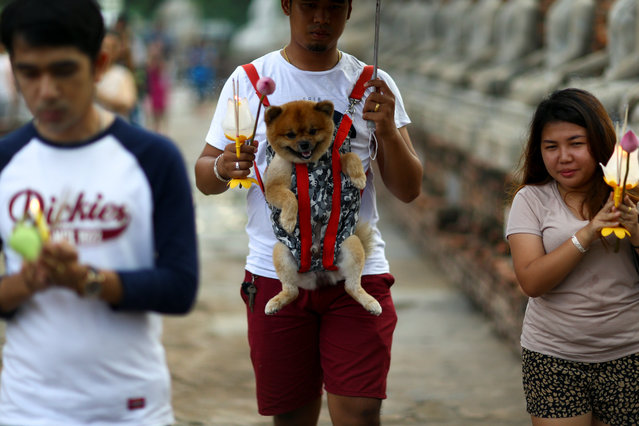
A man carries his dog as he prays during Vesak Day, an annual celebration of Buddha's birth, enlightenment and death, at Wat Yai Chai Mongkhon temple in Ayutthaya, Thailand, May 10, 2017. (Photo by Athit Perawongmetha/Reuters)

A man carries his dog as he prays during Vesak Day, an annual celebration of Buddha's birth, enlightenment and death, at Wat Yai Chai Mongkhon temple in Ayutthaya, Thailand, May 10, 2017. (Photo by Athit Perawongmetha/Reuters)
Details
11 May 2017 07:12:00