Robot Xian'er is placed in the main building of Longquan Buddhist temple for photographs by the temple's staff, on the outskirts of Beijing, April 20, 2016. (Photo by Kim Kyung-Hoon/Reuters)
Young Turkana tribeswomen sing in a village near Baragoy, Kenya August 6, 2017. Kenyans are due to go to the polls on Aug. 8. to vote in presidential elections after a tightly-fought race between President Uhuru Kenyatta and main opposition leader Raila Odinga. (Photo by Goran Tomasevic/Reuters)
Aerial view of tourists in life vests and rubber rafts in the Grand Canyon of western Henan, Sanmenxia, China on August 5, 2017. (Photo by Imaginechina/Rex Features/Shutterstock)
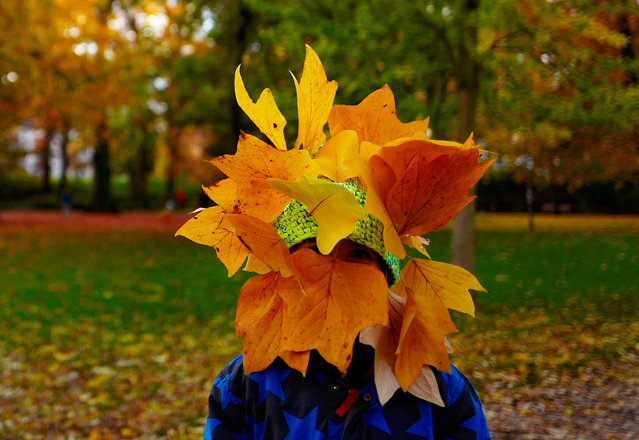
A boy covers his head with fallen leaves as he enjoys a stroll with his family in a park in downtown Frankfurt, Germany, November 6, 2016. (Photo by Kai Pfaffenbach/Reuters)
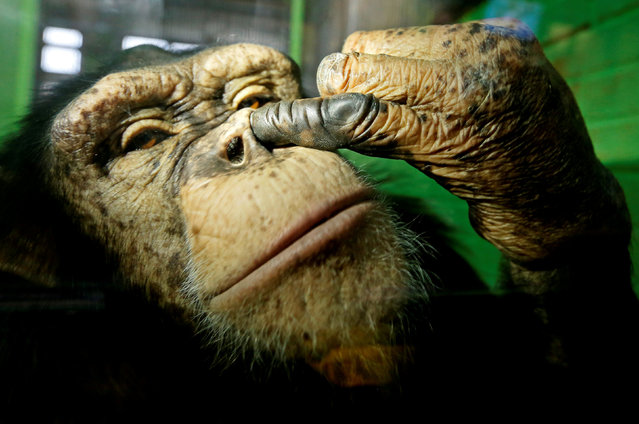
Anfisa, a twelve-year-old female chimpanzee, picks its nose at the Royev Ruchey Zoo in a suburb of the Siberian city of Krasnoyarsk, Russia on October 18, 2017. (Photo by Ilya Naymushin/Reuters)
A so-called “Supermoon” dominates the sky while traffic rolls in the streets in Naypyitaw, Myanmar, 03 December 2017. According to the National Aeronautics and Space Administration (NASA) a series of three “Supermoons” – dubbed the “Supermoon trilogy” – will appear in the sky on 03 December 2017, on 01 January 2018 and and 31 January 2018. A “Supermoon” commonly is a full moon at its closest distance to the earth with the moon appearing larger than usual. (Photo by Hein Htet/EPA/EFE)
A member of the Acorda Capoeira (Awaken Capoeira) group performs on a rooftop in the Rocinha favela in Rio de Janeiro, Brazil, July 24, 2016. In a favela with a history of violence between police and drug gangs, or armed battles between traffickers themselves, capoeira is an outlet that gives kids a sense of community – its practice a collective exercise blending characteristics of drum circles, sparring and tag-team gymnastics. (Photo by Bruno Kelly/Reuters)
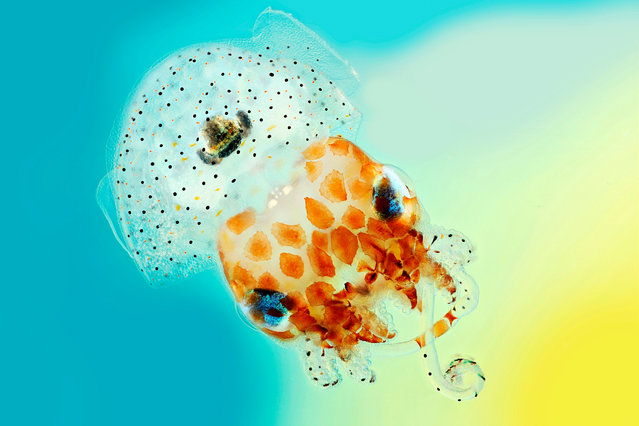
With its huge eyes, comical name and diminutive size, Mark R. Smith’s image of a baby Hawaiian bobtail squid can’t help but raise a smile. A curiously endearing creature, the cephalopod is just 1.5cm across, its mantle cavity bearing more than a passing resemblance to a rather natty shower cap. But it is also a beautiful example of symbiosis – nature’s version of “I’ll scratch your back if you scratch mine” – for on the underside of the squid is a light organ which houses bioluminescent bacteria. The squid offers the bacteria protection and food, while the bacteria emit a glow – a handy trait that the squid uses to offset its silhouette, helping it to evade predators in the depths below. Mark R. Smith’s entry combines several images of a Hawaiian bobtail squid with different focus lengths to create a final picture with greater depth of field than normal. (Photo by Mark R. Smith/Wellcome Images/Macroscopic Solutions)