Loading...
Done
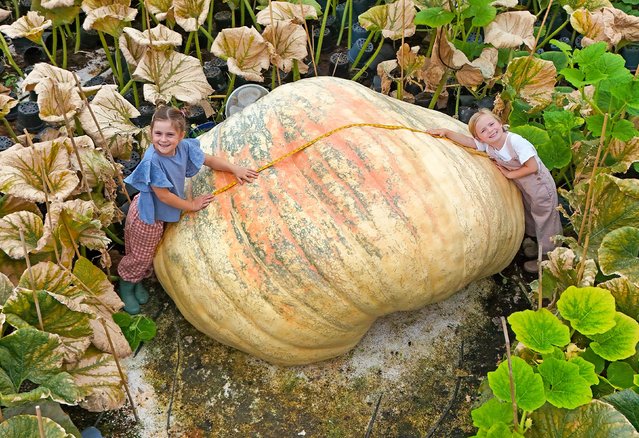
Sisters Martha Syrett, 6, left, and Etta Syrett, 4, right, measure one of Ian Paton's huge pumpkins at Pinetops Nurseries, Lymington, Hants, UK on October 5, 2025. An enormous pumpkin grown by a pair of green-fingered twins has smashed two world records – it is the heaviest and the longest pumpkin on the planet. Ian and Stuart Paton grew the pumpkin which weighed in at 2,819.8 pounds (1,278.8 kg) – the equivalent of about two bulls. (Photo by Ollie Thompson/Solent News & Photo Agency)

Sisters Martha Syrett, 6, left, and Etta Syrett, 4, right, measure one of Ian Paton's huge pumpkins at Pinetops Nurseries, Lymington, Hants, UK on October 5, 2025. An enormous pumpkin grown by a pair of green-fingered twins has smashed two world records – it is the heaviest and the longest pumpkin on the planet. Ian and Stuart Paton grew the pumpkin which weighed in at 2,819.8 pounds (1,278.8 kg) – the equivalent of about two bulls. (Photo by Ollie Thompson/Solent News & Photo Agency)
Details
04 Nov 2025 04:56:00
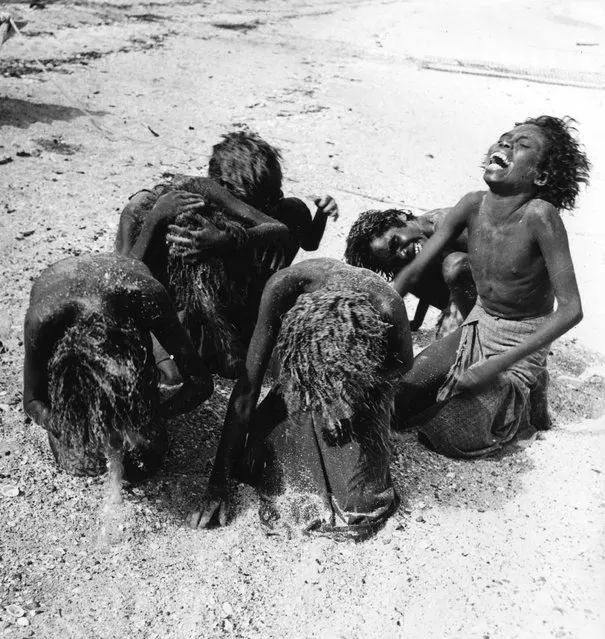
1st January 1950:  Aboriginal women washing their hair with sand at Arnhem land in the Northern Territory of Australia.  (Photo by Three Lions/Getty Images)

“Australian Aborigines are those people regarded as indigenous to the Australian continent. In the High Court of Australia, Australian Aborigines have been specifically identified as a group of people who share, in common, biological ancestry back to the original occupants of the continent”. – Wikipedia

Photo: Aboriginal women washing their hair with sand at Arnhem land in the Northern Territory of Australia. 1st January 1950. (Photo by Three Lions)
Details
02 Feb 2014 07:29:00
A local boy plays football on Iracema Beach on June 11, 2014 in Fortaleza, Brazil. (Photo by Robert Cianflone/Getty Images)

A local boy plays football on Iracema Beach on June 11, 2014 in Fortaleza, Brazil. (Photo by Robert Cianflone/Getty Images)
Details
17 Jun 2014 10:20:00
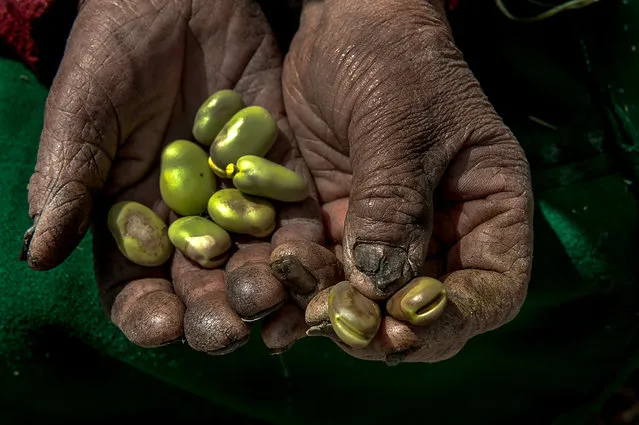
The hard-worked hands of Jacaba Coaquira, 80, holding the green beans she grew on her land. This year the production of her land was affected by lack of rain and early cold weather that froze the crops before they finished growing. Santiago de Okola, Bolivia. (Photo by Renée C. Byer/Living on a Dollar a Day)

The hard-worked hands of Jacaba Coaquira, 80, holding the green beans she grew on her land. This year the production of her land was affected by lack of rain and early cold weather that froze the crops before they finished growing. Santiago de Okola, Bolivia. (Photo by Renée C. Byer/Living on a Dollar a Day)
Details
16 Oct 2014 13:11:00
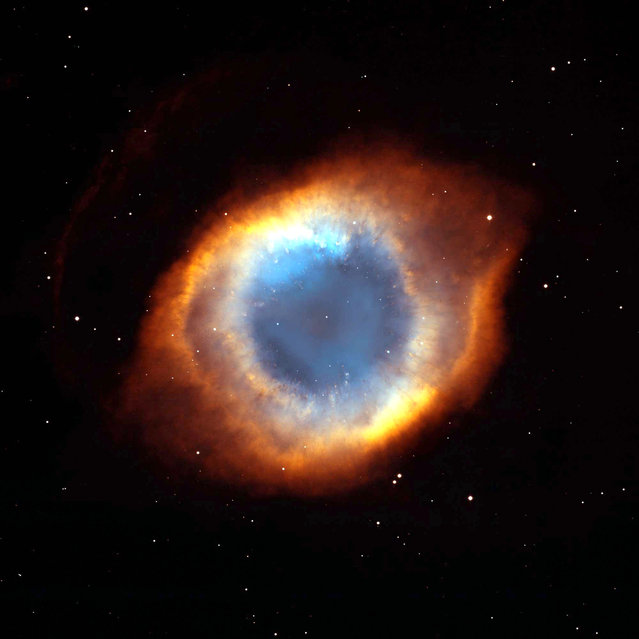
A coil-shaped Helix Nebula showing a fine web of filamentary “bicycle-spoke” features embedded in the colorful red and blue ring of gas. At 650 light-years away, the Helix is one of the nearest planetary nebulae to Earth. A planetary nebula is the glowing gas around a dying, Sun-like star. (Photo by Reuters/NASA)

A coil-shaped Helix Nebula showing a fine web of filamentary “bicycle-spoke” features embedded in the colorful red and blue ring of gas. At 650 light-years away, the Helix is one of the nearest planetary nebulae to Earth. A planetary nebula is the glowing gas around a dying, Sun-like star. (Photo by Reuters/NASA)
Details
22 Oct 2014 14:01:00
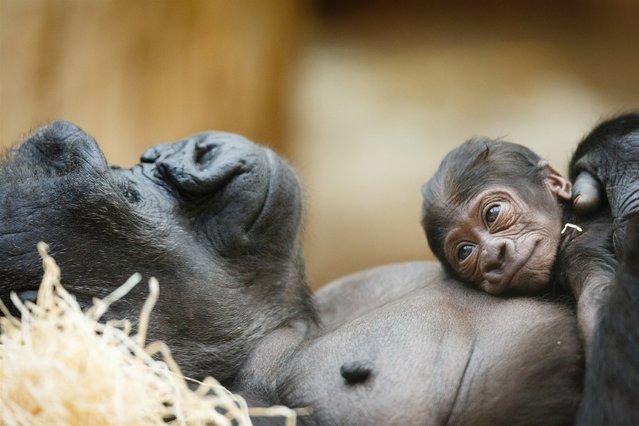
Western lowland gorilla Kijivu holds her newborn baby at the Prague Zoo in the Czech Republic. (Photo by Isifa/Getty Images)

Western lowland gorilla Kijivu holds her newborn baby at the Prague Zoo in the Czech Republic. (Photo by Isifa/Getty Images)
Details
12 May 2013 11:44:00
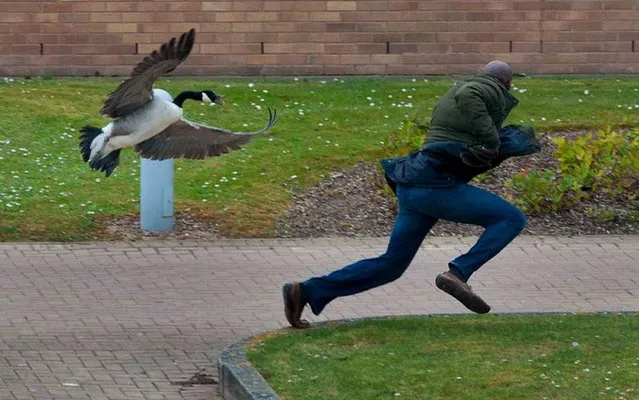
A goose has terrorized students at the University of Warwick, Coventry, UK, on May 22, 2013. The bird built its nest near a block of student apartments and attacks anyone who goes near the nest. (Photo by Caters News/The Grosby Group)

A goose has terrorized students at the University of Warwick, Coventry, UK, on May 22, 2013. The bird built its nest near a block of student apartments and attacks anyone who goes near the nest. (Photo by Caters News/The Grosby Group)
Details
26 May 2013 13:01:00
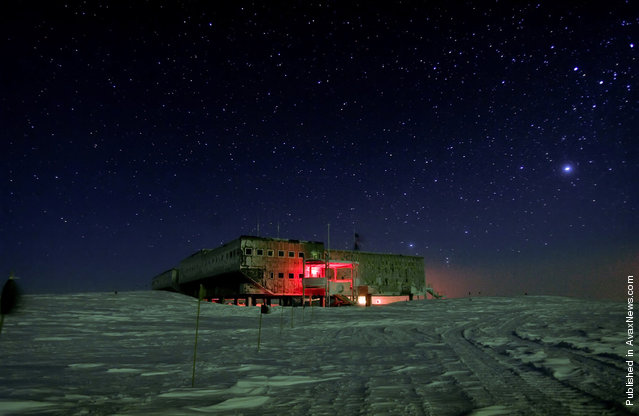
Amundsen-Scott South Pole Station experiences months of darkness. The sun dips below the horizon on March 21, after which follows several weeks of twilight before complete darkness results

Amundsen-Scott South Pole Station experiences months of darkness. The sun dips below the horizon on March 21, after which follows several weeks of twilight before complete darkness results. Photo taken on June 25, 2009. (National Science Foundation/Jeremy Johnson)
Details
08 Apr 2012 13:07:00