Kayla DiCello of the U.S. in action during the Women's All-Around Final at the World Artistic Gymnastics Championships in Kitakyushu, Japan, October 21, 2021. (Photo by Kim Kyung-Hoon/Reuters)
Pet dogs wearing sunglasses and face mask on board a tricycle are pictured in Chinatown district of Manila on January 20, 2023, ahead of the Lunar New Year of the Rabbit which falls on January 22. (Photo by Ted Aljibe/AFP Photo)
Dancers perform during a rehearsal for the “2023 Christmas Spectacular Starring the Radio City Rockettes” at St. Paul the Apostle Church on Thursday, October 19, 2023, in New York. (Photo by Andres Kudacki/AP Photo)
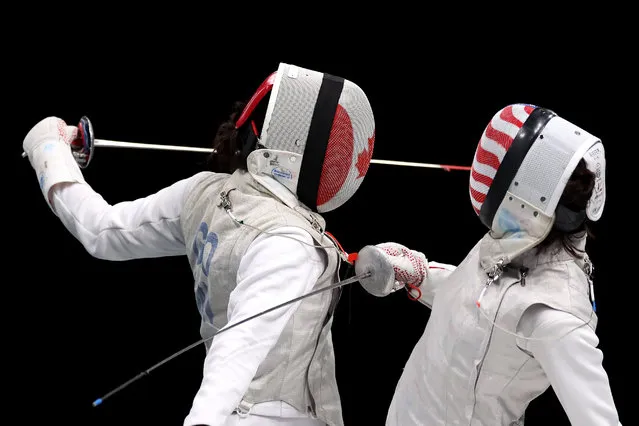
Lee Kiefer of Team United States competes against Jessica Zi Jia Guo of Team Canada on Fencing - Women's Foil Individual at Parque Deportivo Panamericano on Day 10 of Santiago 2023 Pan Am Games on October 30, 2023 in Santiago, Chile. (Photo by Ezra Shaw/Getty Images)
A woman walks the grounds in costume as revellers celebrate Dia De Los Muertos (Day of the Dead) at Hollywood Forever Cemetery in Los Angeles, California, on October 28, 2023. Every year on the last Saturday before November 2nd, Hollywood Forever Cemetery welcomes members of the community to celebrate Dia de Los Muertos, which reunites and honors beloved ancestors, family, and friends. (Photo by David Swanson/AFP Photo)
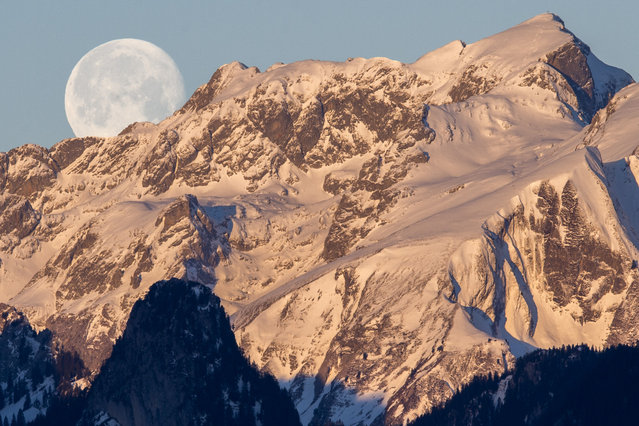
The waning moon is setting over the mountain “Les Cornettes de Bise” located at the border of the Haute-Savoie and the Valais canton of Switzerland in the Chablais Alps, photographed from Glutieres, January 7, 2015. (Photo by Anthony Anex/EPA)
A three-month-old Sumatran tiger cub named “Bandar” shows his displeasure after being dunked in the tiger exhibit moat for a swim reliability test at the National Zoo in Washington, on November 6, 2013. All cubs born at the zoo must take a swim test before being allowed to roam in the exhibit. Bandar passed his test. (Photo by Manuel Balce Ceneta/Associated Press)
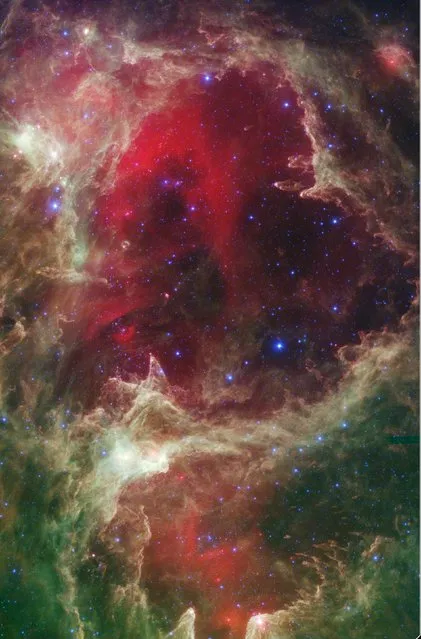
An infrared portrait from NASA's Spitzer Space Telescope which shows generations of stars is seen in this undated NASA handout image released February 14, 2013. In this wispy star-forming region, called W5, the oldest stars can be seen as blue dots in the centers of the two hollow cavities (other blue dots are background and foreground stars not associated with the region). Red shows heated dust that pervades the region's cavities, while green highlights dense clouds. (Photo by NASA/Reuters/JPL-Caltech/Harvard-Smithsonian/Handout)