Loading...
Done
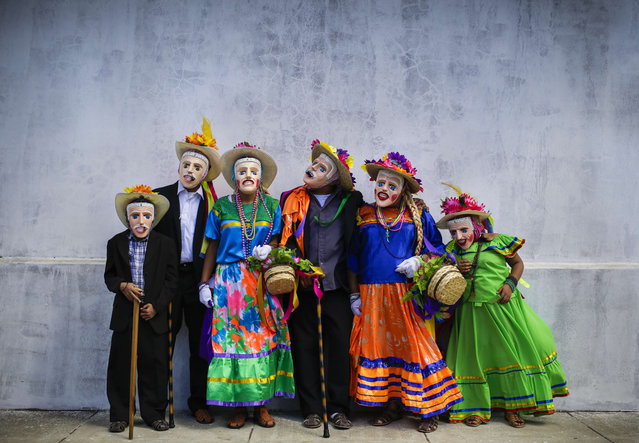
Dancers pose after performing “El Macho Raton”, “El Toro Huaco” and “El Gueguense” traditional dances during San Sebastian festivity in Diriamba, province of Carazo, some 50 km south of Managua on January 19, 2016. Devotees of Saint Sebastian dance in traditional costumes between the cities of Diriamba and Dolores, which are some three kilometers away. (Photo by Inti Ocon/AFP Photo)

Dancers pose after performing “El Macho Raton”, “El Toro Huaco” and “El Gueguense” traditional dances during San Sebastian festivity in Diriamba, province of Carazo, some 50 km south of Managua on January 19, 2016. Devotees of Saint Sebastian dance in traditional costumes between the cities of Diriamba and Dolores, which are some three kilometers away. (Photo by Inti Ocon/AFP Photo)
Details
21 Jan 2016 12:08:00
A policeman comforts a man next to the body of Maria Duron, a pregnant fruit vendor caught in the crossfire after gunmen opened fire on a vehicle, killing a sixteen year-old student, her police bodyguard and three other people who were on the street in the city of Tegucigalpa, Honduras, on April 15, 2013. (Photo by Fernando Antonio/Associated Press)

A policeman comforts a man next to the body of Maria Duron, a pregnant fruit vendor caught in the crossfire after gunmen opened fire on a vehicle, killing a sixteen year-old student, her police bodyguard and three other people who were on the street in the city of Tegucigalpa, Honduras, on April 15, 2013. (Photo by Fernando Antonio/Associated Press)

P.S. All pictures are presented in high resolution. To see Hi-Res images – just TWICE click on any picture. In other words, click small picture – opens the BIG picture. Click BIG picture – opens VERY BIG picture (if available; this principle works anywhere on the site AvaxNews)
Details
20 Apr 2013 11:43:00
The Chilean ship “Skorpios II” is seen after it ran aground in “Maillen” island, near Puerto Montt, south of Santiago, in this handout picture from the Chilean Navy, February 5, 2015. According to the Chilean Navy, the ship's 89 passengers and 31 crew members were all evacuated and no oil spills or casualties were reported. (Photo by Reuters/Chilean Navy)

The Chilean ship “Skorpios II” is seen after it ran aground in “Maillen” island, near Puerto Montt, south of Santiago, in this handout picture from the Chilean Navy, February 5, 2015. According to the Chilean Navy, the ship's 89 passengers and 31 crew members were all evacuated and no oil spills or casualties were reported. (Photo by Reuters/Chilean Navy)
Details
07 Feb 2015 14:22:00
Ziripot, a traditional figure stuffed with straw, is helped up during Carnival celebrations in the Navarran village of Lantz, on February 16, 2015. (Photo by Vincent West/Reuters)

Ziripot, a traditional figure stuffed with straw, is helped up during Carnival celebrations in the Navarran village of Lantz, on February 16, 2015. (Photo by Vincent West/Reuters)
Details
21 Feb 2015 11:21:00
A girl jumps over a campfire while celebrating Ivan Kupala Night, a traditional Slavic holiday not far from Kiev on July 6, 2013. During the celebration, originating in pagan times, people plait wreaths, jump over fires, and swim naked. (Photo by Sergei Supinsky/AFP Photo)

A girl jumps over a campfire while celebrating Ivan Kupala Night, a traditional Slavic holiday not far from Kiev on July 6, 2013. During the celebration, originating in pagan times, people plait wreaths, jump over fires, and swim naked. (Photo by Sergei Supinsky/AFP Photo)
Details
13 Jul 2013 11:59:00
Two Chinese farmers got more than they bargained for when they pulled up the root of a fleece flower – and came face-to-face with the doppelganger of Homer Simpson, on May 17, 2013. The large root appears to have two bulging eyes and a prominent nose – giving it an uncanny resemblance to the famous cartoon character. With two offshoot roots shaped like arms, it even looks like it is pondering or confused – just what you would expect from the real Homer. (Photo by ImagineChina)

Two Chinese farmers got more than they bargained for when they pulled up the root of a fleece flower – and came face-to-face with the doppelganger of Homer Simpson, on May 17, 2013. The large root appears to have two bulging eyes and a prominent nose – giving it an uncanny resemblance to the famous cartoon character. With two offshoot roots shaped like arms, it even looks like it is pondering or confused – just what you would expect from the real Homer. (Photo by ImagineChina)
Details
18 May 2013 11:52:00
A Nepalese boy gets ready to perform a stick dance during a rally held to pay tribute to the victims of an earthquake, in Bhaktapur, Nepal, Wednesday, September 2, 2015. Two powerful earthquakes in April and May devastated the Himalayan nation killing more than 8,800 people. (Photo by Niranjan Shrestha/AP Photo)

A Nepalese boy gets ready to perform a stick dance during a rally held to pay tribute to the victims of an earthquake, in Bhaktapur, Nepal, Wednesday, September 2, 2015. Two powerful earthquakes in April and May devastated the Himalayan nation killing more than 8,800 people. (Photo by Niranjan Shrestha/AP Photo)
Details
03 Sep 2015 13:07:00
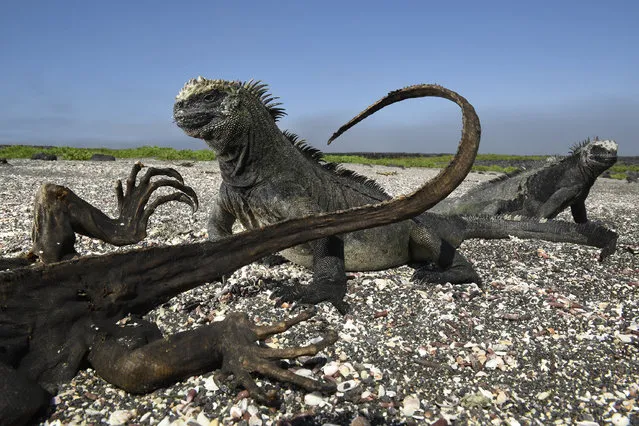
Galapagos – Rocking the Cradle: Four major ocean currents converge along the Galapagos archipelago, creating the conditions for an extraordinary diversity of animal life, April 25, 2016. The islands are home to at least 7,000 flora and fauna species, of which 97 percent of the reptiles, 80 percent of the land birds, 50 percent of the insects and 30 percent of the plants are endemic. The local ecosystem is highly sensitive to the changes in temperature, rainfall and ocean currents that characterize the climatic events known as El Niño and La Niña. These changes cause marked fluctuations in weather and food availability. Many scientists expect the frequency of El Niño and La Niña to increase as a result of climate change, making the Galapagos a possible early-warning location for its effects. (Photo by Thomas P. Peschak for National Geographic/World Press Photo)

Galapagos – Rocking the Cradle: Four major ocean currents converge along the Galapagos archipelago, creating the conditions for an extraordinary diversity of animal life, April 25, 2016. The islands are home to at least 7,000 flora and fauna species, of which 97 percent of the reptiles, 80 percent of the land birds, 50 percent of the insects and 30 percent of the plants are endemic. (Photo by Thomas P. Peschak for National Geographic/World Press Photo)
Details
16 Apr 2018 00:01:00