Loading...
Done
In this Thursday, August 27, 2015 photo, a homeless man drinks water while sitting on the beach at Ala Moana Beach Park located near Waikiki in Honolulu. Homelessness in Hawaii has grown steadily in recent years, leaving the state with the nation's highest rate of homeless people per capita. (Photo by Jae C. Hong/AP Photo)

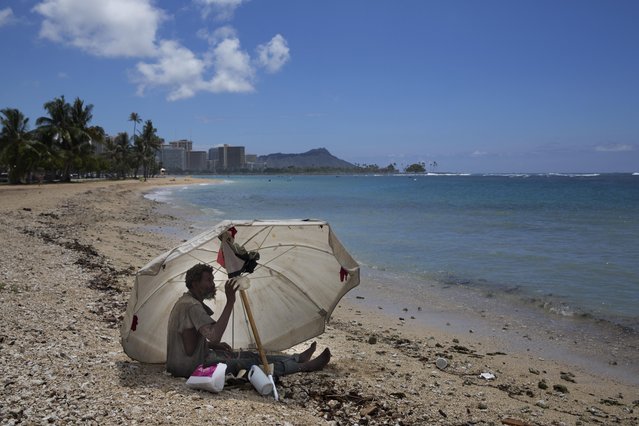
Hawaii has long been known as a tropical paradise, but in recent years another image has intruded into the state's carefully crafted one of idyllic beaches and relaxing resorts: homelessness. The number of homeless people has grown in recent years, leaving the state with 487 homeless per 100,000 people, the nation's highest rate per capita, above New York and Nevada, according to federal statistics. Many of the homeless, however, defy the stereotype of the mentally ill or drug addicted. They are families, with men and women who work full-time jobs. They are struggling to get a foothold in a place with a high cost of living and low wages. Here: in this Thursday, August 27, 2015 photo, a homeless man drinks water while sitting on the beach at Ala Moana Beach Park located near Waikiki in Honolulu. (Photo by Jae C. Hong/AP Photo)
Details
11 Nov 2015 08:03:00
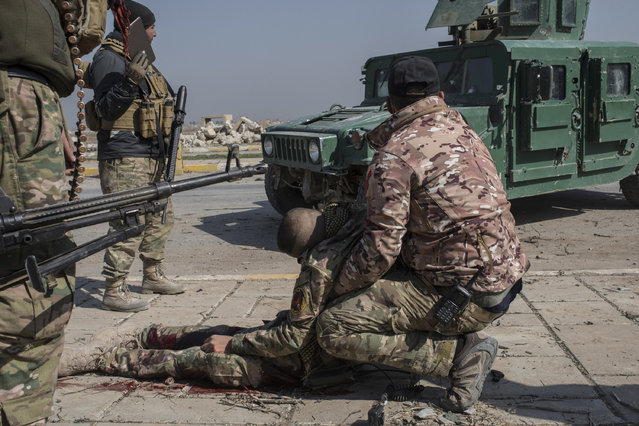
An injured Iraqi Emergency Response Division (ERD) soldier hit by a mortar is held by another officer as they wait for medics to arrive at the Islamic State occupied Mosul Airport in west Mosul, part of the offensive to retake the city some two years after it fell to the hardline jihadist group, February 23, 2017. Iraqi forces encountered stiff resistance with improvised explosives, heavy mortar fire and snipers hampering their advance before they successfully took the airport. (Photo by Martyn Aim/Getty Images)

An injured Iraqi Emergency Response Division (ERD) soldier hit by a mortar is held by another officer as they wait for medics to arrive at the Islamic State occupied Mosul Airport in west Mosul, part of the offensive to retake the city some two years after it fell to the hardline jihadist group, February 23, 2017. Iraqi forces encountered stiff resistance with improvised explosives, heavy mortar fire and snipers hampering their advance before they successfully took the airport. (Photo by Martyn Aim/Getty Images)
Details
27 Feb 2017 00:01:00
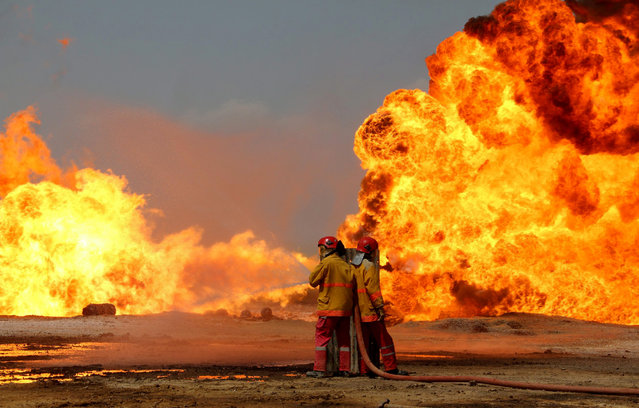
Iraqi firefighters try to stop the fire of burning oil wells in Kirkuk, northern Iraq, 02 June 2016. Two Khabbaz oil field wells in Kirkuk Province, northern Iraq, exploded by suspected insurgents, a security official said. (Photo by EPA/Stringer)

Iraqi firefighters try to stop the fire of burning oil wells in Kirkuk, northern Iraq, 02 June 2016. Two Khabbaz oil field wells in Kirkuk Province, northern Iraq, exploded by suspected insurgents, a security official said. (Photo by EPA/Stringer)
Details
12 Nov 2016 10:42:00
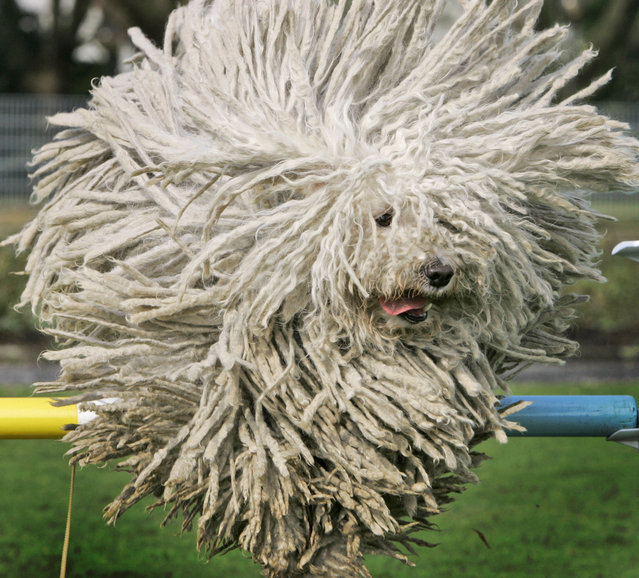
Hungarian Puli sheep dog, Fee, jumps over a hurdle during a preview for a pedigree dog  show in Dortmund on Thursday April 24, 2008. (Photo by Frank Augstein/AP Photo)

Hungarian Puli sheep dog, Fee, jumps over a hurdle during a preview for a pedigree dog show in Dortmund on Thursday April 24, 2008. (Photo by Frank Augstein/AP Photo)
Details
03 Sep 2015 12:49:00
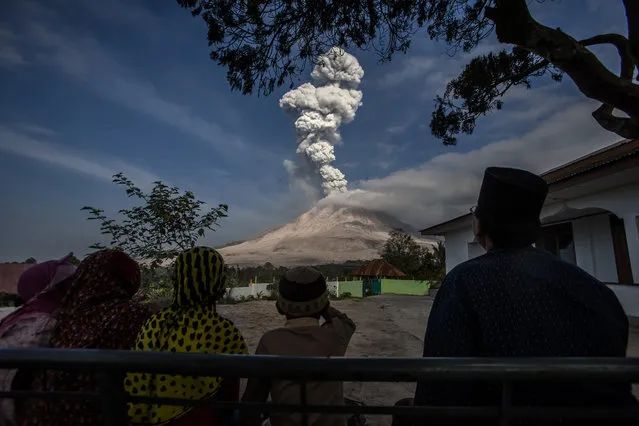
Residents watch volcanic smoking and ashes rising from Mount Sinabung during an eruption in Karo, North Sumatra, Indonesia, February 24, 2016. Authorities have repeatedly called on local residents to remain patient in dealing with the impact of Sinabung's eruptions, which some experts have predicted will continue for five more years. (Photo by Xinhua/Barcroft Media)

Residents watch volcanic smoking and ashes rising from Mount Sinabung during an eruption in Karo, North Sumatra, Indonesia, February 24, 2016. Authorities have repeatedly called on local residents to remain patient in dealing with the impact of Sinabung's eruptions, which some experts have predicted will continue for five more years. (Photo by Xinhua/Barcroft Media)
Details
28 Feb 2016 11:36:00
A man holds up for a picture a one hundred trillion Zimbabwean dollars note inside a shop in Harare, Zimbawe, June 12, 2015. (Photo by Philimon Bulawayo/Reuters)

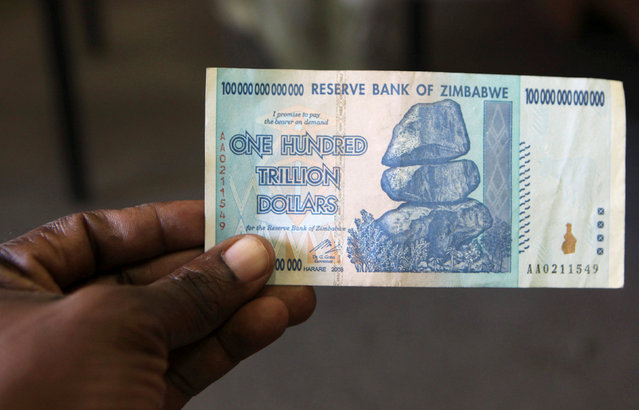
A man holds up for a picture a one hundred trillion Zimbabwean dollars note inside a shop in Harare, Zimbawe, June 12, 2015. Hyperinflation in Zimbabwe was a period of currency instability that began in the late 1990s shortly after the confiscation of private farms from landowners, towards the end of Zimbabwean involvement in the Second Congo War. During the height of inflation from 2008 to 2009, it was difficult to measure Zimbabwe's hyperinflation because the government of Zimbabwe stopped filing official inflation statistics. However, Zimbabwe's peak month of inflation is estimated at 79.6 billion percent in mid-November 2008. (Photo by Philimon Bulawayo/Reuters)
Details
25 Oct 2016 10:08:00
For her series “Japanese Whispers”, Belgian photographer Zaza Bertrand headed inside the intimate world of rabuhos – Japanese love hotels. Love hotels became popular in Japan from the 1960s onwards, due to a lack of privacy in many family homes. There are now around 37,000 of these hotels in Japan, allowing short daytime “rests” or overnight stays. (Photo by Zaza Bertrand/The Guardian)

For her series “Japanese Whispers”, Belgian photographer Zaza Bertrand headed inside the intimate world of rabuhos – Japanese love hotels. Love hotels became popular in Japan from the 1960s onwards, due to a lack of privacy in many family homes. There are now around 37,000 of these hotels in Japan, allowing short daytime “rests” or overnight stays. (Photo by Zaza Bertrand/The Guardian)
Details
02 Dec 2016 11:30:00
The secretive indri (Indri indri) of Madagascar, the largest living lemur. It is also critically endangered and highly evolutionarily distinct with no close relatives, which makes its branch one of most precarious on the mammal evolutionary tree. In the likely event that the indri goes extinct, we will lose 19m years of unique evolutionary history from the mammal tree of life. (Photo by Pierre-Yves Babelon/Aarhus University)

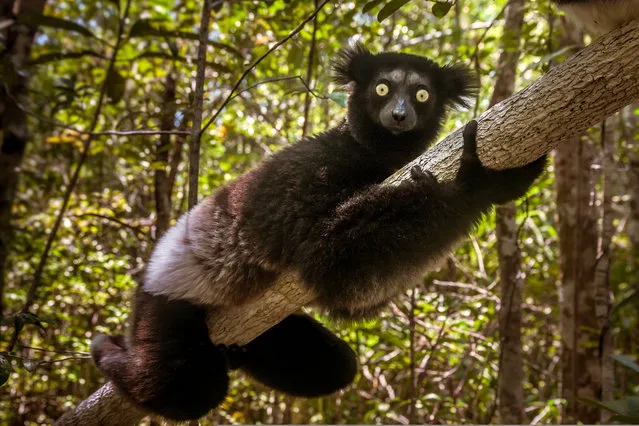
The secretive indri (Indri indri) of Madagascar, the largest living lemur. It is also critically endangered and highly evolutionarily distinct with no close relatives, which makes its branch one of most precarious on the mammal evolutionary tree. In the likely event that the indri goes extinct, we will lose 19m years of unique evolutionary history from the mammal tree of life. (Photo by Pierre-Yves Babelon/Aarhus University)
Details
18 Nov 2018 00:02:00