Loading...
Done
In Extremis By Sandro Giordano

There is something strangely appealing about the set of pictures created by Sandro Giordano in a series “In Extremis (Bodies With No Regret)”. Could it be the absurdity of the situation? Or the fact that our brain tries to make up some bizarre story to justify what is happening in the pictures? Of course it is impossible to explain why a pair of tennis players ended up lying flat on the ground with a pack of bananas hanging on the net, even if we forget about the tennis racket lodged in the neck of one of the players. Nevertheless, it is fun to recreate these scenes in your mind just seconds before the tragedy took place. (Photo by Sandro Giordano)
Details
18 Oct 2014 07:09:00
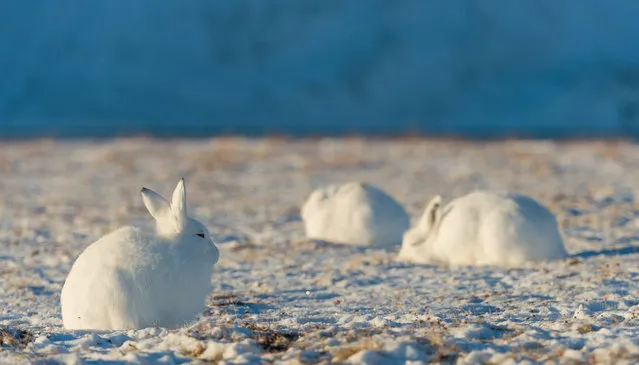
Arctic Hare

The arctic hare, or polar rabbit, is a species of hare which is adapted largely to polar and mountainous habitats. The arctic hare survives with a thick coat of fur and usually digs holes in the ground or under snow to keep warm and sleep. Arctic hares look like rabbits but have shorter ears, are taller when standing, and, unlike rabbits, can thrive in cold climates. They can travel together with many other hares, sometimes huddling with dozens or more, but are usually found alone, taking, in some cases, more than one partner. The arctic hare can run up to 60 kilometres per hour (40 mph). Its predators include the arctic wolf, arctic fox, and ermine.
Details
17 Mar 2014 13:56:00


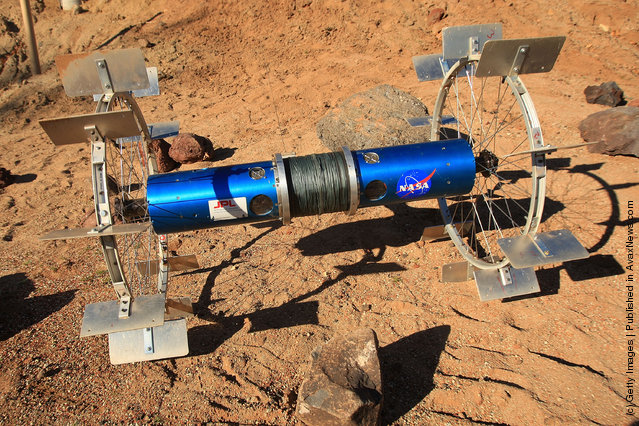
Axel, a research prototype rover for exploring the Moon, Mars and other planets, is remotely driven over rocks as engineers from Jet Propulsion (JPL) and grad students from Caltech (California Institute of Technology) demonstrate its mobile over the steep and rocky grounds of the JPL Mars Yard on January 14, 2009 in Pasadena, California. The rover is capable of descending cliffs or into craters and returning by a cable tethered to its starting point. Development of the Axel rover is a point effort funded by NASA Exploration Systems Mission Directorate (ESMD) and lead by Principal Investigator Issa Newnas and Co-Investigator and Caltech professor of mechanical engineering bio engineering Joel Burdick. (Photo by David McNew/Getty Images)
Details
05 Apr 2011 07:47:00
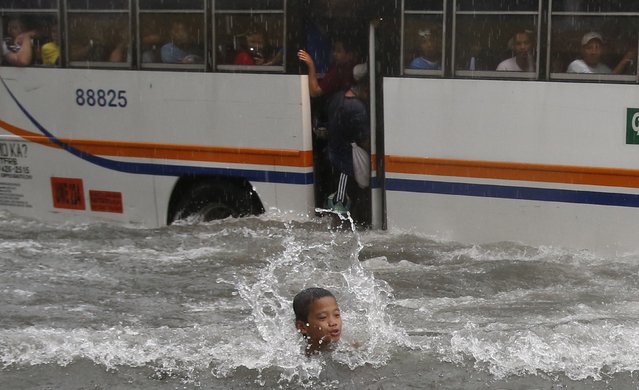
A boy plays at a flooded street in front of a passing bus as tropical storm Fung-Wong battered the Philippine capital Manila September 19, 2014. Heavy rain in the Philippine capital, Manila, caused flooding in many areas on Friday, shutting schools, government offices and financial markets as a tropical storm made landfall to the north. Thousands of residents in low-lying areas were moved to higher ground, officials said, as flood waters rose quickly after the equivalent of half a month's usual rain fell in six hours. (Photo by Erik De Castro/Reuters)

A boy plays at a flooded street in front of a passing bus as tropical storm Fung-Wong battered the Philippine capital Manila September 19, 2014. Heavy rain in the Philippine capital, Manila, caused flooding in many areas on Friday, shutting schools, government offices and financial markets as a tropical storm made landfall to the north. Thousands of residents in low-lying areas were moved to higher ground, officials said, as flood waters rose quickly after the equivalent of half a month's usual rain fell in six hours. (Photo by Erik De Castro/Reuters)
Details
19 Sep 2014 09:39:00
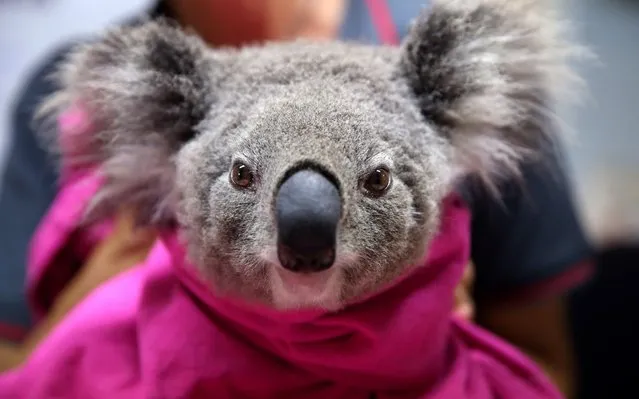
A koala named Lisa from Pappinbarra recovers from burns at The Port Macquarie Koala Hospital on November 29, 2019 in Port Macquarie, Australia. Volunteers from the Koala Hospital have been working alongside National Parks and Wildlife Service crews searching for koalas following weeks of devastating bushfires across New South Wales and Queensland. Koalas rescued from fire grounds have been brought back to the hospital for treatment. An estimated million hectares of land has been burned by bushfire across Australia following catastrophic fire conditions in recent weeks, killing an estimated 1000 koalas along with other wildlife. (Photo by Nathan Edwards/Getty Images)

A koala named Lisa from Pappinbarra recovers from burns at The Port Macquarie Koala Hospital on November 29, 2019 in Port Macquarie, Australia. Volunteers from the Koala Hospital have been working alongside National Parks and Wildlife Service crews searching for koalas following weeks of devastating bushfires across New South Wales and Queensland. Koalas rescued from fire grounds have been brought back to the hospital for treatment. An estimated million hectares of land has been burned by bushfire across Australia following catastrophic fire conditions in recent weeks, killing an estimated 1000 koalas along with other wildlife. (Photo by Nathan Edwards/Getty Images)
Details
15 Dec 2019 05:31:00
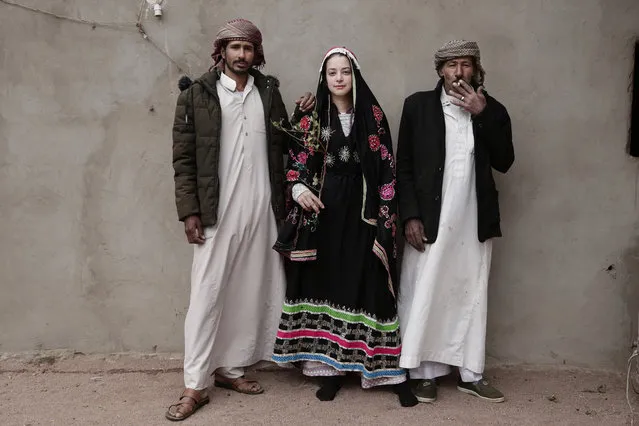
In this March 31, 2019 photo, an Egyptian student borrows a Bedouin wedding dress to pose for a photograph with Bedouin men from the Hamada tribe, in Wadi Sahw, Abu Zenima, in South Sinai, Egypt. Four Bedouin women are for the first time leading tours in Egypt’s Sinai Peninsula, breaking new ground in their deeply conservative community, where women almost never work outside the home or interact with outsiders.  The tourists can only be women, and the tours can’t go overnight. Each day before the sun sets, the group returns to the Hamada’s home village in Wadi Sahu, a narrow desert valley. (Photo by Nariman El-Mofty/AP Photo)

In this March 31, 2019 photo, an Egyptian student borrows a Bedouin wedding dress to pose for a photograph with Bedouin men from the Hamada tribe, in Wadi Sahw, Abu Zenima, in South Sinai, Egypt. Four Bedouin women are for the first time leading tours in Egypt’s Sinai Peninsula, breaking new ground in their deeply conservative community, where women almost never work outside the home or interact with outsiders. The tourists can only be women, and the tours can’t go overnight. Each day before the sun sets, the group returns to the Hamada’s home village in Wadi Sahu, a narrow desert valley. (Photo by Nariman El-Mofty/AP Photo)
Details
11 Apr 2019 00:01:00
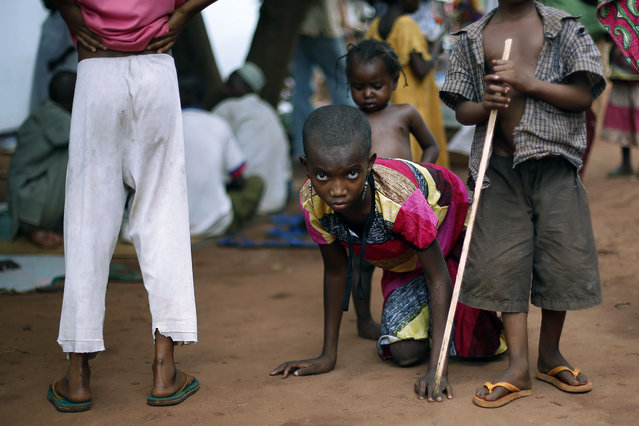
In this April 14, 2014 file photo, Hamamatou Harouna, 10, who lost the use of her legs to polio, crawls to the restroom on the grounds of the Catholic Church where she and hundreds of others found refuge after fleeing violence in her village, in Carnot, Central African Republic. Health authorities on Tuesday, August 25, 2020 are expected to declare the African continent free of the wild poliovirus after decades of effort, though cases of vaccine-derived polio are still sparking outbreaks of the paralyzing disease in more than a dozen countries. (Photo by Jerome Delay/AP Photo/File)

In this April 14, 2014 file photo, Hamamatou Harouna, 10, who lost the use of her legs to polio, crawls to the restroom on the grounds of the Catholic Church where she and hundreds of others found refuge after fleeing violence in her village, in Carnot, Central African Republic. Health authorities on Tuesday, August 25, 2020 are expected to declare the African continent free of the wild poliovirus after decades of effort, though cases of vaccine-derived polio are still sparking outbreaks of the paralyzing disease in more than a dozen countries. (Photo by Jerome Delay/AP Photo/File)
Details
15 Sep 2020 00:03:00
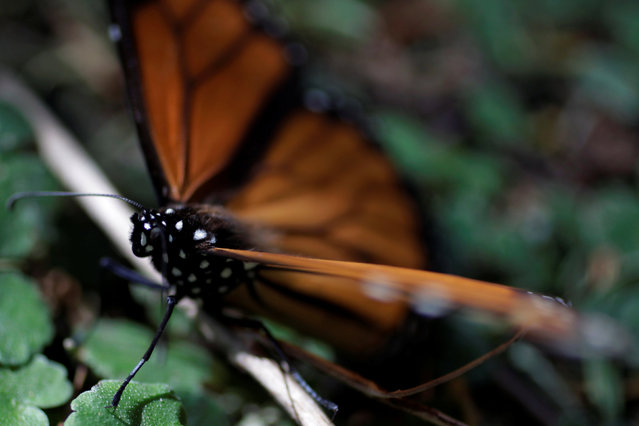
A monarch butterfly rests on the ground at the Sierra Chincua butterfly sanctuary on a mountain in Angangeo, Michoacan November 24, 2016. Angangueo is a town and municipality located in far eastern Michoacán state in central Mexico noted for its history of mining and its location in the Monarch Butterfly Biosphere Reserve. The Monarch Butterfly Biosphere Reserve is a World Heritage Site containing most of the over-wintering sites of the eastern population of the monarch butterfly. The reserve is located in the Trans-Mexican Volcanic Belt pine-oak forests ecoregion on the border of Michoacán and State of Mexico, 100 km (62 miles), northwest of Mexico City. Millions of butterflies arrive in the reserve annually. Butterflies only inhabit a fraction of the 56,000 hectares of the reserve from October–March. (Photo by Carlos Jasso/Reuters)

A monarch butterfly rests on the ground at the Sierra Chincua butterfly sanctuary on a mountain in Angangeo, Michoacan November 24, 2016. Angangueo is a town and municipality located in far eastern Michoacán state in central Mexico noted for its history of mining and its location in the Monarch Butterfly Biosphere Reserve. The Monarch Butterfly Biosphere Reserve is a World Heritage Site containing most of the over-wintering sites of the eastern population of the monarch butterfly. (Photo by Carlos Jasso/Reuters)
Details
26 Nov 2016 10:20:00