Loading...
Done
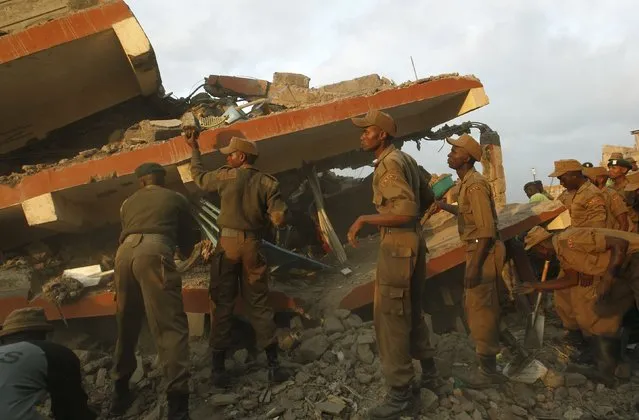
Rescuers search for survivors in the rubble of a collapsed residential building in Makongeni estate in Nairobi December 17, 2014. (Photo by Thomas Mukoya/Reuters)

Rescuers search for survivors in the rubble of a collapsed residential building in Makongeni estate in Nairobi December 17, 2014. Three more bodies were recovered on Wednesday night from the building that collapsed in Makongeni estate in Nairobi, raising the death toll to four, Kenya Red Cross has reported. The residential building whose sixth floor was still under construction had allegedly not been cleared for occupation by the Nairobi City County and its owner has been missing since it collapsed. A search and rescue and rescue operation is ongoing for the unknown number of people still trapped under the rubble, Kenya Red Cross also reported. (Photo by Thomas Mukoya/Reuters)
Details
18 Dec 2014 14:23:00
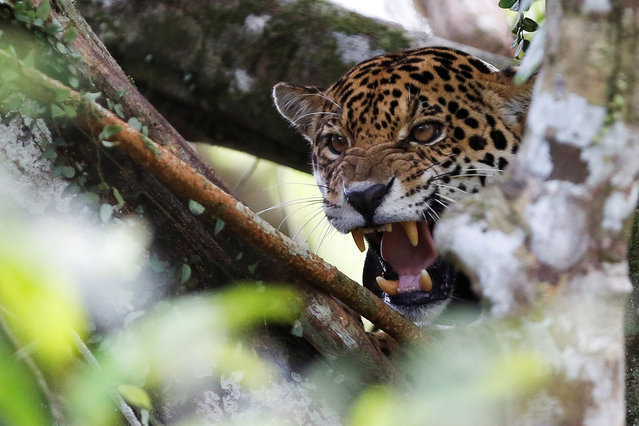
A female adult jaguar, which has a cub, growls at the Mamiraua Sustainable Development Reserve in Uarini, Amazonas state, Brazil, June 5, 2017. (Photo by Bruno Kelly/Reuters)

Brazilian jaguars, imperilled by hunters, ranchers and destruction of their habitat, have learned to survive at least one menace – flooding in the Amazon. They take to the trees. Although they can be six feet long and 200 pounds, the largest South American cats nimbly navigate treetops where they stay from April to July when the rainforest floor is under meters-deep water. Here: A female adult jaguar, which has a cub, growls at the Mamiraua Sustainable Development Reserve in Uarini, Amazonas state, Brazil, June 5, 2017. (Photo by Bruno Kelly/Reuters)
Details
07 Apr 2018 00:03:00


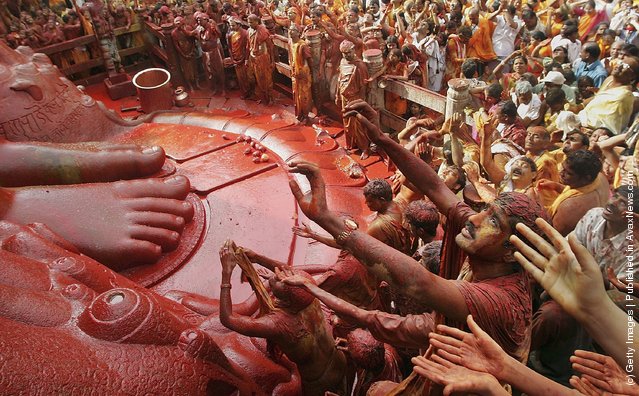
“The Mahamasthakabhisheka (or Mahamasthak Abhishek) is an important Jain festival held once every twelve years in the town of Shravanabelagola in Karnataka state, India. The festival is held in veneration of an immense 18 meter high statue of the Bhagwan (or Saint) Gomateshwara Bahubali. The anointing last took place in February 2006, and the next ceremony will occur in 2018”. – Wikipedia

Photo: A Jain Sadhu (2nd L) and devotees gather and pray at the feet of the monolithic statue of Jain sage Gomateswara during preparations for the Mahamastak Abhisheka ceremony February 7, 2006 in Shravanabelagola, India. The Mahamastak Abhisheka ceremony is held just once every twelve years where the statue will be bathed with milk, yogurt, saffron, gold coins and other religious items. The statue is said to be the world's largest monolith. The ceremony officially runs February 8-19. (Photo by Mario Tama/Getty Images)
Details
21 Jun 2011 12:27:00
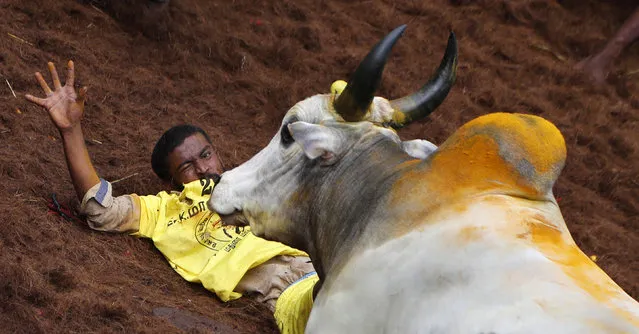
In this Thursday, January 17, 2019, photo, an Indian tamer reacts as a bull charges towards him during a traditional bull-taming festival called Jallikattu, in the village of Allanganallur, near Madurai, Tamil Nadu state, India. (Photo by Aijaz Rahi/AP Photo)

In this Thursday, January 17, 2019, photo, an Indian tamer reacts as a bull charges towards him during a traditional bull-taming festival called Jallikattu, in the village of Allanganallur, near Madurai, Tamil Nadu state, India. Jallikattu involves releasing a bull into a crowd of people who are expected to hang on to the animal's hump for a stipulated distance or hold on to the hump for a minimum of three jumps made by the bull. The sport, performed during the four-day “Pongal” or winter harvest festival, is hugely popular in Tamil Nadu. (Photo by Aijaz Rahi/AP Photo)
Details
21 Jan 2019 00:01:00
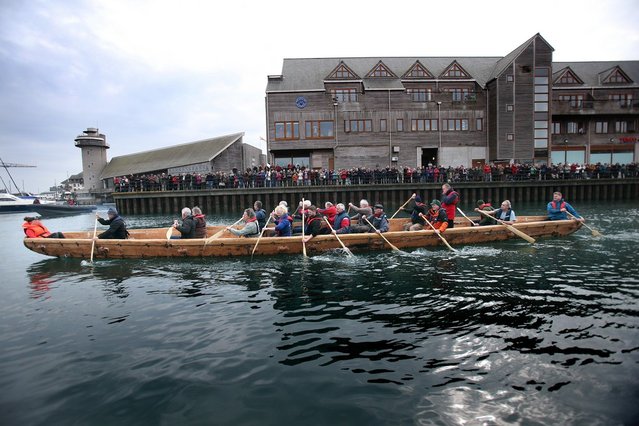
Crew in Britain's first ever full-size reconstructed sea-going Bronze Age boat, paddle out to sea near to the National Maritime Museum as it makes its maiden voyage on March 6, 2013 in Falmouth, England. With a crew of of 18, equipped with Bronze-Age-style wooden paddles, the 15 metre long experimental vessel – a replica of the sort of craft used for long-distance trade between Britain and the continent 4000 years ago – will be used to test prehistoric seafaring methods in a project in collaboration with the University of Exeter and the Falmouth-based National Maritime Museum Cornwall. (Photo by Matt Cardy)

Crew in Britain's first ever full-size reconstructed sea-going Bronze Age boat, paddle out to sea near to the National Maritime Museum as it makes its maiden voyage on March 6, 2013 in Falmouth, England. (Photo by Matt Cardy)
Details
07 Mar 2013 08:48:00
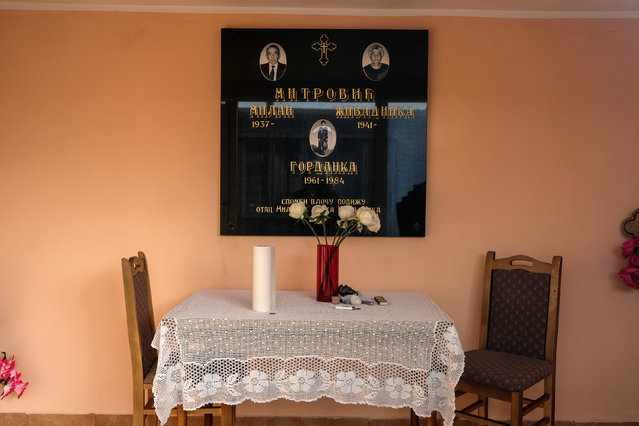
Pictures of deceased people are seen inside a chapel at a cemetery in the village of Smoljinac, Serbia, October 25, 2016. (Photo by Marko Djurica/Reuters)

Pictures of deceased people are seen inside a chapel at a cemetery in the village of Smoljinac, Serbia, October 25, 2016. From a distance, the cemetery in the eastern Serbian village of Smoljinac looks like a residential neighbourhood eerily placed among graves. But once inside the grounds, after passing a section with the usual stone slabs, visitors find rows of small bungalows painted in pastel colours. They have one or two rooms, large windows and ornate plaques – some inside, some outside – memorialising the deceased. These are the burial chapels of Smoljinac, cosy cabins with a furnished room inside, a storage place for wreaths and funeral paraphernalia, and the family crypt below. Some even have electric power inside. (Photo by Marko Djurica/Reuters)
Details
12 Nov 2016 10:37:00
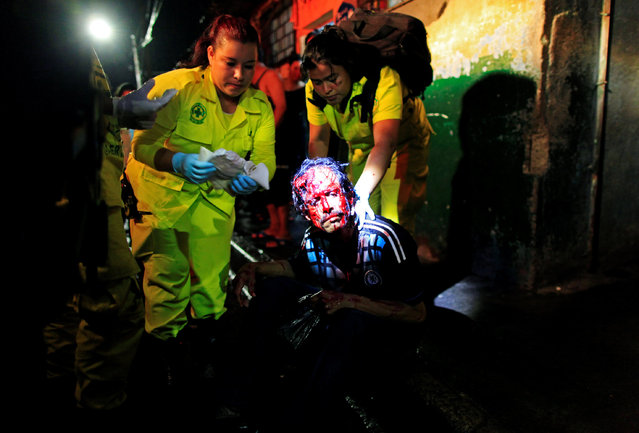
Comandos de Salvamento rescuers Maria Martinez (L) and Ana Chichilla attend to a wounded homeless man in San Salvador, El Salvador July 16, 2016. The man was attacked with a machete by suspected gang members. (Photo by Jose Cabezas/Reuters)

Comandos de Salvamento rescuers Maria Martinez (L) and Ana Chichilla attend to a wounded homeless man in San Salvador, El Salvador July 16, 2016. The man was attacked with a machete by suspected gang members. In 2015, El Salvador registered a record 103 homicides per 100,000 habitants, making it one of the most dangerous countries in the world outside a war zone. But for many young people who have few chances to distance themselves from rivalries between so-called maras in their schools and neighbourhoods, a civil-society organisation called the Comandos de Salvamento, or Rescue Corps, has been a refuge. (Photo by Jose Cabezas/Reuters)
Details
16 Nov 2016 11:10:00
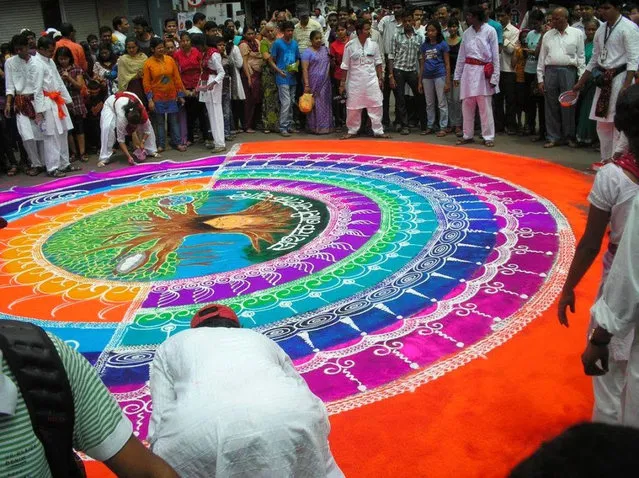
Rangoli Folk Art From India

Rangoli, also known as kolam or Muggu, is a folk art from India in which patterns are created on the floor in living rooms or courtyards using materials such as colored rice, dry flour, colored sand or flower petals. It is usually made during Diwali, Onam, Pongal and other Indian festivals. They are meant to be sacred welcoming areas for the Hindu deities. The ancient symbols have been passed down through the ages, from each generation to the next, keeping both the art form and the tradition alive. Similar practices are followed in different Indian states: in Tamil Nadu, there is Kolam in Tamil Nadu; Mandana in Rajasthan; Chaookpurna in Chhattisgarh; Alpana in West Bengal; Aripana in Bihar; Chowk pujan in Uttar Pradesh; Muggu in Andhra Pradesh and others.
Details
16 Jun 2014 10:37:00