Loading...
Done
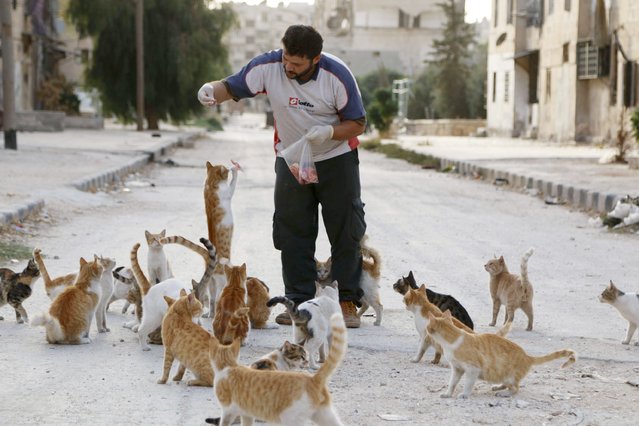
Alaa, an ambulance driver, feeds cats in Masaken Hanano in Aleppo, September 24, 2014. Alaa buys about $4 of meat everyday to feed about 150 abandoned cats in Masaken Hanano, a neigbourhood in Aleppo that has been abandoned because of shelling from forces loyal to Syria's president Bashar Al-Assad on it. Alaa said that he has been feeding and taking care of the cats for over 2 months. (Photo by Hosam Katan/Reuters)

Alaa, an ambulance driver, feeds cats in Masaken Hanano in Aleppo, September 24, 2014. Alaa buys about $4 of meat everyday to feed about 150 abandoned cats in Masaken Hanano, a neigbourhood in Aleppo that has been abandoned because of shelling from forces loyal to Syria's president Bashar Al-Assad on it. Alaa said that he has been feeding and taking care of the cats for over 2 months. (Photo by Hosam Katan/Reuters)
Details
25 Sep 2014 13:29:00
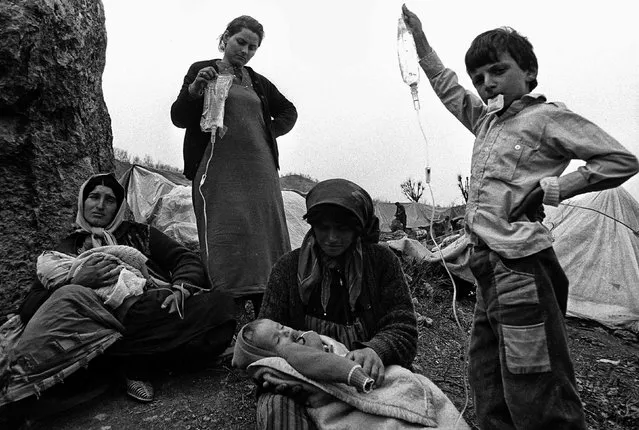
Iraqi Kurdish refugees wait with children in Cukurca refugee camp in Turkey April 8, 1991. Reuters photographers have chronicled Kurdish refugee crises over the years. In 1991 Srdjan Zivulovic documented refugees in Cukurca who had escaped a military operation by Saddam Hussein's government in Iraq aimed at “Arabising” Kurdish areas in the north. (Photo by Srdjan Zivulovic/Reuters)

Iraqi Kurdish refugees wait with children in Cukurca refugee camp in Turkey April 8, 1991. Reuters photographers have chronicled Kurdish refugee crises over the years. In 1991 Srdjan Zivulovic documented refugees in Cukurca who had escaped a military operation by Saddam Hussein's government in Iraq aimed at “Arabising” Kurdish areas in the north. Hundreds of thousands fled into Turkey and Iran. Images shot in recent months show familiar scenes as crowds of people flee Islamic State militants in Syria. There are as many as 30 million Kurds, spread through Turkey, Iraq, Syria and Iran. Most Kurds are Sunni Muslims, but tend to feel more loyalty to their Kurdishness, rather than their religion. (Photo by Srdjan Zivulovic/Reuters)
Details
14 Nov 2014 14:09:00
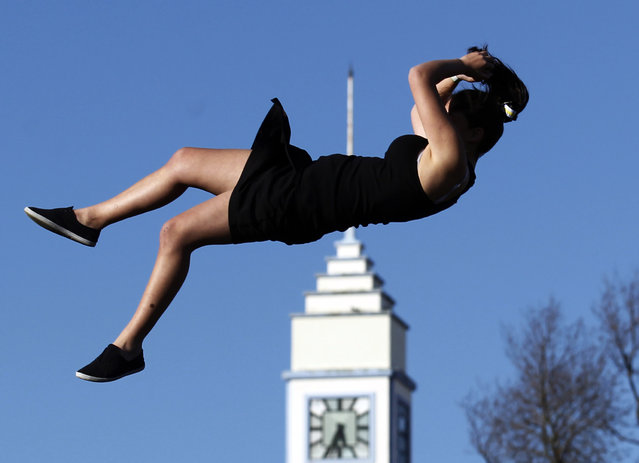
8. NEW ZEALAND: A woman dives from a platform into a giant air bed at a park in Palmerston North September 29, 2011. (Photo by Marcos Brindicci/Reuters)

The report, prepared by the Sustainable Development Solutions Network (SDSN) and the Earth Institute at Columbia University, showed Syria, Afghanistan and eight sub-Saharan countries as the 10 least happy places on earth to live. The top 10 this year were Denmark, Switzerland, Iceland, Norway, Finland, Canada, Netherlands, New Zealand, Australia, and Sweden. Denmark was in third place last year, behind Switzerland and Iceland. The bottom 10 were Madagascar, Tanzania, Liberia, Guinea, Rwanda, Benin, Afghanistan, Togo, Syria and Burundi. The United States came in at 13, the United Kingdom at 23, France at 32, and Italy at 50. Here: #8. NEW ZEALAND: A woman dives from a platform into a giant air bed at a park in Palmerston North September 29, 2011. (Photo by Marcos Brindicci/Reuters)
Details
26 Mar 2016 13:19:00
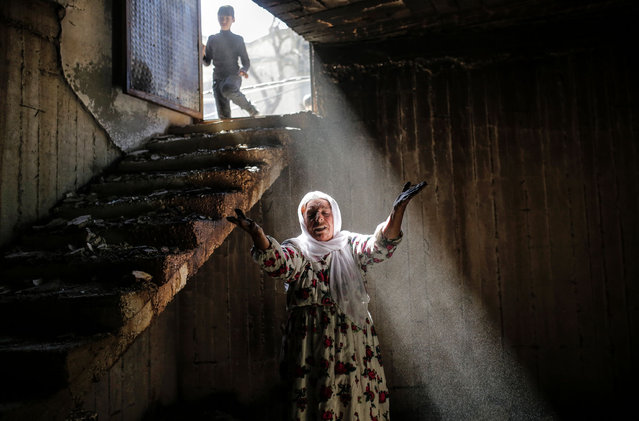
A woman reacts while walking among the ruins of damaged buildings following heavy fighting between government troops and Kurdish fighters, on March 2, 2016 in the southeastern Turkey Kurdish town of Cizre, near the border with Syria and Iraq. Thousands in Turkey's Kurdish-majority town of Cizre started returning to their homes today after authorities partially lifted a curfew in place since December for a controversial military operation to root out separatist rebels. (Photo by Yasin Akgül/AFP Photo)

A woman reacts while walking among the ruins of damaged buildings following heavy fighting between government troops and Kurdish fighters, on March 2, 2016 in the southeastern Turkey Kurdish town of Cizre, near the border with Syria and Iraq. Thousands in Turkey's Kurdish-majority town of Cizre started returning to their homes today after authorities partially lifted a curfew in place since December for a controversial military operation to root out separatist rebels. (Photo by Yasin Akgül/AFP Photo)
Details
03 Mar 2016 11:29:00
A boy uses remnants of ordnance as he prepares dough inside Abu Khaled's shop in the Douma neighborhood of Damascus April 28, 2015. Abu Khaled opened a shop for making “barley bread” using remnants of weapons including rockets, tank shells and other ordnance fired by forces loyal to Syria's President Bashar al-Assad. (Photo by Amer Almohibany/Reuters)

A boy uses remnants of ordnance as he prepares dough inside Abu Khaled's shop in the Douma neighborhood of Damascus April 28, 2015. Abu Khaled opened a shop for making “barley bread” using remnants of weapons including rockets, tank shells and other ordnance fired by forces loyal to Syria's President Bashar al-Assad. (Photo by Amer Almohibany/Reuters)
Details
09 Aug 2015 11:13:00
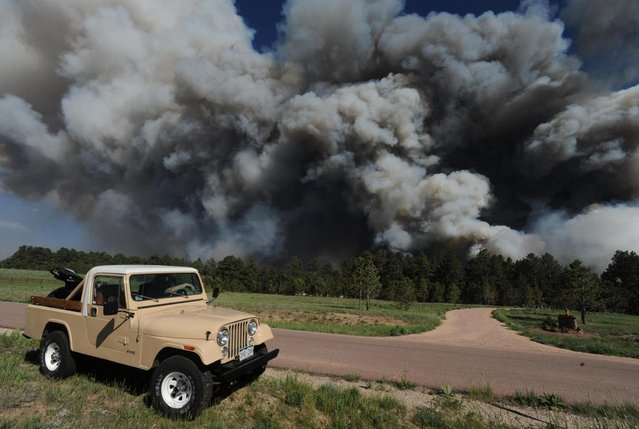
Bill Moreau watches as the Black Forest fire burns near his house near Black Forest Road Tuesday afternoon, June 11, 2013, near Colorado Springs, Colo. The Black Forest Fire was one of at least three significant wildfires burning in Colorado amid gusty winds and record-breaking hot, dry weather. (Photo by Christian Murdock/AP Photo/The Colorado Springs Gazette)

Bill Moreau watches as the Black Forest fire burns near his house near Black Forest Road Tuesday afternoon, June 11, 2013, near Colorado Springs, Colo. The Black Forest Fire was one of at least three significant wildfires burning in Colorado amid gusty winds and record-breaking hot, dry weather. (Photo by Christian Murdock/AP Photo/The Colorado Springs Gazette)
Details
12 Jun 2013 08:44:00
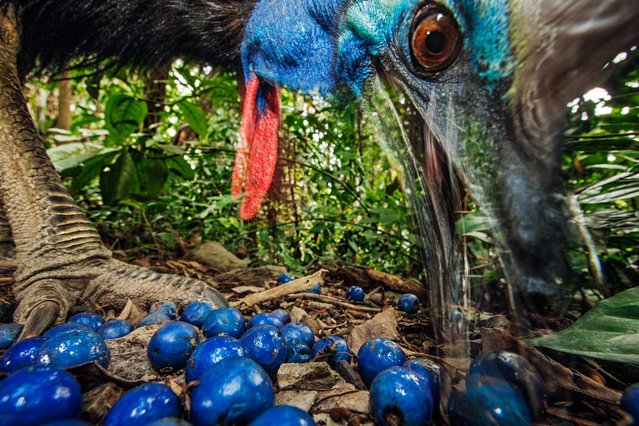
“Cassowaries are large, flightless birds related to emus and (more distantly) to ostriches, rheas, and kiwis”, writes Olivia Judson in the September issue of National Geographic magazine. (Photo by Christian Ziegler/National Geographic)

“Cassowaries are large, flightless birds related to emus and (more distantly) to ostriches, rheas, and kiwis”, writes Olivia Judson in the September issue of National Geographic magazine. How large? People-size: Adult males stand well over five foot five and top 110 pounds. Females are even taller, and can weigh more than 160 pounds. Dangerous when roused, they’re shy and peaceable when left alone. But even birds this big and tough are prey to habitat loss. The dense New Guinea and Australia rain forests where they live have dwindled. Today cassowaries might number 1,500 to 2,000. And because they help shape those same forests – by moving seeds from one place to another – “if they vanish”, Judson writes, “the structure of the forest would gradually change” too. (Photo by Christian Ziegler/National Geographic)
Details
06 Jan 2014 12:21:00
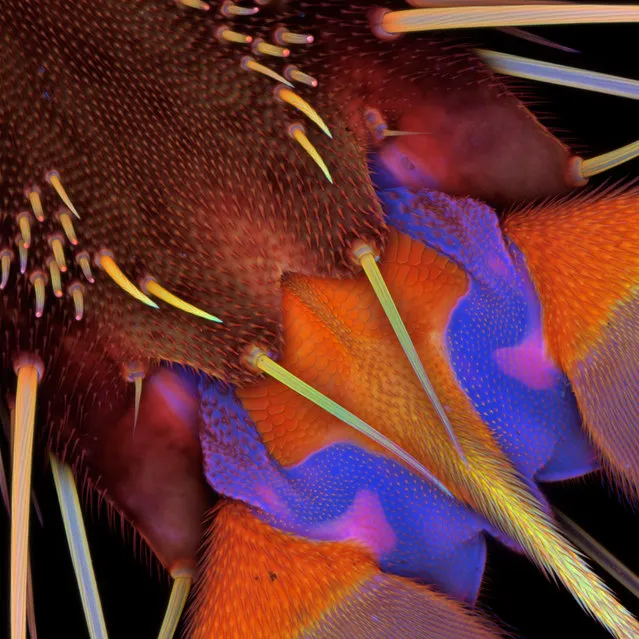
Pretarsus of the third leg of a female drone fly (Eristalis tenax), ventral view, by Dr. Jan Michels, Institute of Zoology, Christian-Albrechts-University of Kiel, Germany. (Photo by Olympus BioScapes)

“Microscope images forge an extraordinary bond between science and art, said Hidenao Tsuchiya, Olympus America's Vice President and General Manager for the Scientific Equipment Group. We founded this competition to focus on the fascinating stories coming out of today's life science research laboratories. The thousands of images that people have shared with the competition over the years reflect some of the most exciting work going on in research today – work that can help shed light on the living universe and ultimately save lives. We look at BioScapes and these beautiful images as sources of education and inspiration to us and the world”. – OlympusBioScapes

Photo: Pretarsus of the third leg of a female drone fly (Eristalis tenax), ventral view, by Dr. Jan Michels, Institute of Zoology, Christian-Albrechts-University of Kiel, Germany. (Photo by Olympus BioScapes)
Details
29 Jul 2012 09:20:00