Loading...
Done
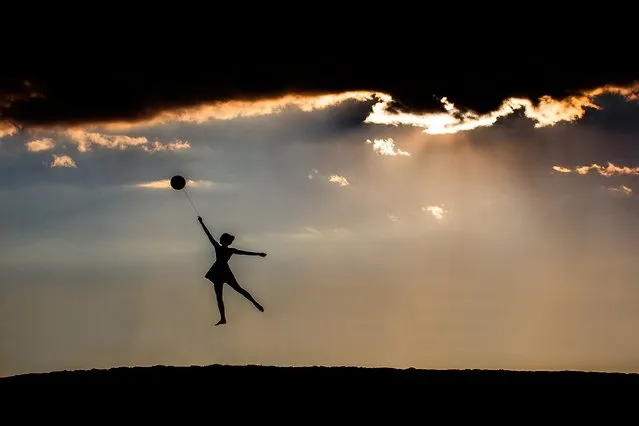
“Balloon”. (Photo by Tyler Shields)

Photographer Tyler Shields had become comfortable, a feeling he found “terrible” as an artist. He wanted to do something challenging, something that pushed the human boundaries. So he spent a year documenting heights, fear, energy and falling – a series he calls “Suspense”. Photo: “Balloon”. (Photo by Tyler Shields)
Details
13 Jul 2014 10:58:00
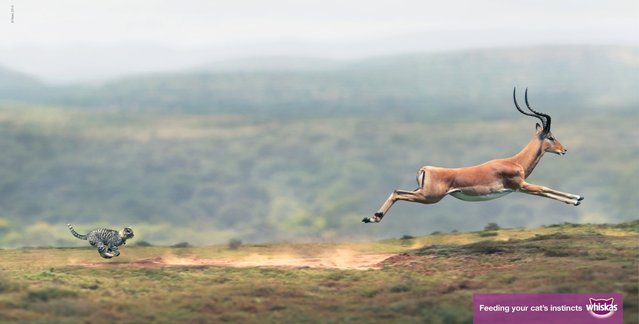
Whiskas: Big Cat-Small Cat

Scottish photographer George Logan and retoucher Tony Swinney let’s you imagine what it would be like if your cat wasn’t just a purring ball of fur. As a part of “Big Cat, Small Cat” ad campaign for Whiskas, they created a series of funny images showing tiny domestic cats chasing after antelopes, zebras, elephants and doing other “big cat” stuff.
Details
29 Sep 2013 12:16:00
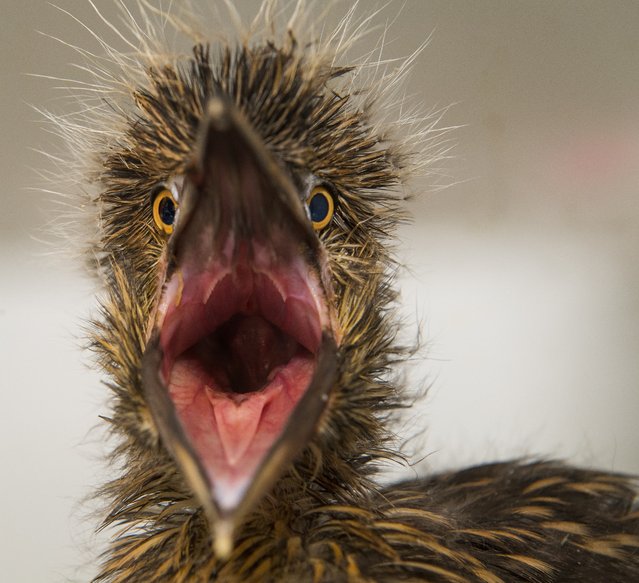
A baby Black-crowned Night Heron squawks in its incubator while being cared for at City Wildlife rescue and rehabilitation center in Washington, DC on May 31, 2017. The heron is one of several that have been brought to CW by the staff at The National Zoo over the past few years. The heron is a native bird and has made an established rookery inside the zoo grounds over a hundred years ago.  Every year at this time, some of the chicks get pushed or fall out of the nest and require human care.  Because the birds are native and not part of the Smithsonian collection, they partnered with CW to rehabilitate the herons for re-release back to the flock inside Zoo. They're reintroduced back to their flock so that they can migrate together in the Fall. The Black-crowned heron usually migrates from the DC area down to southeast North Carolina, some going as far as Jacksonville, FL in winter. The Black-crowned heron is the species of greatest conservation need in the District of Columbia because their numbers are in such rapid decline due to habitat loss. (Photo Linda Davidson/The Washington Post)

A baby Black-crowned Night Heron squawks in its incubator while being cared for at City Wildlife rescue and rehabilitation center in Washington, DC on May 31, 2017. The heron is one of several that have been brought to CW by the staff at The National Zoo over the past few years. (Photo Linda Davidson/The Washington Post)
Details
04 Jun 2017 08:04:00
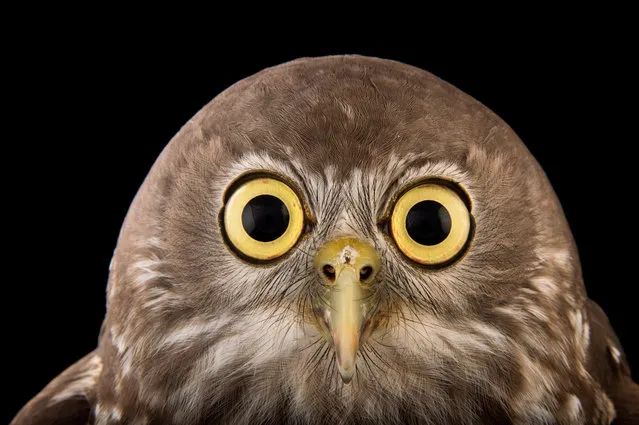
The National Geographic Photo Ark is a travelling exhibition of photographer Joel Sartore’s quest to create a photo archive of biodiversity around the world. So far, Sartore has captured studio portraits of more than 6,000 species – a number that he hopes to double. On 1 July, the ark will open at Melbourne zoo – the first time it has been exhibited in the southern hemisphere. More than 50 portraits will be on display, including many of Australian endangered animals being protected by programs at the zoo itself. These captions have been edited from text supplied by Melbourne zoo. Here: Barking owl. So-named because its call sounds like a barking dog, these birds are native to Australia, Indonesia and Papua New Guinea. In Victoria they are listed as an endangered species, and in 2003 there were estimated to be fewer than 50 breeding pairs. The main threat to the species in Victoria is loss of habitat, especially large trees with hollows in which they can nest and on which many of their prey depend. Apart from a bark, they may utter a chilling scream when they feel threatened. (Photo by Joel Sartore/National Geographic Photo Ark/The Guardian)

The National Geographic Photo Ark is a travelling exhibition of photographer Joel Sartore’s quest to create a photo archive of biodiversity around the world. So far, Sartore has captured studio portraits of more than 6,000 species – a number that he hopes to double. On 1 July, the ark will open at Melbourne zoo – the first time it has been exhibited in the southern hemisphere. More than 50 portraits will be on display, including many of Australian endangered animals being protected by programs at the zoo itself. These captions have been edited from text supplied by Melbourne zoo. Here: Barking owl. (Photo by Joel Sartore/National Geographic Photo Ark/The Guardian)
Details
01 Jul 2017 07:45:00
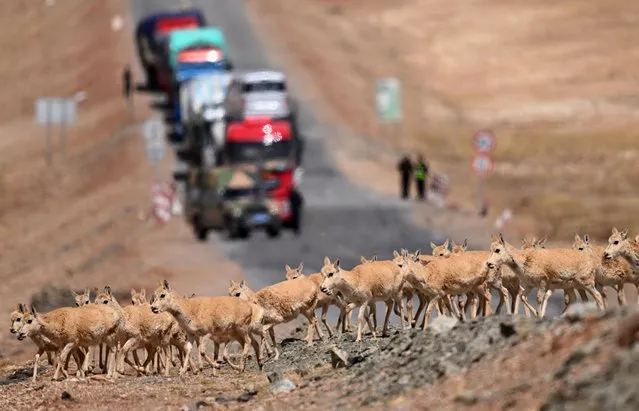
Pregnant Tibetan antelopes move across the Qinghai-Tibet highway in Hoh Xil, northwest China's Qinghai Province, May 29, 2023. A growing number of pregnant Tibetan antelopes are migrating to the heart of northwest China's Hoh Xil National Nature Reserve to give birth, according to the reserve's management office. Every year, tens of thousands of pregnant Tibetan antelopes start their migration to Hoh Xil in around May to give birth and leave with their offspring in late July. Under the first-class state protection in China, the once-endangered species is found in Tibet Autonomous Region, Qinghai Province, and Xinjiang Uygur Autonomous Region. Their population has increased over the past three decades thanks to the ban on illegal hunting and other measures implemented to improve its habitat. (Photo by Xinhua News Agency/Rex Features/Shutterstock)

Pregnant Tibetan antelopes move across the Qinghai-Tibet highway in Hoh Xil, northwest China's Qinghai Province, May 29, 2023. A growing number of pregnant Tibetan antelopes are migrating to the heart of northwest China's Hoh Xil National Nature Reserve to give birth, according to the reserve's management office. Every year, tens of thousands of pregnant Tibetan antelopes start their migration to Hoh Xil in around May to give birth and leave with their offspring in late July. (Photo by Xinhua News Agency/Rex Features/Shutterstock)
Details
08 Jun 2023 02:20:00
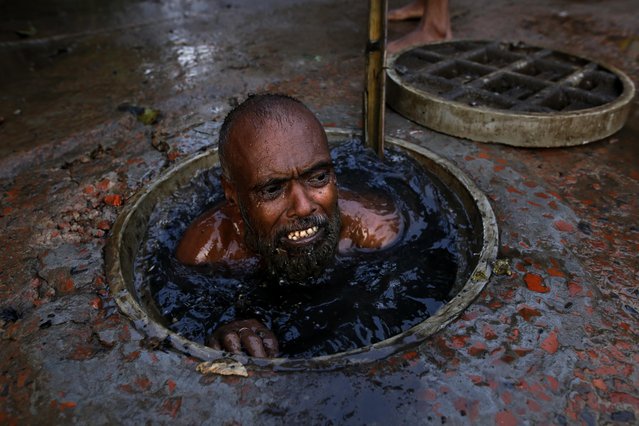
Men are sent down into the sludge to clear the sewers in the Bangladeshi capital Dhaka on May 23, 2018. One man holds his nose as he goes under to scoop blockages out for no more than $10a day. (Photo by Rehman Asad/Barcroft Media)

Men are sent down into the sludge to clear the sewers in the Bangladeshi capital Dhaka on May 23, 2018. The people who do the work aren’t even given any protective clothing or goggles and have to dig out the clogged-up muck with a stick or their bare hands. (Photo by Rehman Asad/Barcroft Media)
Details
26 May 2018 00:05:00
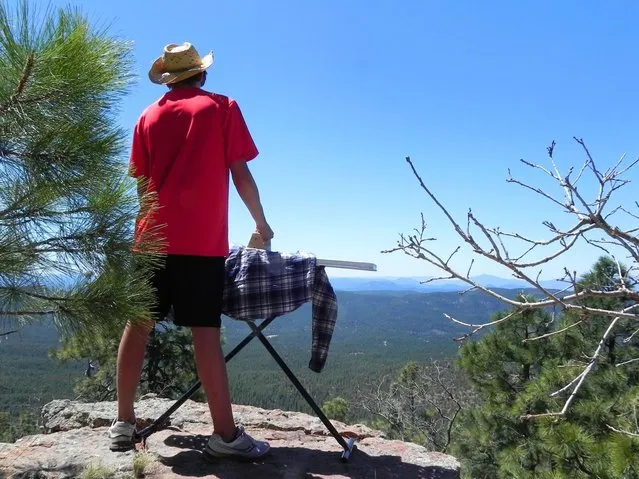
Extreme Ironing. (Photo by Kevin Krupitzer/Caters News)

For most ironing is one of those boring chores we tend to put off doing – but for one teenager ironing has become something of an extreme sport. Kevin Krupitzer, 17, has turned the mundane into the insane by taking his ironing board to the most extraordinary of locations, from the edge of cliff to on board a canoe. The daring teenager travels around his hometown of Gilbert, Arizona in search of the weirdest places to iron. And he has even climbed to the top of a 120ft high rock, dubbed the Totem Pole in Queen Creek Canyon, AZ in pursuit of his bizarre hobby. (Photo by Kevin Krupitzer/Caters News)
Details
31 May 2013 12:39:00
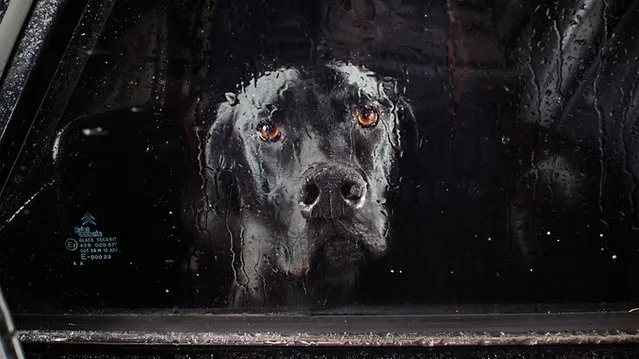
The Silence of Dogs in Cars

At first, British photographer Martin Usborne just wanted to do some reporting on people who leave their dogs locked up in cars. But as he went around scouring parking lots, “making barking noises to try and awaken sleeping dogs that were not actually there,” his project took on a new artistic direction. “The Silence of Dogs in Cars” was inspired by a “childhood memory of waiting in a car whilst his parents were shopping in a supermarket, and the youthful fear that they would not return.”
Details
08 Jul 2013 08:57:00