Loading...
Done
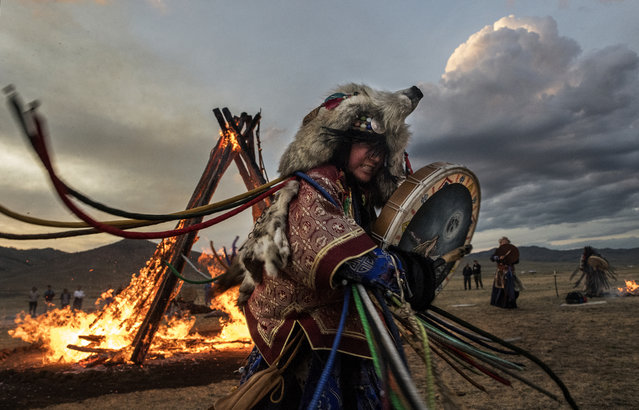
A Mongolian Shamaness or Buu, beats her drum while taking part with others in a fire ritual meant to summon spirits to mark the period of the Summer Solstice in the grasslands on June 22, 2018 outside Ulaanbaatar, Mongolia. (Photo by Kevin Frayer/Getty Images)

A Mongolian Shamaness or Buu, beats her drum while taking part with others in a fire ritual meant to summon spirits to mark the period of the Summer Solstice in the grasslands on June 22, 2018 outside Ulaanbaatar, Mongolia. Banned for 70 years under Communist rule, shamanism has seen a resurgence in Mongolia since 1992, when the ancient practice became protected by the country's Constitution. Known as Tengrism, in which Shamans channel ancestral spirits, it is widely regarded as Mongolia's national religion and part of its indigenous identity. (Photo by Kevin Frayer/Getty Images)
Details
30 Jun 2018 00:05:00
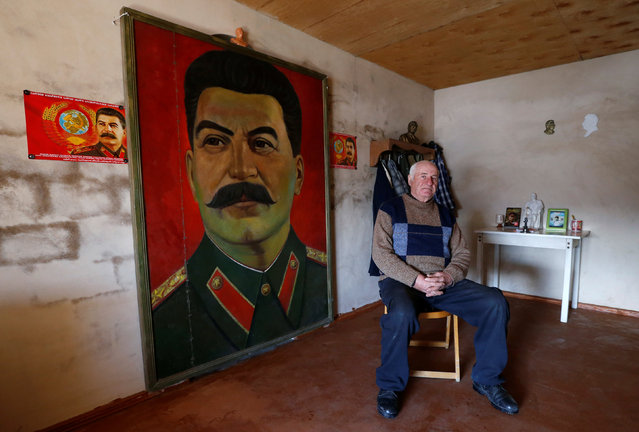
Retired builder Vasili Sidamonidze, 70, poses for a portrait at his home in Gori, Georgia, December 6, 2016. “Unfortunately, Stalin is not popular nowadays. Our people don't respect him. Only we, members of the (Communist) Party, respect him”, Sidamonidze said. “I always try to attend Stalin's birthday anniversaries in Gori. Unfortunately many people don't want to join us even if they live nearby. They look at us from their windows”. Stalin, who was born in Gori in 1878 and died in 1953, is largely reviled today in Georgia, which regained its independence during the 1991 collapse of the Soviet Union. Over the years, his memorials have been dismantled, most recently in 2010 when authorities removed a statue of the dictator from Gori's central square. But Stalin is still revered by a small group of mainly elderly supporters who stress his role in the industrialisation of the Soviet Union and in defeating Nazi Germany in World War Two. Each Dec. 21, a few dozen people mark his birthday by gathering outside a Gori museum dedicated to Stalin, where they make speeches and walk to the square where a 6-meter-high bronze statue of him once stood, calling for it to be reinstated. Opponents say it was a symbol of Moscow's still lingering shadow. In 2008, Russia fought a brief war with Georgia and recognised its breakaway regions of Abkhazia and South Ossetia as independent states. (Photo by David Mdzinarishvili/Reuters)

Retired builder Vasili Sidamonidze, 70, poses for a portrait at his home in Gori, Georgia, December 6, 2016. “Unfortunately, Stalin is not popular nowadays. Our people don't respect him. Only we, members of the (Communist) Party, respect him”, Sidamonidze said. “I always try to attend Stalin's birthday anniversaries in Gori. Unfortunately many people don't want to join us even if they live nearby. They look at us from their windows”. (Photo by David Mdzinarishvili/Reuters)
Details
17 Dec 2016 07:59:00
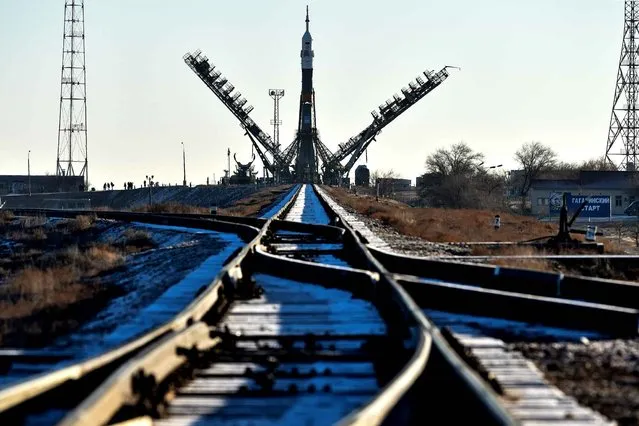
The Soyuz TMA-19M spacecraft is mounted on a launch pad at the Russian-leased Baikonur cosmodrome in Kazakhstan early on December 13, 2015. Russia's Soyuz TMA-19M spacecraft carrying the International Space Station (ISS) Expedition 46/47 crew of Britain's astronaut Tim Peake, Russian cosmonaut Yuri Malenchenko and US astronaut Tim Kopra is scheduled to blast off to the ISS on December 15, 2015. (Photo by Kirill Kudryavtsev/AFP Photo)

The Soyuz TMA-19M spacecraft is mounted on a launch pad at the Russian-leased Baikonur cosmodrome in Kazakhstan early on December 13, 2015. Russia's Soyuz TMA-19M spacecraft carrying the International Space Station (ISS) Expedition 46/47 crew of Britain's astronaut Tim Peake, Russian cosmonaut Yuri Malenchenko and US astronaut Tim Kopra is scheduled to blast off to the ISS on December 15, 2015. (Photo by Kirill Kudryavtsev/AFP Photo)
Details
14 Dec 2015 10:13:00
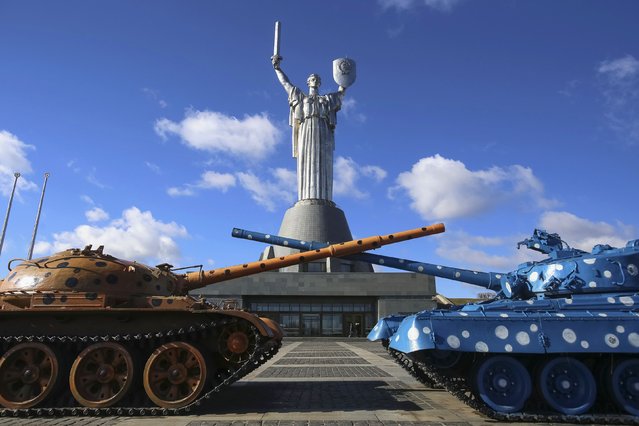
The 100-metre (300-foot), sword-wielding statue of “The Motherland” is seen in the National Museum of the History of the Great Patriotic War in Kiev March 17, 2014. On a blustery day on the banks of the Dnieper, the statue of “The Motherland”, a Soviet hammer and sickle on her shield, towered overhead, a reminder of the common cause Ukrainians and Russians died for side by side in their millions in World War Two and which Russian President Vladimir Putin thinks Ukraine has betrayed by turning to “fascism” and the West. (Photo by Konstantin Grishin/Reuters)

The 100-metre (300-foot), sword-wielding statue of “The Motherland” is seen in the National Museum of the History of the Great Patriotic War in Kiev March 17, 2014. On a blustery day on the banks of the Dnieper, the statue of “The Motherland”, a Soviet hammer and sickle on her shield, towered overhead, a reminder of the common cause Ukrainians and Russians died for side by side in their millions in World War Two and which Russian President Vladimir Putin thinks Ukraine has betrayed by turning to “fascism” and the West. (Photo by Konstantin Grishin/Reuters)
Details
22 Mar 2014 13:47:00
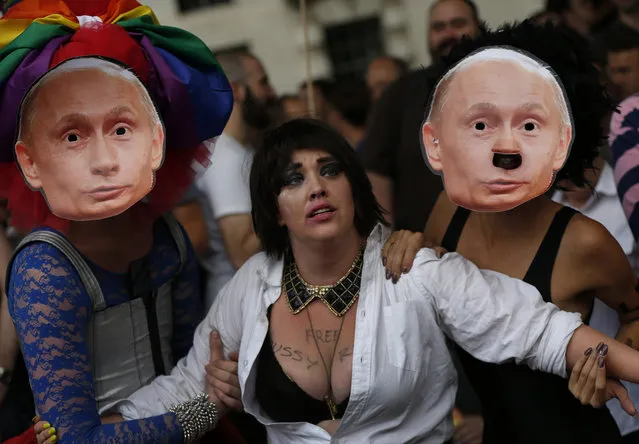
Activists stage a theatrical play where gay people are restrained by others wearing masks depicting Russian President Vladimir Putin, during a protest against Russia's new law on gays, in central London, Saturday, August 10, 2013. Hundreds of protesters, called for the Winter 2014 Olympic Games to be taken away from Sochi, Russia, because of a new Russian law that bans “propaganda of nontraditional sexual relations” and imposes fines on those holding gay pride rallies. (Photo by Lefteris Pitarakis/AP Photo)

Activists stage a theatrical play where gay people are restrained by others wearing masks depicting Russian President Vladimir Putin, during a protest against Russia's new law on gays, in central London, Saturday, August 10, 2013. Hundreds of protesters, called for the Winter 2014 Olympic Games to be taken away from Sochi, Russia, because of a new Russian law that bans “propaganda of nontraditional sexual relations” and imposes fines on those holding gay pride rallies. (Photo by Lefteris Pitarakis/AP Photo)
Details
11 Aug 2013 10:50:00
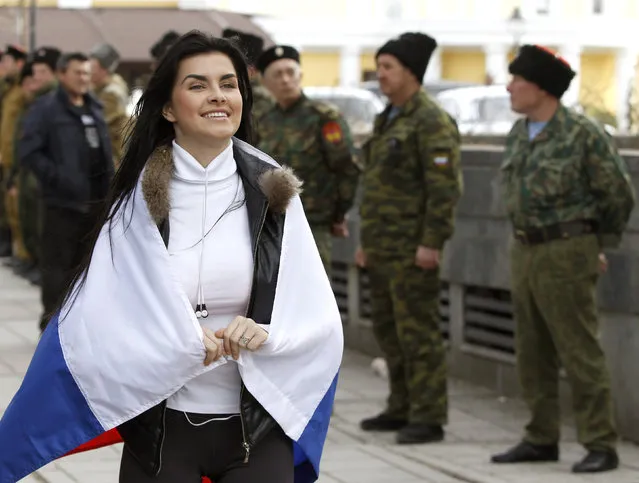
A pro-Russian supporter with the Russian national flag on her shoulders takes part in a meeting in Simferopol, March 6, 2014. Crimea's parliament voted to join Russia on Thursday and its Moscow-backed government set a referendum within 10 days on the decision in a dramatic escalation of the crisis over the Ukrainian Black Sea peninsula. (Photo by Vasily Fedosenko/Reuters)

A pro-Russian supporter with the Russian national flag on her shoulders takes part in a meeting in Simferopol, March 6, 2014. Crimea's parliament voted to join Russia on Thursday and its Moscow-backed government set a referendum within 10 days on the decision in a dramatic escalation of the crisis over the Ukrainian Black Sea peninsula. (Photo by Vasily Fedosenko/Reuters)
Details
07 Mar 2014 09:34:00
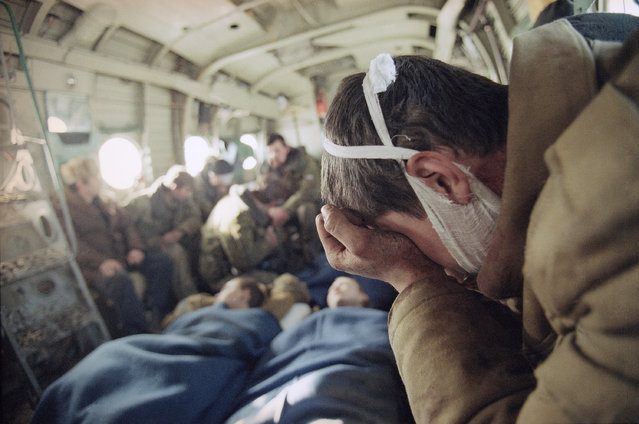
A wounded Russian soldier, who has been evacuated with his comrades, weeps in a helicopter on his way out of Grozny on Friday, February 3, 1995, as the fighting in the Chechen capital continues. The massive Russian force that invaded Chechnya has taken very heavy losses against a small but determined guerrilla force. (Photo by Karsten Thielker/AP Photo/File)

Karsten Thielker, a Pulitzer Prize-winning German photographer with The Associated Press who covered human suffering in conflict zones around the globe, has died at the age of 54. Thielker died on October 3 in Berlin of esophageal cancer, his wife Janna Ressel said. Here: A wounded Russian soldier, who has been evacuated with his comrades, weeps in a helicopter on his way out of Grozny on Friday, February 3, 1995, as the fighting in the Chechen capital continues. The massive Russian force that invaded Chechnya has taken very heavy losses against a small but determined guerrilla force. (Photo by Karsten Thielker/AP Photo/File)
Details
11 Oct 2020 00:05:00
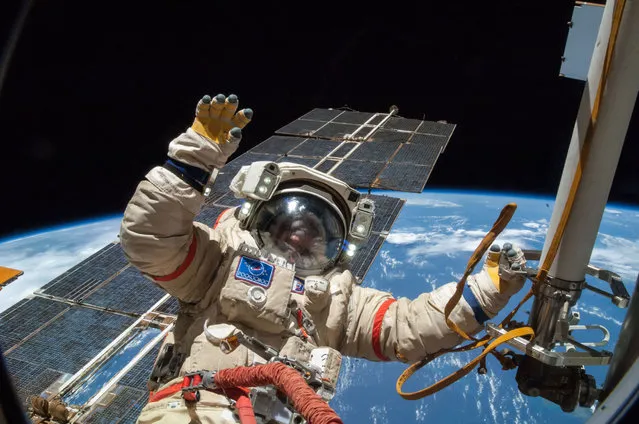
Russian cosmonaut Alexander Skvortsov, Expedition 40 flight engineer, attired in a Russian Orlan spacesuit, participates in a session of extravehicular activity (EVA) in support of science and maintenance on the International Space Station on August 18, 2014. During the five-hour, 11-minute spacewalk, Skvortsov and cosmonaut Oleg Artemyev (out of frame) deployed a small science satellite, retrieved and installed experiment packages and inspected components on the exterior of the orbital laboratory. (Photo by NASA)

Russian cosmonaut Alexander Skvortsov, Expedition 40 flight engineer, attired in a Russian Orlan spacesuit, participates in a session of extravehicular activity (EVA) in support of science and maintenance on the International Space Station on August 18, 2014. During the five-hour, 11-minute spacewalk, Skvortsov and cosmonaut Oleg Artemyev (out of frame) deployed a small science satellite, retrieved and installed experiment packages and inspected components on the exterior of the orbital laboratory. (Photo by NASA)
Details
13 Apr 2022 06:53:00