Loading...
Done
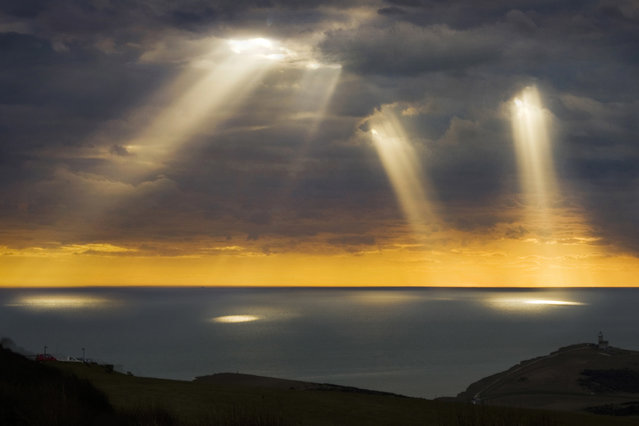
This breathtaking natural light show illuminating waters off the British coast looks like something out of hit film “Close Encounters of the Third Kind”. Photographer Adrian Campfield was out having dinner at a restaurant at Beachy Head, East Sussex, when the rays suddenly appeared. The 59-year-old and his wife Louise rushed outside onto the 535ft high cliffs to watch the spectacle. (Photo by Adrian Campfield/Solent/Visual Press Agency)

This breathtaking natural light show illuminating waters off the British coast looks like something out of hit film “Close Encounters of the Third Kind”. Photographer Adrian Campfield was out having dinner at a restaurant at Beachy Head, East Sussex, when the rays suddenly appeared. The 59-year-old and his wife Louise rushed outside onto the 535ft high cliffs to watch the spectacle. Mr Campfield, a former graphic designer, from Bexley, Kent, said the light was “changing all the time” for more than 15 minutes. (Photo by Adrian Campfield/Solent/Visual Press Agency)
Details
30 Sep 2014 09:16:00
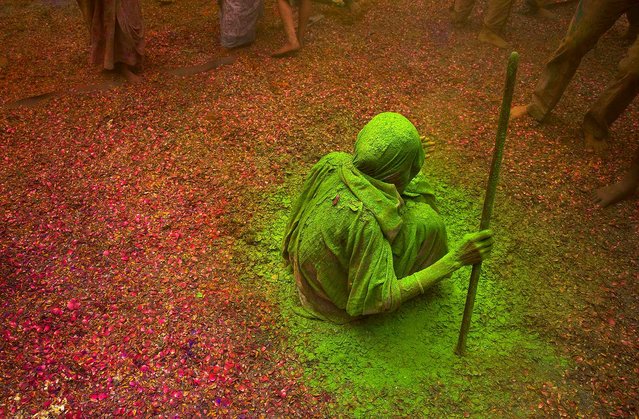
An Indian Hindu widow smeared with colors sits and watches others playing during Holi celebrations at the Gopinath temple, 180 kilometres (112 miles) south-east of New Delhi, India Monday, March 21, 2016. (Photo by Manish Swarup/AP Photo)

An Indian Hindu widow smeared with colors sits and watches others playing during Holi celebrations at the Gopinath temple, 180 kilometres (112 miles) south-east of New Delhi, India Monday, March 21, 2016. A few years ago this joyful celebration was forbidden for Hindu widows. Like hundreds of thousands of observant Hindu women they would have been expected to live out their days in quiet worship, dressed only in white, their very presence being considered inauspicious for all religious festivities. (Photo by Manish Swarup/AP Photo)
Details
22 Mar 2016 11:24:00
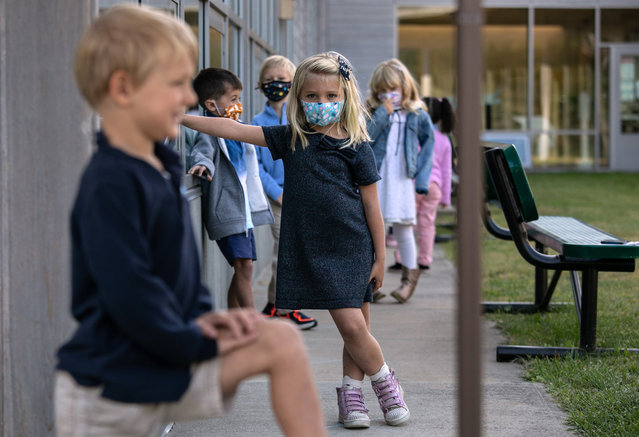
Kindergartner Cameron McManus, 5, watches as a fellow student has his portrait made during “picture day” at Rogers International School on September 23, 2020 in Stamford, Connecticut. Students lined up outside to be photographed while socially distanced due to COVID-19 precautions. Most students at Stamford Public Schools are taking part in a hybrid education model, attending in-school classes every other day and distance learning the rest. (Photo by John Moore/Getty Images)

Kindergartner Cameron McManus, 5, watches as a fellow student has his portrait made during “picture day” at Rogers International School on September 23, 2020 in Stamford, Connecticut. Students lined up outside to be photographed while socially distanced due to COVID-19 precautions. Most students at Stamford Public Schools are taking part in a hybrid education model, attending in-school classes every other day and distance learning the rest. (Photo by John Moore/Getty Images)
Details
03 Oct 2020 00:03:00
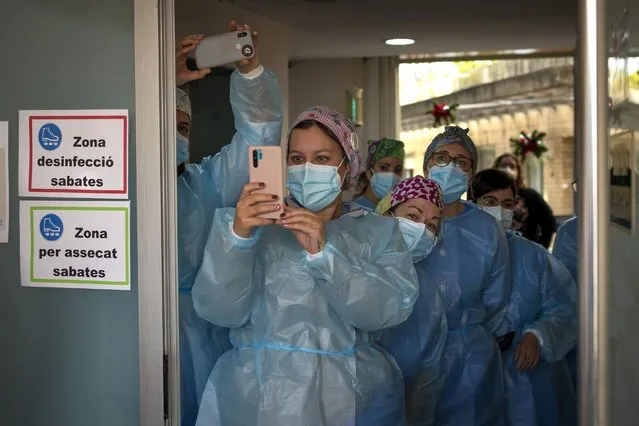
Health workers watch as the vaccine against the Coronavirus arrives at a nursing home in l'Hospitalet de Llobregat in Barcelona, Spain, on Sunday, December 27, 2020. The first shipments of coronavirus vaccines developed by BioNTech and Pfizer have arrived across the European Union, authorities started to vaccinate the most vulnerable people in a coordinated effort on Sunday. (Photo by Emilio Morenatti/AP Photo)

Health workers watch as the vaccine against the Coronavirus arrives at a nursing home in l'Hospitalet de Llobregat in Barcelona, Spain, on Sunday, December 27, 2020. The first shipments of coronavirus vaccines developed by BioNTech and Pfizer have arrived across the European Union, authorities started to vaccinate the most vulnerable people in a coordinated effort on Sunday. (Photo by Emilio Morenatti/AP Photo)
Details
29 Dec 2020 00:07:00
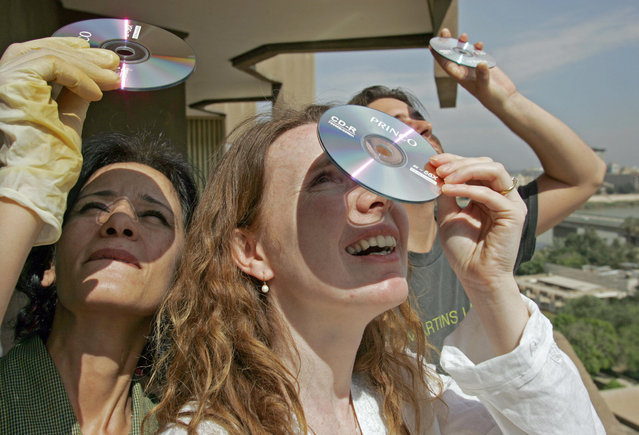
An Iraqi woman and foreigners use  pair of compact discs as a filter to watch the partial solar eclipse in war-torn Baghdad, 29 March 2006. Without access to proper equipment to protect their eyes from the sun's rays, eclipse watchers in Iraq used makeshift filters.  The moon blotted out the sun over northwest Africa early Wednesday, turning day into night in a total solar eclipse as it swept a shadowy path from the outer tip of Brazil to the steppes of Mongolia. (Photo by Hassan Ammar/AFP Photo)

An Iraqi woman and foreigners use pair of compact discs as a filter to watch the partial solar eclipse in war-torn Baghdad, 29 March 2006. Without access to proper equipment to protect their eyes from the sun's rays, eclipse watchers in Iraq used makeshift filters. The moon blotted out the sun over northwest Africa early Wednesday, turning day into night in a total solar eclipse as it swept a shadowy path from the outer tip of Brazil to the steppes of Mongolia. (Photo by Hassan Ammar/AFP Photo)
Details
25 Jul 2017 09:31:00
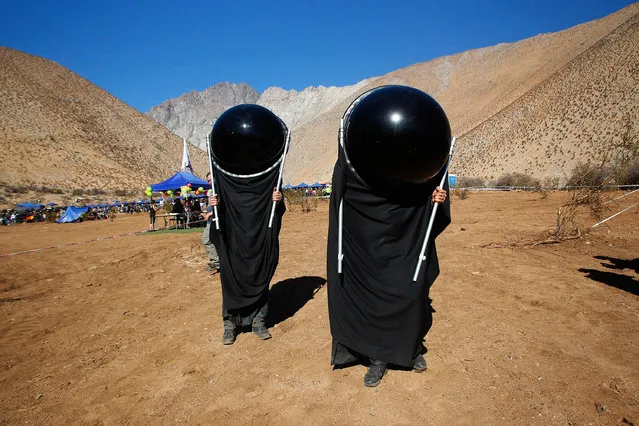
Chileans watch the sky with special suits prior to a total solar eclipse on July 2, 2019 in Paiguano, Chile. Around 25,0000 tourists arrived to Paiguano, a small town of around 1,000 inhabitants in the Elqui Valley, 650 km away Santiago. This is the only Earth's total solar eclipse of 2019 and the first one since 2017. From this point, the sun will fully disappear for around two minutes. It is best visible from a stripe in the South Pacific, Chile and Argentina. (Photo by Marcelo Hernandez/Getty Images)

Chileans watch the sky with special suits prior to a total solar eclipse on July 2, 2019 in Paiguano, Chile. Around 25,0000 tourists arrived to Paiguano, a small town of around 1,000 inhabitants in the Elqui Valley, 650 km away Santiago. This is the only Earth's total solar eclipse of 2019 and the first one since 2017. From this point, the sun will fully disappear for around two minutes. It is best visible from a stripe in the South Pacific, Chile and Argentina. (Photo by Marcelo Hernandez/Getty Images)
Details
04 Jul 2019 00:05:00
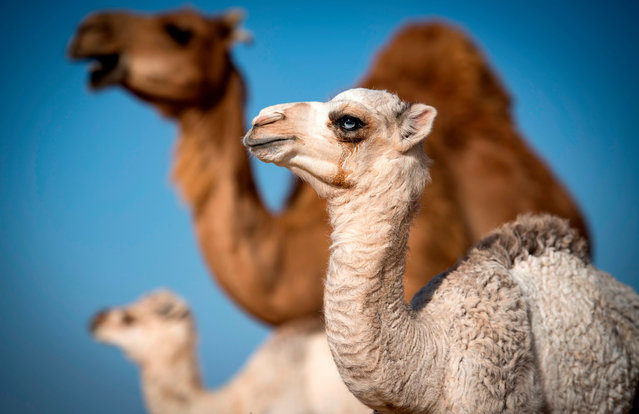
A camel calf is seen among a herd in the desert near Dakhla in Morocco-administered Western Sahara, on October 13, 2019. In the Oued Eddahab desert in Western Sahara, Habiboullah Dlimi raises dairy and racing camels just like his ancestors used to, but with a little help from modern technology. While his animals roam free and are milked traditionally, by hand, at dawn and dusk, they are watched over by hired herders and Dlimi follows GPS coordinates across the desert in a 4X4 vehicle to reach them. (Photo by Fadel Senna/AFP Photo)

A camel calf is seen among a herd in the desert near Dakhla in Morocco-administered Western Sahara, on October 13, 2019. In the Oued Eddahab desert in Western Sahara, Habiboullah Dlimi raises dairy and racing camels just like his ancestors used to, but with a little help from modern technology. While his animals roam free and are milked traditionally, by hand, at dawn and dusk, they are watched over by hired herders and Dlimi follows GPS coordinates across the desert in a 4X4 vehicle to reach them. (Photo by Fadel Senna/AFP Photo)
Details
24 Nov 2019 00:03:00
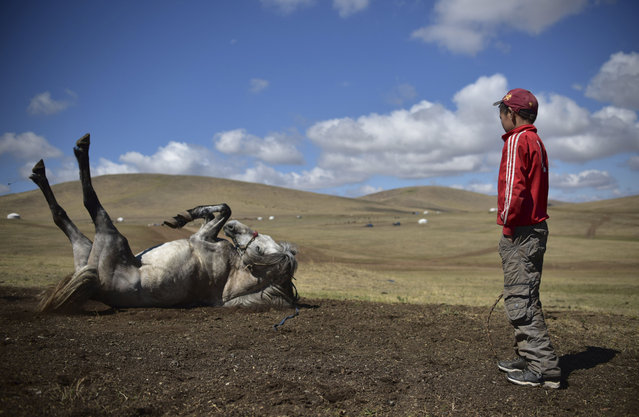
This picture taken on July 8, 2015 shows 13-year-old jockey Purevsurengiin Togtokhsuren (R) watching a horse rolling in the dirt after a training session in Khui Doloon Khudag, some 50 kms west of Ulan Bator. Despite being only 13 years old, Togtokhsuren is riding for the fifth time in the national races for Mongolia's summer festival, known as Naadam, lining up against some 170 other child jockeys. (Photo by Johannes Eisele/AFP Photo)

This picture taken on July 8, 2015 shows 13-year-old jockey Purevsurengiin Togtokhsuren (R) watching a horse rolling in the dirt after a training session in Khui Doloon Khudag, some 50 kms west of Ulan Bator. Despite being only 13 years old, Togtokhsuren is riding for the fifth time in the national races for Mongolia's summer festival, known as Naadam, lining up against some 170 other child jockeys. (Photo by Johannes Eisele/AFP Photo)
Details
17 Nov 2015 08:04:00